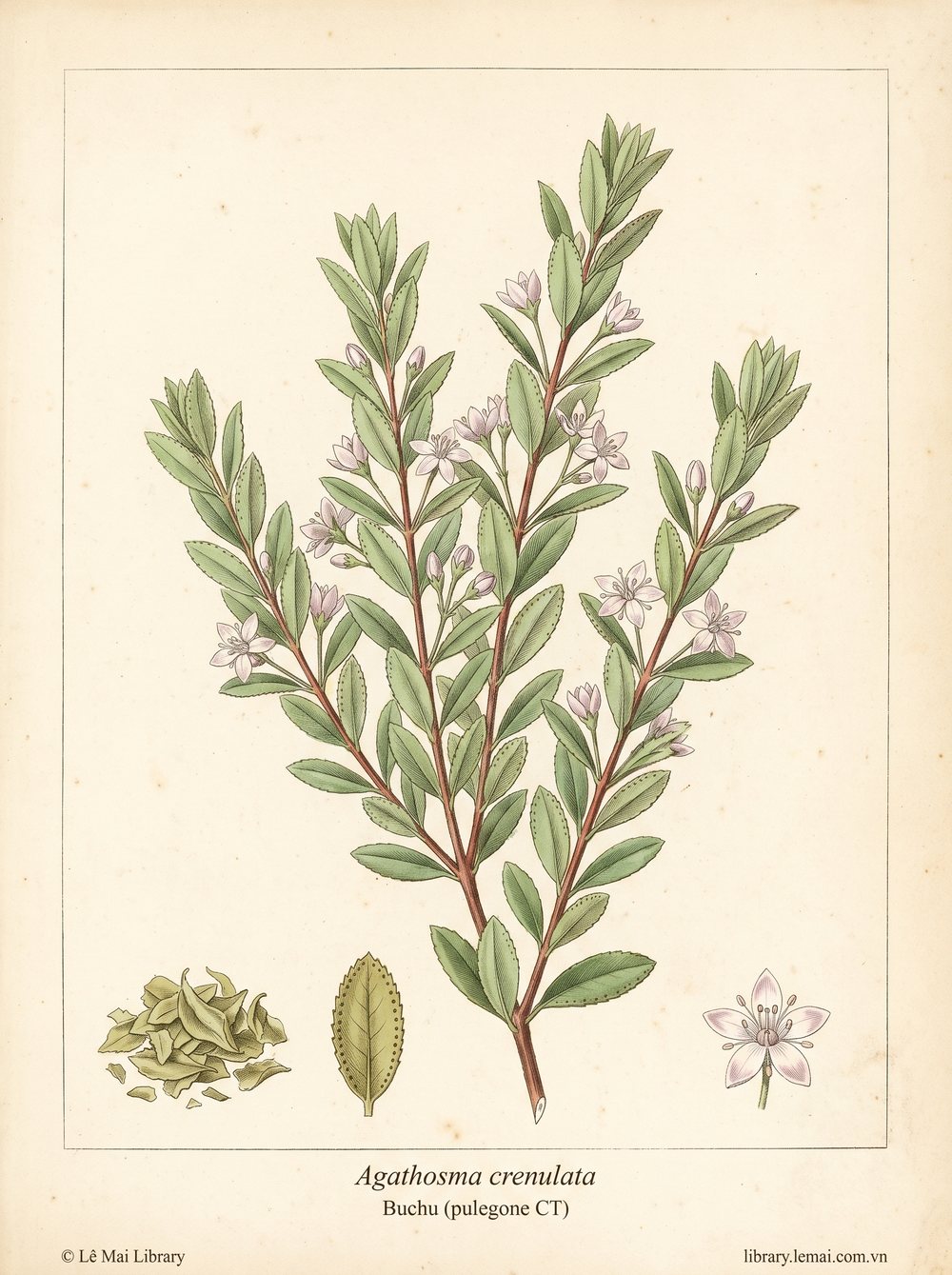
ブチュ プレゴン CT
Buchu (CT pulegone)
Agathosma crenulata
Barosma crenulata, Oval leaf buchu
May be abortifacient. Hepatotoxic.
Broad contraindications: pregnancy, breastfeeding.
Should not be taken orally.
Maximum dermal use level 1.4 percent, based on 81.9 percent total pulegone and a dermal limit of 1.2 percent for pulegone.
This oil is presumed toxic due to high pulegone content, likely presenting a risk similar to pennyroyal oil. Pulegone is hepatotoxic because it is metabolized to epoxides.
| (1R)-(+)-β-Pulegone | 31.6 – 73.2 % |
| Isomenthone | 3.6 – 27.6 % |
| (+)-Limonene | 2.1 – 17.2 % |
| (E)-8-Acetylthio-p-menthan-3-one | 0.4 – 10.4 % |
| Menthone | 1.3 – 7.0 % |
| (−)-(E)-α-Pulegone | 1.8 – 4.8 % |
| 8-Hydroxymenthone | 0 – 4.7 % |
| (+)-(Z)-α-Pulegone | 2.2 – 3.9 % |
| (Z)-8-Mercapto-p-menthan-3-one | 0 – 3.1 % |
| β-Myrcene | 0.1 – 2.6 % |
| (E)-β-Ocimene | 0.1 – 2.6 % |
| (E)-8-Mercapto-p-menthan-3-one | 0 – 2.5 % |
| α-Pinene | 0.5 – 2.0 % |
| 1,8-Cineole | tr, 1.9 % |
| Sabinene | tr, 1.8 % |
Agathosma crenulata is the less common of the two main commercial buchu sources. The leaves are elongated, unlike A. betulina with its round leaves.
Cape region, South Africa. Family Rutaceae. Botanical synonym Barosma crenulata.
Due to a pulegone content many times higher than A. betulina, the safety profile is markedly different, the two species share only the commercial name 'buchu'.
May be adulterated with synthetic monoterpene sulfides, such as p-mentan-8-thiol-3-one.
A theoretical oral maximum based on a 0.5 mg per kg per day limit for pulegone would extrapolate to 43 mg for an adult. However, there is no significant medicinal benefit from A. crenulata oil, so it is best avoided entirely.
The certificate of analysis must be read carefully, suppliers sometimes do not clearly distinguish between A. betulina and A. crenulata, labeling both as 'buchu' although the safety profiles differ significantly.