Geraniol
(2E)-3,7-Dimethyl-2,6-octadien-1-ol
(E)-Geraniol · trans-Geraniol · Geranyl alcohol · Lemonol
化学組成 · Constituent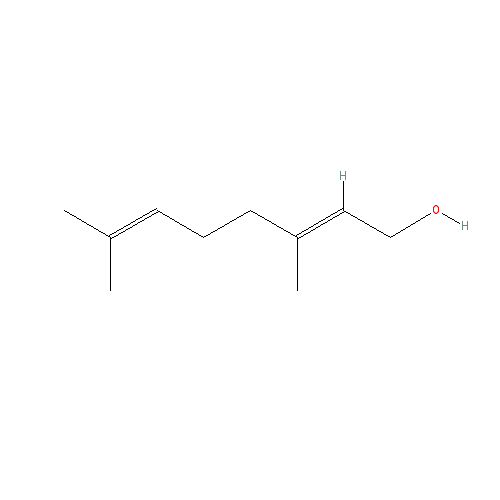
(2E)-3,7-Dimethyl-2,6-octadien-1-ol
(E)-Geraniol · trans-Geraniol · Geranyl alcohol · Lemonol
化学組成 · Constituent
Geraniol là một monoterpenoid alcohol phổ biến, cấu tử chủ đạo trong palmarosa, jamrosa, hoa hồng và bergamot dại. EU liệt kê là một trong 26 chất gây dị ứng hương liệu cần khai báo.
Trên da. Patch test ở 5 phần trăm trên 100 tình nguyện viên không gây phản ứng. Trên 237 tình nguyện viên ở Nhật cũng không có phản ứng. Trong các nghiên cứu lớn trên 11.875 bệnh nhân viêm da, chỉ 0.42 phần trăm phản ứng với geraniol ở 1 – 5 phần trăm.
Bệnh nhân nhạy cảm hương liệu. Tỷ lệ phản ứng cao hơn, có thể đến 7 phần trăm ở nhóm này khi test ở 1 phần trăm.
Đường uống. LD50 cấp tính trên chuột 3.6 đến 4.8 g/kg. Cho chuột ăn 1.000 ppm trong 28 tuần hoặc 10.000 ppm trong 16 tuần không gây tác động đáng kể.
Sinh sản. Geraniol gây dị tật trên phôi gà khi tiêm vào trứng thụ tinh. Ý nghĩa lâm sàng cho người chưa rõ. Vì geraniol là isomer của linalool, có thể có hồ sơ độc sinh sản tương tự.
Đột biến gen và ung thư. Không gây đột biến trong thử nghiệm Ames. Có hoạt tính chống ung thư rõ rệt in vitro và trên mô hình động vật đối với bạch cầu, hắc tố, ung thư gan, đại tràng, tuỵ và vú.
Geraniol is a common monoterpenoid alcohol, the dominant constituent in palmarosa, jamrosa, rose and wild bergamot oils. The EU lists it as one of 26 fragrance allergens requiring declaration.
Skin. A 5 percent patch test on 100 volunteers produced no reactions. In 237 Japanese volunteers there were also no reactions. In large studies of 11,875 dermatitis patients, only 0.42 percent reacted to geraniol at 1 to 5 percent.
Fragrance-sensitive patients. Reaction rates can rise to as high as 7 percent in this group when tested at 1 percent.
Oral. Acute oral LD50 in rats is 3.6 to 4.8 g/kg. Rats fed 1,000 ppm for 28 weeks or 10,000 ppm for 16 weeks showed no observable adverse effects.
Reproductive. Geraniol produced malformations in chick embryos when injected into fertilized eggs. Clinical relevance for humans is unknown. Since geraniol is an isomer of linalool, its reproductive toxicity profile may be similar.
Mutagenicity and cancer. Not mutagenic in the Ames test. Pronounced anticancer activity in vitro and in animal models against leukemia, melanoma, liver, colon, pancreatic and breast cancers.
Trên thỏ, geraniol được chuyển hoá rộng rãi thành dẫn xuất axit dicarboxylic. Trong gan, hợp chất được chuyển thành 8-carboxygeranic acid và đào thải qua nước tiểu. Sau ba ngày uống, nồng độ CYP gan chuột tăng đáng kể.
In rabbits, geraniol is extensively metabolized to a dicarboxylic acid derivative. In the liver, the compound is converted to 8-carboxygeranic acid and excreted in urine. After three days of dosing, hepatic CYP concentrations in rats increased significantly.
Có lời kêu gọi từ các chuyên gia da liễu để xem xét geraniol ít hạn chế hơn. Trong 11.875 bệnh nhân viêm da chỉ 0.42 phần trăm phản ứng, khó hiểu vì sao EU xếp loại nguy cơ cao.
There has been a call from dermatologists to treat geraniol less restrictively. Among 11,875 dermatitis patients only 0.42 percent reacted, making it difficult to understand the EU high-risk classification.