Geraniol
(2E)-3,7-Dimethyl-2,6-octadien-1-ol
(E)-Geraniol · trans-Geraniol · Geranyl alcohol · Lemonol
化学組成 · Constituent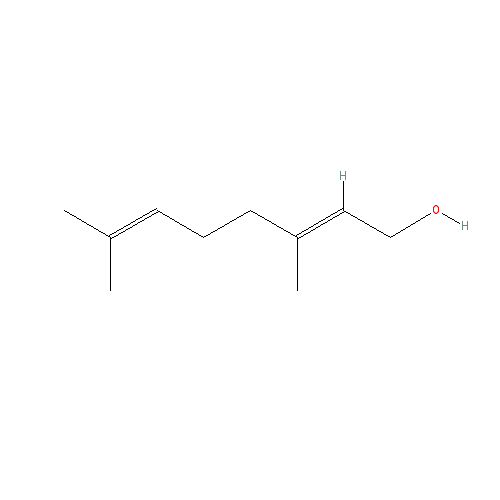
(2E)-3,7-Dimethyl-2,6-octadien-1-ol
(E)-Geraniol · trans-Geraniol · Geranyl alcohol · Lemonol
化学組成 · Constituent
Geraniol is a common monoterpenoid alcohol, the dominant constituent in palmarosa, jamrosa, rose and wild bergamot oils. The EU lists it as one of 26 fragrance allergens requiring declaration.
Skin. A 5 percent patch test on 100 volunteers produced no reactions. In 237 Japanese volunteers there were also no reactions. In large studies of 11,875 dermatitis patients, only 0.42 percent reacted to geraniol at 1 to 5 percent.
Fragrance-sensitive patients. Reaction rates can rise to as high as 7 percent in this group when tested at 1 percent.
Oral. Acute oral LD50 in rats is 3.6 to 4.8 g/kg. Rats fed 1,000 ppm for 28 weeks or 10,000 ppm for 16 weeks showed no observable adverse effects.
Reproductive. Geraniol produced malformations in chick embryos when injected into fertilized eggs. Clinical relevance for humans is unknown. Since geraniol is an isomer of linalool, its reproductive toxicity profile may be similar.
Mutagenicity and cancer. Not mutagenic in the Ames test. Pronounced anticancer activity in vitro and in animal models against leukemia, melanoma, liver, colon, pancreatic and breast cancers.
| Bergamot (wild) | 86.8 – 93.2 % |
| Jamrosa | 54.0 – 85.0 % |
| Palmarosa | 74.5 – 81.0 % |
| Thyme (lemon) | 39.2 % |
| Geranium | 7.3 – 30.3 % |
| Citronella | 16.8 – 29.1 % |
| Rose (Damask) | 2.1 – 25.7 % |
| Thyme (geraniol CT) | 24.9 % |
| Finger root | 20.8 % |
| Lemon leaf | 0.5 – 15.0 % |
| Rose (Japanese) | 12.8 % |
| Melissa | 1.0 – 8.1 % |
| Snakeroot | 0.8 – 7.2 % |
| Osmanthus | 1.2 – 7.1 % |
| Lemongrass | 0 – 6.7 % |
| Rose (Provence) | 4.9 – 6.4 % |
| Coriander seed | 0.3 – 5.3 % |
| Davana | 5.0 % |
| Basil (lemon) | 4.3 – 4.7 % |
| Lemon balm (Australian) | 3.7 % |
| Neroli | 0.8 – 3.6 % |
| Myrtle (honey) | 3.4 % |
| Eucalyptus (macarthurii) | 1.9 – 3.3 % |
| African bluegrass | 1.7 – 3.2 % |
| Ylang-ylang | 0 – 3.0 % |
| Eucalyptus (radiata) | 0.2 – 2.8 % |
| Tea tree (lemon-scented) | 2.7 % |
| Betel | 0 – 2.5 % |
| Carrot seed | 0 – 2.2 % |
| Skimmia | 1.9 % |
| Cistus | 0 – 1.7 % |
| May chang | 0.5 – 1.6 % |
| Cananga | 1.5 % |
| Hop | 1.5 % |
| Clary sage | tr – 1.2 % |
| Cardamon | 0.3 – 1.1 % |
| Galangal (greater) | 0.3 – 1.1 % |
| Linaloe wood | 1.0 % |
In rabbits, geraniol is extensively metabolized to a dicarboxylic acid derivative. In the liver, the compound is converted to 8-carboxygeranic acid and excreted in urine. After three days of dosing, hepatic CYP concentrations in rats increased significantly.
There has been a call from dermatologists to treat geraniol less restrictively. Among 11,875 dermatitis patients only 0.42 percent reacted, making it difficult to understand the EU high-risk classification.