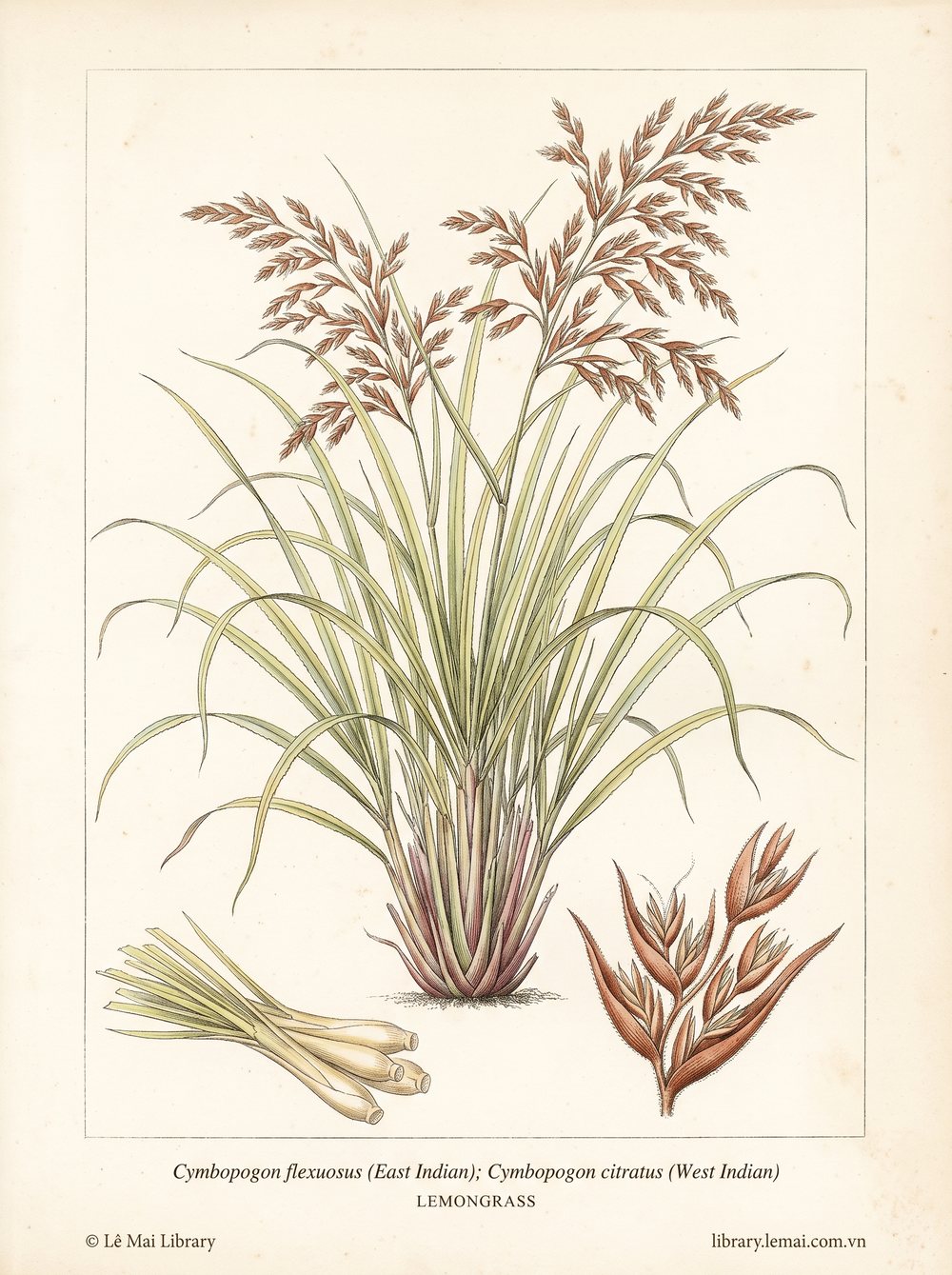
レモングラス
Sả chanh
Cymbopogon flexuosus (East Indian); Cymbopogon citratus (West Indian)
Andropogon flexuosus, Andropogon citratus
Citral (geranial cộng neral) chiếm tới 90 phần trăm. Khả năng nhạy ứng da rõ rệt nếu vượt nồng độ giới hạn.
Tỷ lệ phản ứng dermal: 25 trong 1,606 bệnh nhân viêm da tiếp xúc (1.6 phần trăm) phản ứng với 2 phần trăm lemongrass oil. Trong 100 bệnh nhân, không có phản ứng với 1 phần trăm.
Tương tác thuốc qua ức chế CYP2B6 từ citral và geraniol. Thận trọng nếu dùng oral với thuốc chuyển hóa qua enzyme này, đặc biệt thuốc tiểu đường (citral có tác dụng tim mạch).
Teratogenicity: citral có rủi ro gây dị tật bẩm sinh ở liều cao. Liều oral tối đa hàng ngày trong thai kỳ chỉ 46 mg.
Trẻ em dưới 2 tuổi: tránh dermal. Da nhạy cảm, da tổn thương: thận trọng.
Lemongrass oil không phototoxic. Trên chuột, thử trên 21 ngày ở liều 1, 10, 100 mg/kg không gây biến đổi sinh lý, sinh hóa, hay khối lượng cơ quan đáng kể.
Citral (geranial plus neral) constitutes up to 90 percent. Clear skin sensitization potential if used above the dermal limit.
Dermal reaction rate: 25 of 1,606 contact dermatitis patients (1.6 percent) reacted to 2 percent lemongrass oil. In 100 patients, no reactions occurred at 1 percent.
Drug interactions through CYP2B6 inhibition by citral and geraniol. Use orally with caution alongside drugs metabolized by this enzyme, particularly antidiabetic drugs (citral has cardiovascular effects).
Teratogenicity: citral carries a risk of birth defects at high doses. Maximum daily oral dose in pregnancy is only 46 mg.
Children under 2 years: avoid dermal use. Hypersensitive or damaged skin: use with caution.
Lemongrass oil is not phototoxic. In a 21-day mouse trial at 1, 10, and 100 mg/kg there were no significant changes in gross pathology, biochemistry, or organ weights.
| Geranial (East Indian) | 45.1 – 54.5 % |
| Neral (East Indian) | 30.1 – 36.1 % |
| Geranial (West Indian) | 36.7 – 55.9 % |
| Neral (West Indian) | 25.0 – 35.2 % |
| β-Myrcene (West Indian) | 5.6 – 19.2 % |
| Limonene oxide (West Indian) | 0 – 6.4 % |
| Geraniol | 0 – 6.7 % |
| Geranyl acetate | 0.1 – 4.0 % |
| (+)-Limonene | 0.1 – 3.8 % |
| Linalool | 0.2 – 2.0 % |
| 6-Methyl-5-hepten-2-one | 0.1 – 2.6 % |
| 1,8-Cineole (West Indian) | 0 – 2.9 % |
Lemongrass có hai loài chính. East Indian (Cymbopogon flexuosus) trồng tại Ấn Độ, Sri Lanka, Đông Nam Á. West Indian (Cymbopogon citratus) trồng tại Caribbean, Brazil, Châu Phi, một phần Đông Nam Á.
Sả chanh trồng ở Việt Nam là Cymbopogon citratus. Mẫu dầu từ nhiều vùng trong nước cho 61 đến 76 phần trăm citral, dầu lá cao hơn dầu thân. Xem Tinh dầu Việt Nam.
East Indian thường có citral cao hơn và ít β-myrcene. West Indian có chemistry phức tạp hơn với β-myrcene đáng kể.
Cây cỏ nhiệt đới, mọc thành bụi dày, lá dài và sắc. Tinh dầu chưng cất từ lá tươi hoặc khô. Năng suất tinh dầu khoảng 0.2-0.4 phần trăm khối lượng lá.
Tại Việt Nam, lemongrass là gia vị thường gặp, 'sả' trong tên gọi địa phương. Cùng loài Cymbopogon, gồm các loài có chemistry khác nhau (citronella, palmarosa, gingergrass).
Họ Poaceae (Gramineae), cùng họ với lúa, ngô, mía.
Lemongrass comes in two main species. East Indian (Cymbopogon flexuosus) grows in India, Sri Lanka, and Southeast Asia. West Indian (Cymbopogon citratus) grows in the Caribbean, Brazil, Africa, and parts of Southeast Asia.
Lemongrass grown in Vietnam is Cymbopogon citratus. Oils from several Vietnamese regions contain 61 to 76 percent citral, higher in leaf oil than stem oil. See Essential oils of Vietnam.
East Indian typically has higher citral and less β-myrcene. West Indian has more complex chemistry with significant β-myrcene.
A tropical grass that grows in dense clumps with long, sharp leaves. The oil is distilled from fresh or dried leaves. Oil yield is around 0.2-0.4 percent by leaf weight.
In Vietnam, lemongrass is a common culinary herb, known locally as 'sả'. Belongs to genus Cymbopogon, which includes related species with different chemistry (citronella, palmarosa, gingergrass).
Family Poaceae (Gramineae), same family as rice, corn, and sugarcane.
Lemongrass oil thường bị làm giả bằng citral tổng hợp. Phân biệt qua GC-MS chiral analysis.
East Indian và West Indian khác nhau về mùi và chemistry. Đôi khi nhãn 'lemongrass' không ghi rõ loài.
Lemongrass tươi cho profile mùi khác lemongrass khô, chưng cất ngay sau cắt giữ được hương phong phú hơn.
Lemongrass oil is commonly adulterated with synthetic citral. Distinguished by chiral GC-MS analysis.
East Indian and West Indian differ in aroma and chemistry. Sometimes the label 'lemongrass' does not specify the species.
Fresh lemongrass produces a different aromatic profile from dried, distillation immediately after cutting preserves a richer character.
Hoạt tính chống ung thư đáng kể in vitro. East Indian lemongrass oil cytotoxic với 12 dòng tế bào ung thư người (cổ tử cung, phổi, gan, đại tràng, tuyến tiền liệt, miệng, neuroblastoma) với IC50 4.2-79.0 μg/mL.
Trên chuột, ở liều 200 mg/kg ip, lemongrass oil ức chế khối u Ehrlich và Sarcoma-180 từ 37-97 phần trăm.
Cũng có hoạt tính chống đột biến, giảm tổn thương DNA trong bạch cầu chuột do MNU gây ra.
Trong ứng dụng cosmetic, lemongrass phổ biến trong xà phòng, dầu massage, sản phẩm đuổi muỗi. Mùi tươi, sắc, kích thích.
Vai trò văn hóa tại Việt Nam: sả là một trong những gia vị cơ bản, từ thịt nướng, bún, đến chè. Lá khô hãm trà, tradition kéo dài hàng thế kỷ.
Notable anticarcinogenic activity in vitro. East Indian lemongrass oil is cytotoxic to 12 human cancer cell lines (cervix, lung, liver, colon, prostate, mouth, neuroblastoma) with IC50 values of 4.2-79.0 μg/mL.
In mice at 200 mg/kg ip, lemongrass oil inhibited Ehrlich and Sarcoma-180 tumors by 37-97 percent.
Also has antigenotoxic activity, reduces MNU-induced DNA damage in mouse leukocytes.
In cosmetic applications, lemongrass is common in soaps, massage oils, and mosquito-repellent products. Fresh, sharp, stimulating aroma.
Cultural role in Vietnam: lemongrass is among the foundational seasonings, from grilled meats and noodle soups to sweet broths. Dried leaves brewed as tea, a centuries-long tradition.