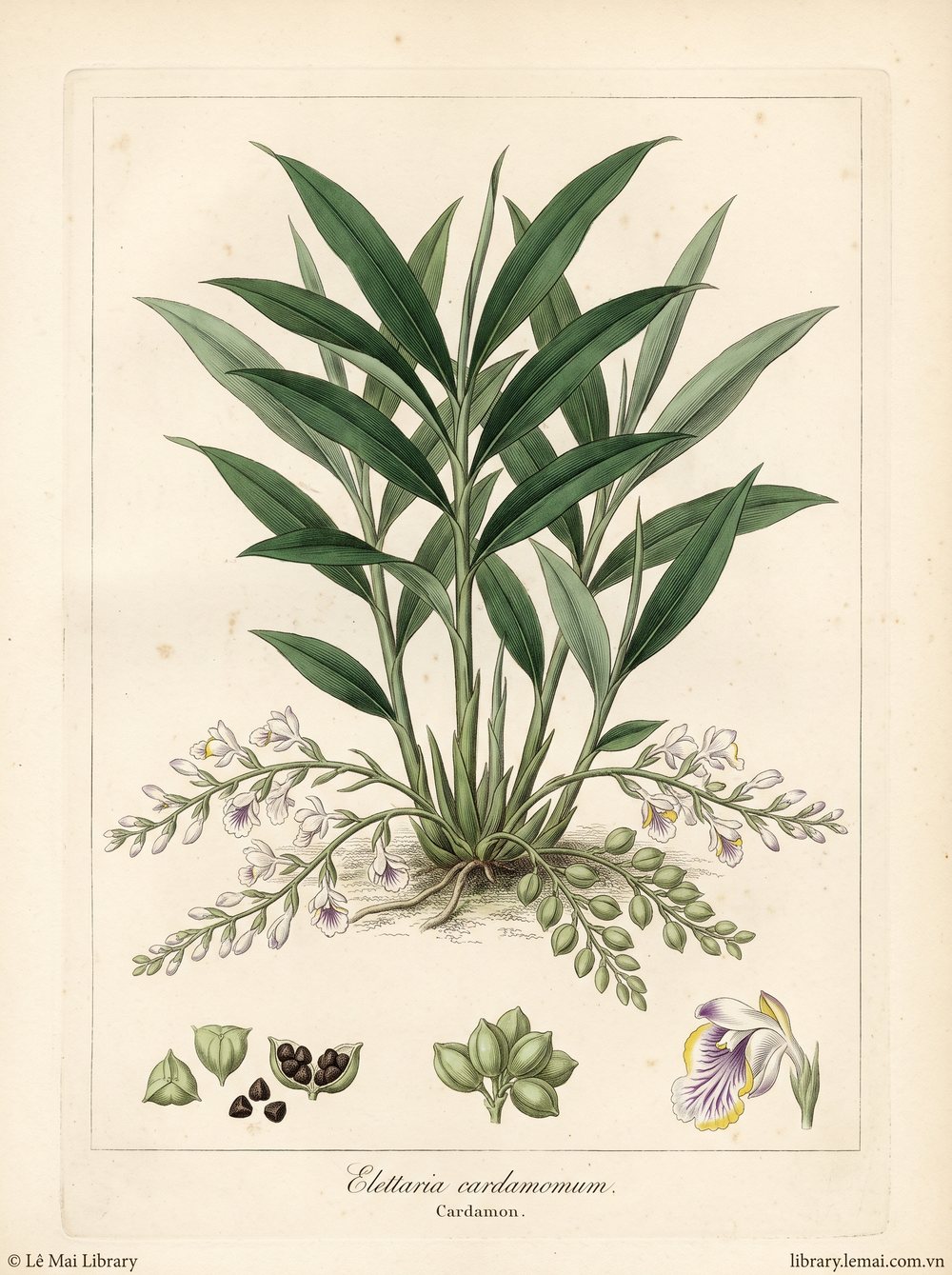
カルダモン
Bạch đậu khấu
Elettaria cardamomum
Green cardamon, True cardamon
Tinh dầu giàu 1,8-cineole có thể gây vấn đề thần kinh trung ương và hô hấp ở trẻ nhỏ khi tiếp xúc gần mũi.
Chống chỉ định: không thoa lên mặt hoặc gần mặt trẻ sơ sinh và trẻ nhỏ.
Có GRAS status. Không kích ứng hay nhạy ứng da ở liều thử nghiệm. Không phototoxic.
Cardamon oil ức chế đáng kể tổn thương dạ dày và loét do ethanol và aspirin gây ra ở chuột thí nghiệm (Jamal et al 2006).
Oils high in 1,8-cineole can cause CNS and breathing problems in young children when applied near the nose.
Contraindication: do not apply to or near the face of infants or children.
GRAS status. No skin irritation or sensitization at tested levels. Non-phototoxic.
Cardamon oil significantly inhibited gastric irritation and ulcerative lesions induced by ethanol and aspirin in rats (Jamal et al 2006).
| 1,8-Cineole | 26.5 – 44.6 % |
| α-Terpinyl acetate | 29.2 – 39.7 % |
| Linalyl acetate | 0.7 – 7.7 % |
| (+)-Limonene | 1.7 – 6.0 % |
| Linalool | 0.4 – 5.9 % |
| α-Terpineol | 0.8 – 4.3 % |
| Sabinene | 2.5 – 3.8 % |
| Terpinen-4-ol | 0.9 – 3.2 % |
| (E)-Nerolidol | 0.1 – 2.7 % |
| β-Myrcene | 0.2 – 2.2 % |
| α-Pinene | 0.6 – 1.5 % |
| Geraniol | 0.3 – 1.1 % |
| L'Autre | Diptyque · 1973 · nốt đầu top |
| Dolce Vita | Dior · 1994 · nốt đầu top |
| Eau de Parfum | Comme des Garçons · 1994 · nốt đầu top |
| Santal 33 | Le Labo · 2011 · nốt đầu top |
| Sauvage Elixir | Dior · 2021 · nốt đầu top |
Theo danh sách nốt hương do nhà sản xuất công bố. Tên nước hoa và thương hiệu thuộc chủ sở hữu tương ứng.Based on note lists published by each house. Fragrance names and marks belong to their owners.
Elettaria cardamomum là cây thảo nhiều năm vùng tropic Nam Á. Hạt nhỏ, đen, nằm trong vỏ ba múi xanh.
Họ Zingiberaceae, cùng họ với ginger và turmeric. Sản xuất chủ yếu tại Guatemala và Ấn Độ.
Hạt cardamon là gia vị giá trị cao trong ẩm thực Ấn Độ, Ả Rập và Bắc Âu. Tinh dầu chiết từ hạt là một trong những nguyên liệu perfumery quan trọng cho note spicy oriental.
Elettaria cardamomum is a tropical South Asian perennial herb. Small black seeds sit inside three-ridged green pods.
Family Zingiberaceae, same family as ginger and turmeric. Produced mainly in Guatemala and India.
Cardamon seeds are a high-value spice in Indian, Arab and Scandinavian cuisines. The seed oil is one of the key perfumery materials for the spicy oriental note.
Có thể bị làm giả bằng thêm 1,8-cineole, α-terpinyl acetate hoặc linalyl acetate.
May be adulterated by addition of 1,8-cineole, α-terpinyl acetate or linalyl acetate.