Linalyl acetate
2,6-Dimethyl-2,7-octadien-6-yl ethanoate
Linalool acetate · Acetic acid linalyl ester · Bergamol
化学組成 · Constituent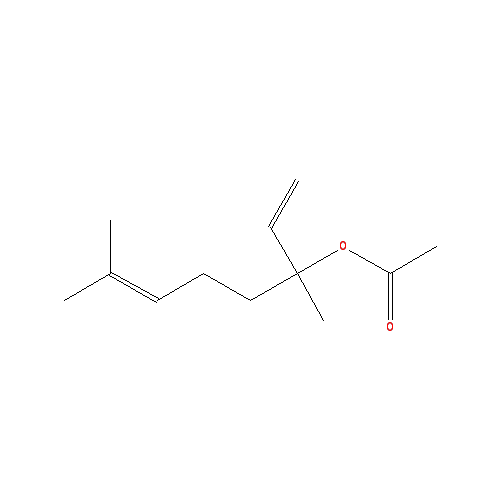
2,6-Dimethyl-2,7-octadien-6-yl ethanoate
Linalool acetate · Acetic acid linalyl ester · Bergamol
化学組成 · Constituent
Linalyl acetate là ester chủ đạo trong nhiều tinh dầu hoa và bergamot. Hợp chất ít gây phản ứng da và không độc.
Trên da. Patch test ở nhiều nồng độ trên hàng trăm người tình nguyện không gây kích ứng đáng kể. Ở 12 phần trăm trên 25 người và 20 phần trăm trên 25 người, không gây mẫn cảm. Trong các nghiên cứu trên bệnh nhân viêm da, tỷ lệ phản ứng dị ứng dưới 2.3 phần trăm và một số mẫu được cho là chứa tạp chất gây phản ứng.
Đường uống. LD50 cấp tính rất cao, 14.5 g/kg và trên 10 mL/kg ở chuột, 13.36 g/kg ở chuột nhắt. LD50 qua da trên thỏ vượt 5 g/kg.
Đột biến gen. Không gây đột biến trong các Ames test với và không có S9. Không gây độc gen trong tế bào gan chuột hoặc tế bào lympho người.
Ung thư. Trong nghiên cứu dài hạn trên chuột nhắt, tiêm phúc mạc linalyl acetate không gây ung thư phổi. Khi bôi ngoài da chuột cùng benzo[a]pyrene ở liều cao có thể có hoạt tính đồng gây ung thư yếu.
Linalyl acetate is the dominant ester in many floral and bergamot oils. The compound is minimally skin reactive and non-toxic.
Skin. Patch testing at various concentrations on hundreds of volunteers showed no significant irritation. At 12 percent on 25 subjects and 20 percent on 25 subjects, no sensitization occurred. In dermatitis patient studies, allergic reaction rates were below 2.3 percent, with some samples suspected of containing reactive impurities.
Oral. Acute oral LD50 is very high at 14.5 g/kg and over 10 mL/kg in rats, 13.36 g/kg in mice. Acute dermal LD50 in rabbits exceeded 5 g/kg.
Mutagenicity. Non-mutagenic in Ames tests with or without S9. Did not induce UDS in primary rat hepatocytes and was not clastogenic in cultured human lymphocytes.
Cancer. In long-term mouse studies, ip injection of linalyl acetate did not produce lung tumors. Topical application alongside benzo[a]pyrene at high doses showed weak co-carcinogenic activity.
| Xô thơm Clary · Clary sage | 45.3 – 73.6 % |
| Lá cam · Orange leaf | 47.4 – 71.0 % |
| Bạc hà cam · Mint (bergamot) | 34.0 – 57.3 % |
| Skimmia | 55.6 % |
| Gỗ Linaloe · Linaloe wood | 47.0 % |
| Hoa oải hương · Lavender | 25.0 – 46.0 % |
| Rễ rắn · Snakeroot | 28.0 – 41.4 % |
| Cam Bergamot · Bergamot | 17.1 – 40.4 % |
| Cam Bergamot FCF · Bergamot (FCF) | 18.0 – 28.0 % |
| Snowbush (Breynia) · Snowbush | 18.0 % |
| Cúc Mũi · Chamomile (Cape) | 14.1 % |
| Kinh giới ngọt · Marjoram (sweet) | 7.4 – 10.5 % |
| Neroli | 0.6 – 10.0 % |
| Bạch đậu khấu · Cardamon | 0.7 – 7.7 % |
| Lá chanh vàng · Lemon leaf | 0 – 6.5 % |
| Xô thơm Tây Ban Nha · Sage (Spanish) | 0.1 – 5.8 % |
Linalyl acetate thuỷ phân trong dịch dạ dày, cho linalool. Một phần linalool sau đó nhanh chóng đóng vòng thành a-terpineol.
Linalyl acetate hydrolyses in gastric juice to yield linalool. Some of this linalool is then rapidly ring-closed to a-terpineol.
Linalyl acetate, kết hợp với linalool, tạo nên ký họa mùi đặc trưng của lavender và bergamot. Tỷ lệ cân bằng linalool-linalyl acetate là chỉ số chất lượng quan trọng của dầu lavender.
Linalyl acetate, together with linalool, defines the aroma signature of lavender and bergamot. The linalool to linalyl acetate ratio is a key quality marker for lavender oil.