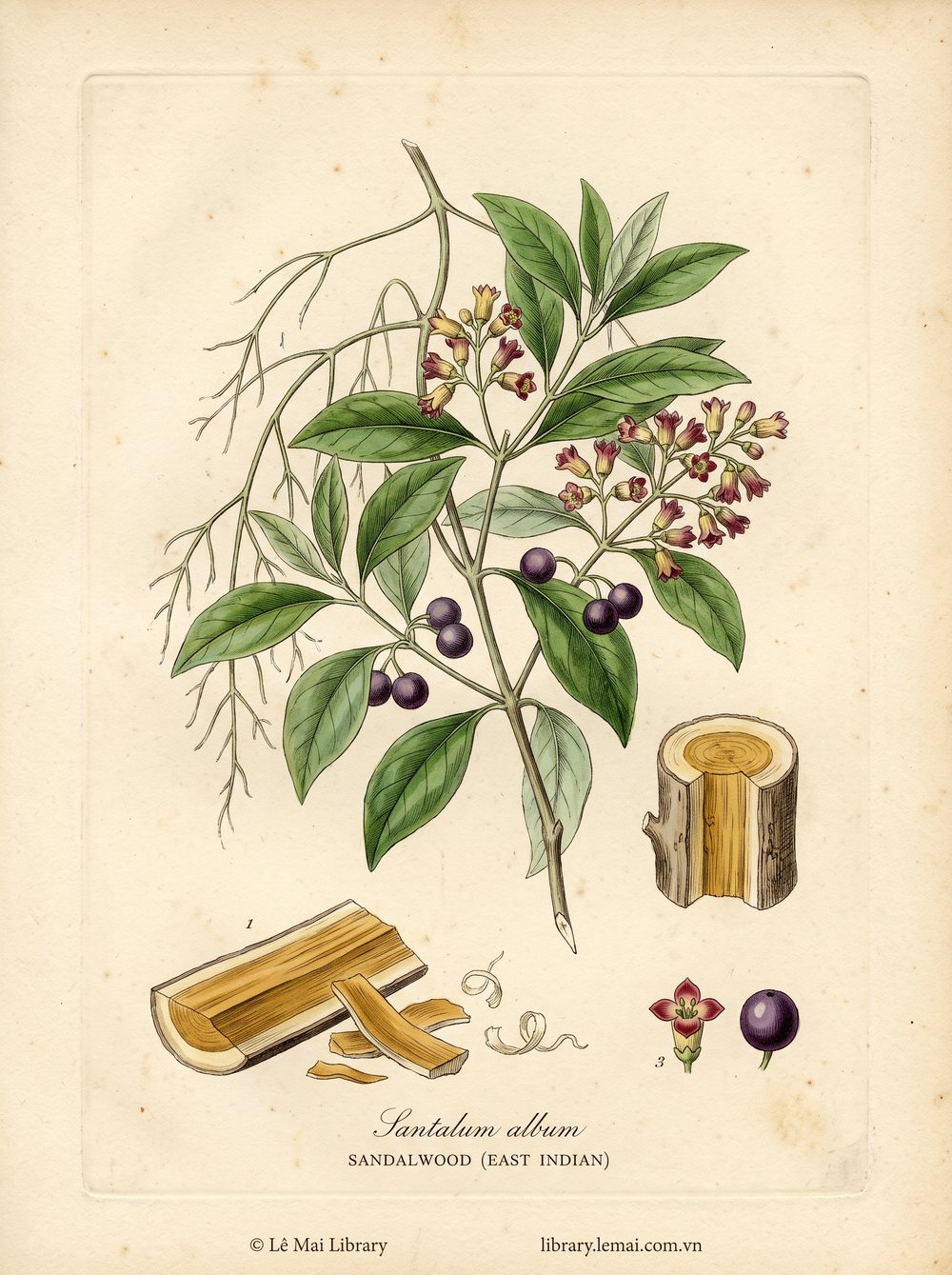
イーストインディアンサンダルウッド
Đàn hương Đông Ấn (Mysore)
Santalum album
White sandalwood, Yellow sandalwood, Chandan
Là một trong những tinh dầu cổ điển và premium nhất trong perfumery. CITES Appendix II, yêu cầu certified sustainable source.
Khả năng nhạy ứng da thấp nhưng rare. Trong 3,542 bệnh nhân da liễu, 12 phản ứng (0.34 phần trăm) với 2 phần trăm sandalwood oil.
Có rủi ro photoallergic, đặc biệt ở người Nhật. Khuyến cáo nồng độ dermal tối đa 2 phần trăm.
Trong 25 người tình nguyện thử 10 phần trăm: không nhạy ứng.
Không có dữ liệu cho thấy nguy hiểm trong thai kỳ.
Sản lượng giảm mạnh do khai thác quá mức trong thế kỷ 20, wild sandalwood India gần như cạn kiệt. Hiện nay nguồn cung chính từ trồng có quản lý.
Among the most classical and premium oils in perfumery. CITES Appendix II, requires certified sustainable source.
Low but rare skin sensitization risk. In 3,542 dermatitis patients, 12 reacted (0.34 percent) to 2 percent sandalwood oil.
Photoallergy risk, particularly in Japanese populations. Recommended maximum 2 percent dermal.
In 25 volunteers tested at 10 percent: not sensitizing.
No data indicates hazard in pregnancy.
Production dropped dramatically due to overharvesting in the 20th century, wild Indian sandalwood nearly depleted. Current supply primarily from managed cultivation.
| (Z)-α-Santalol | 46.2 – 59.9 % |
| (Z)-β-Santalol | 20.5 – 29.0 % |
| (Z)-Nuciferol | 1.1 – 5.5 % |
| epi-β-Santalol | 4.1 – 4.3 % |
| (Z)-α-trans-Bergamotol | < 3.9 % |
| α-Santalal | 0.5 – 2.9 % |
| β-Santalal | 0.6 – 1.9 % |
| (Z)-Lanceol | 1.5 – 1.7 % |
| (E)-β-Santalol | 1.5 – 1.6 % |
| β-Santalene | 0.6 – 1.4 % |
| α-Santalene | 0.8 – 1.1 % |
Santalum album là cây gỗ nhỏ bán ký sinh, có nguồn gốc Ấn Độ và Đông Timor. Cây cần 30 năm trở lên để gỗ tâm phát triển đủ lượng tinh dầu commercial. Cây trên 60-80 năm cho gỗ chất lượng cao nhất.
Tinh dầu chưng cất từ gỗ tâm (heartwood) và rễ. Vỏ ngoài (sapwood) không cho ra tinh dầu chất lượng.
Sản xuất truyền thống tại Mysore, Karnataka, Nam Ấn Độ, 'Mysore sandalwood' từng là chuẩn vàng. Tuy nhiên khai thác quá mức từ thời thuộc địa Anh đến cuối thế kỷ 20 khiến nguồn wild gần cạn kiệt.
Hiện nay nguồn cung chính từ Đông Timor, Sri Lanka, Indonesia, và đặc biệt Australia (Western Australia plantation). Indian government quản lý chặt nguồn nội địa.
Họ Santalaceae, cây bán ký sinh, rễ hút dinh dưỡng từ rễ cây chủ (host plant) thông qua haustoria. Cần cây chủ phù hợp để phát triển.
Santalum album is a small hemi-parasitic tree native to India and East Timor. The tree needs 30+ years for the heartwood to develop sufficient oil content. Trees over 60-80 years yield the highest-quality wood.
The essential oil is distilled from heartwood and roots. The outer sapwood does not yield quality oil.
Traditional production in Mysore, Karnataka, southern India, 'Mysore sandalwood' was once the gold standard. However, overharvesting from colonial times through the late 20th century nearly depleted the wild source.
Current supply mainly from East Timor, Sri Lanka, Indonesia, and particularly Australia (Western Australian plantation). The Indian government strictly manages domestic sources.
Family Santalaceae, a hemi-parasitic tree, with roots drawing nutrients from a host plant via haustoria. Requires a suitable host to develop.
East Indian sandalwood oil bị làm giả nghiêm trọng. Adulterant phổ biến: sandalwood terpenes synthetic, Australian sandalwood, East African sandalwood, Indian bastard sandal (Erythroxylum monohynum), amyris oil, bleached copaiba balsam.
Adulterant không-thơm: polyethylene glycol, castor oil, coconut oil, DEHP, chỉ để pha loãng và tăng khối lượng.
Verify chất lượng bằng GC-MS chiral analysis. Tỷ lệ (Z)-α-santalol và (Z)-β-santalol là chỉ dấu chính. East Indian thật có α-santalol 46-60% và β-santalol 20-29%.
Mùi East Indian thật: gỗ ấm sâu, kem-sữa đặc trưng, lasting trên da nhiều ngày. Khác với Australian (Santalum spicatum), Australian nhẹ hơn, không có chiều sâu kem.
Aged sandalwood (oil đã lưu trữ 3-5 năm) được ưa chuộng hơn oil mới, mùi mềm và harmony hơn.
East Indian sandalwood oil is severely adulterated. Common adulterants: synthetic sandalwood terpenes, Australian sandalwood, East African sandalwood, Indian bastard sandal (Erythroxylum monohynum), amyris oil, bleached copaiba balsam.
Non-aromatic adulterants: polyethylene glycol, castor oil, coconut oil, DEHP, purely for dilution and volume.
Verify quality by chiral GC-MS analysis. The ratio of (Z)-α-santalol and (Z)-β-santalol is the primary indicator. True East Indian has α-santalol 46-60% and β-santalol 20-29%.
True East Indian aroma: deep warm wood, characteristic creamy-milky note, lasting on skin for days. Different from Australian (Santalum spicatum), Australian is lighter, without the creamy depth.
Aged sandalwood (oil stored 3-5 years) is preferred over new, softer and more harmonious aroma.
| Calèche | Hermès · 1961 · nốt đáy base |
| Samsara | Guerlain · 1989 · nốt đáy base |
| Santal de Mysore | Serge Lutens · 1991 · nốt chính main note |
| Sandalo | Lorenzo Villoresi · 1995 · nốt chính main note |
| Tam Dao | Diptyque · 2003 · nốt chính main note |
Theo danh sách nốt hương do nhà sản xuất công bố. Tên nước hoa và thương hiệu thuộc chủ sở hữu tương ứng.Based on note lists published by each house. Fragrance names and marks belong to their owners.
Sandalwood East Indian là một trong những tinh dầu cổ điển nhất trong perfumery thế giới, được dùng từ hơn 4,000 năm trong văn hóa Hindu, Buddhism, và y học Ayurveda.
Trong văn hóa Ấn Độ, sandalwood (chandan) là thành phần thiêng liêng cho nghi lễ tôn giáo, dùng làm hương, dầu xức, bột vẽ trán (tilaka). Bị xem là 'cây của thần'.
Trong perfumery hiện đại, sandalwood là note nền (base note) và fixative không thể thay thế. Các fragrance houses như Chanel, Dior, Guerlain, Tom Ford đều có ít nhất một fragrance signature dùng sandalwood.
Trong cosmetic, sandalwood oil là nguyên liệu cao cấp cho fine fragrance, kem dưỡng anti-ageing, serum cao cấp. Photoallergy chỉ xảy ra hiếm, vẫn được xem là một trong những oils gỗ an toàn nhất.
Đối với Lê Mai brand, quiet luxury VN+JP sensibility, sandalwood (đặc biệt Australian plantation sustainable) là một trong những signature ingredients tiềm năng.
Lưu ý sustainability: tránh wild Indian sandalwood không certified. Ưu tiên Australian (Santalum spicatum) plantation hoặc Santalum album từ Đông Timor có chứng nhận CITES.
East Indian sandalwood is among the most classical essential oils in world perfumery, used for over 4,000 years in Hindu, Buddhist, and Ayurvedic cultures.
In Indian culture, sandalwood (chandan) is a sacred ingredient for religious rituals, used as incense, anointing oil, and forehead-marking paste (tilaka). Considered a 'tree of the gods'.
In modern perfumery, sandalwood is an irreplaceable base note and fixative. Fragrance houses like Chanel, Dior, Guerlain, and Tom Ford all have at least one signature fragrance using sandalwood.
In cosmetics, sandalwood oil is a premium ingredient for fine fragrance, anti-ageing creams, and premium serums. Photoallergy occurs only rarely, still considered one of the safest woody oils.
For the Lê Mai brand, quiet luxury VN+JP sensibility, sandalwood (particularly sustainable Australian plantation) is a potential signature ingredient.
Sustainability note: avoid uncertified wild Indian sandalwood. Prefer Australian (Santalum spicatum) plantation or CITES-certified Santalum album from East Timor.