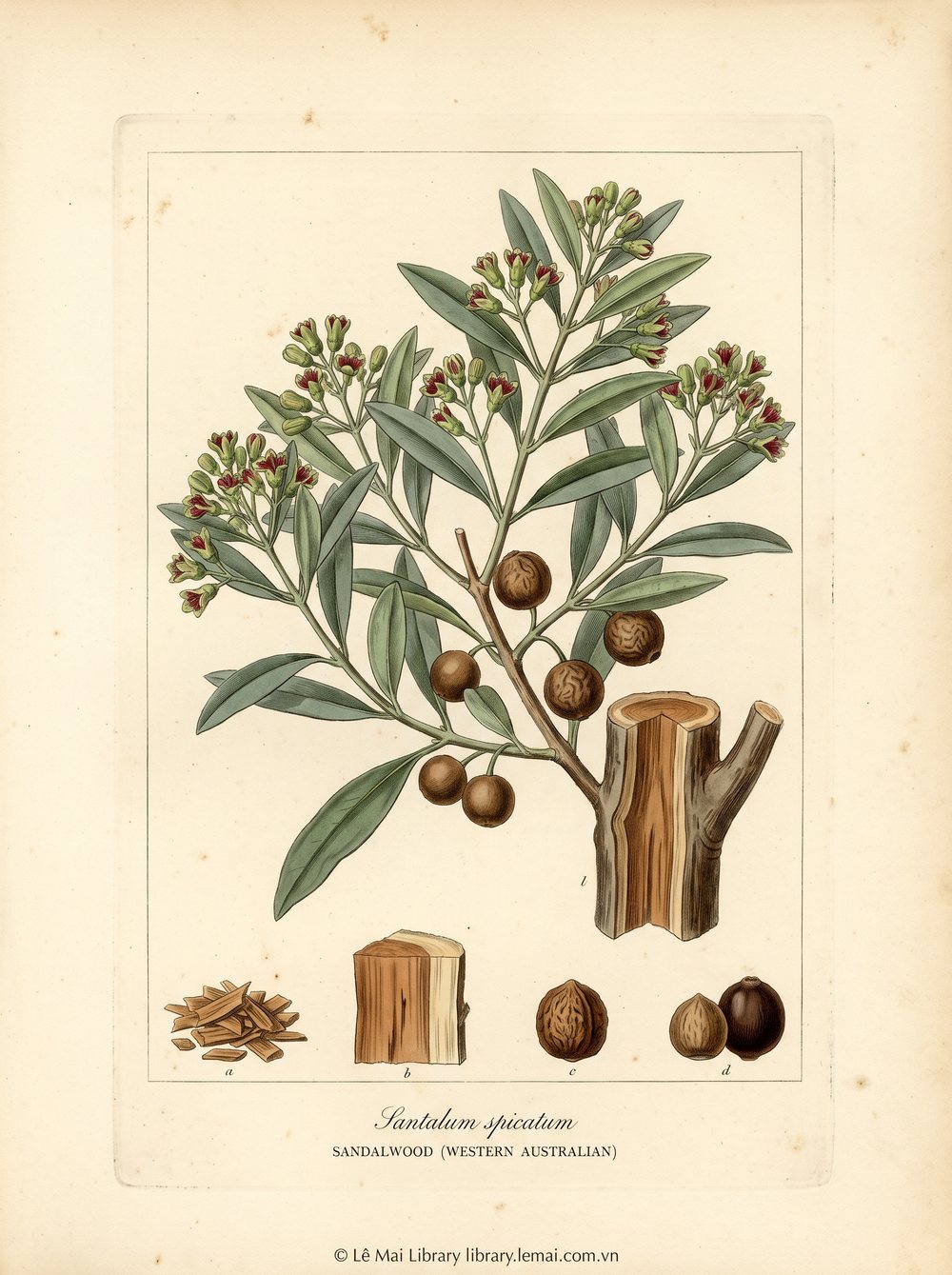
ウェスタンオーストラリアンサンダルウッド
Đàn hương Tây Úc
Santalum spicatum
Australian sandalwood
Australian sandalwood là alternative sustainable nhất cho East Indian sandalwood.
Khả năng nhạy ứng da rất thấp.
Trồng có quản lý tại Western Australia từ thập niên 1990. Indigenous Aboriginal community quản lý một phần.
Không có dữ liệu cho thấy nguy hiểm trong thai kỳ.
Australian sandalwood is the most sustainable alternative to East Indian sandalwood.
Very low skin sensitization risk.
Managed cultivation in Western Australia since the 1990s. Indigenous Aboriginal communities manage some of it.
No data indicates hazard in pregnancy.
| (Z)-α-Santalol | 15.0 – 25.0 % |
| α-Bisabolol | 5.0 – 12.0 % |
| (Z)-β-Santalol | 5.0 – 10.0 % |
| Farnesol | 3.0 – 8.0 % |
| (E)-Nuciferol | 2.0 – 6.0 % |
Santalum spicatum là loài sandalwood Tây Úc. Cây nhỏ hơn Santalum album, mọc trong vùng khô.
Sản xuất chủ yếu Western Australia. Cũng có sản lượng ngày càng tăng từ South Australia, Northern Territory.
Hàm lượng santalol thấp hơn East Indian (chỉ 15-25 phần trăm so với 46-60 phần trăm), đây là điểm khác biệt rõ rệt nhất.
Họ Santalaceae.
Santalum spicatum is a Western Australian sandalwood species. Smaller than Santalum album, growing in arid regions.
Main production: Western Australia. Increasing production from South Australia and Northern Territory.
Lower santalol content than East Indian (only 15-25 percent vs 46-60 percent), the most marked difference.
Family Santalaceae.
| Santal 33 | Le Labo · 2011 · nốt chính main note |
| Santal Blush | Tom Ford · nốt chính main note |
| Bois Marocain | Tom Ford · nốt chính main note |
| Blue Santal | Comme des Garçons · nốt chính main note |
Theo danh sách nốt hương do nhà sản xuất công bố. Tên nước hoa và thương hiệu thuộc chủ sở hữu tương ứng.Based on note lists published by each house. Fragrance names and marks belong to their owners.
Trong industry, Australian sandalwood được khuyến khích thay thế East Indian. Sustainability là lý do chính.
Mùi nhẹ hơn, ít sâu hơn East Indian nhưng vẫn có quality perfumery tốt. Là middle base note thay vì deep base.
In industry, Australian sandalwood is encouraged as a replacement for East Indian. Sustainability is the main reason.
Lighter, less deep than East Indian but still good perfumery quality. A middle base note rather than a deep base.