ラベンダー
Hoa oải hương
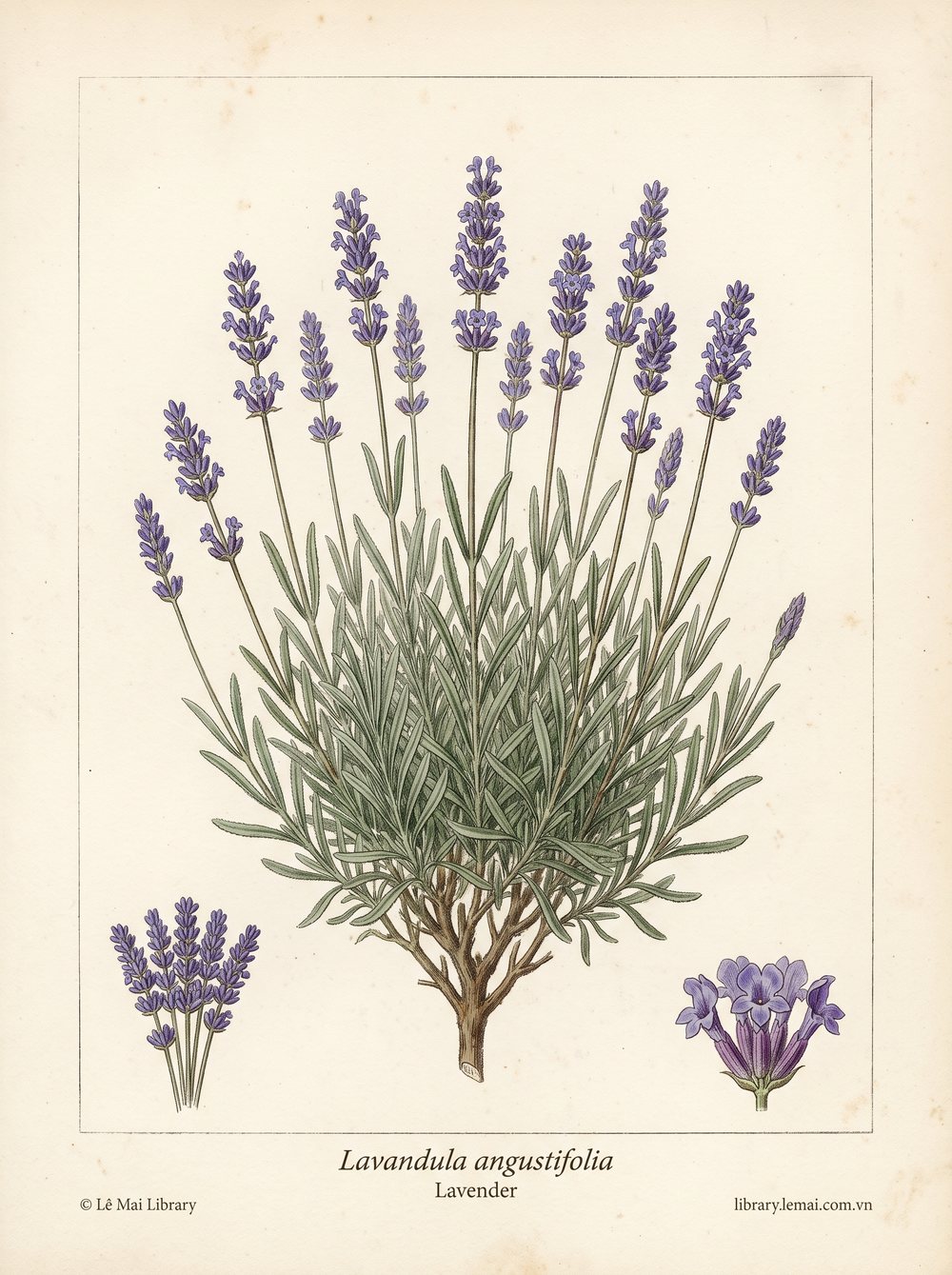
Lavandula angustifolia
Common lavender, English lavender, True lavender, Lavandula officinalis, Lavandula vera
Lavender essential oil được xếp loại GRAS bởi FDA Hoa Kỳ. Không có giới hạn dermal cụ thể từ IFRA.
Tỷ lệ phản ứng da rất thấp dù được dùng phổ biến trong aromatherapy. Báo cáo viêm da tiếp xúc lẻ tẻ.
Có một ca lâm sàng photoallergy được xác nhận với lavender oil thử ở nồng độ 2 phần trăm. Tuy nhiên, lavender oil không phototoxic.
Sản phẩm oxy hóa của linalool có thể gây nhạy ứng da. Bảo quản chai tối, kín, lạnh, thêm chất chống oxy hóa khi formulation.
Không có dữ liệu cho thấy lavender oil nguy hiểm trong thai kỳ.
Lavender absolute (chiết xuất dung môi) có khả năng nhạy ứng da cao hơn essential oil. Nồng độ dermal tối đa khuyến cáo 0.1 phần trăm.
Lavender essential oil is classified as GRAS by the US FDA. No specific dermal limit from IFRA.
Skin reaction rate is very low despite widespread use in aromatherapy. Sporadic contact dermatitis reports.
One confirmed clinical case of photoallergy with lavender oil tested at 2 percent. However, lavender oil is not phototoxic.
Linalool oxidation products can sensitize skin. Store in dark, sealed, refrigerated containers and add antioxidant when formulating.
No data indicates that lavender oil is hazardous in pregnancy.
Lavender absolute (solvent-extracted) has higher sensitization risk than the essential oil. Recommended dermal maximum 0.1 percent.
| Linalyl acetate | 25.0 – 45.0 % |
| Linalool | 20.0 – 38.0 % |
| (Z)-β-Ocimene | 3.0 – 9.0 % |
| Terpinen-4-ol | 1.5 – 6.0 % |
| β-Caryophyllene | 2.0 – 6.0 % |
| Lavandulyl acetate | 1.0 – 3.5 % |
| 3-Octanone | 2.0 – 5.0 % |
| (E)-β-Ocimene | 1.3 – 5.0 % |
| (E)-β-Farnesene | 1.0 – 3.0 % |
| 1,8-Cineole | 0.5 – 2.5 % |
| Camphor | 0.2 – 1.0 % |
| α-Terpineol | 0.5 – 2.0 % |
Lavandula angustifolia là loài lavender thật, mọc vùng Địa Trung Hải, đặc biệt Provence, Pháp. Cây bụi nhỏ, hoa tím xanh, mùi thơm dịu.
Tinh dầu chưng cất từ hoa và phần cuống ngọn cắt vào mùa hè. Thời điểm hái và phương pháp chưng cất quyết định chất lượng.
Lavender thật phải mọc ở độ cao trên 600m để có chemistry tối ưu, linalool cao, camphor thấp. Lavender mọc thấp có camphor cao hơn, mùi sắc hơn.
Sản xuất chính: Pháp (Provence), Bulgaria, Anh, Úc, Ukraine, Tasmania. Mỗi vùng cho profile mùi khác biệt nhỏ.
Họ Lamiaceae (Labiatae). Cùng họ với basil, rosemary, mint.
Lavandula angustifolia is true lavender, native to the Mediterranean, particularly Provence, France. A small shrub with violet-blue flowers and a soft aromatic character.
The essential oil is distilled from flowers and upper stems harvested in summer. Harvest timing and distillation method determine quality.
True lavender must grow at altitudes above 600m for optimal chemistry, high linalool, low camphor. Low-altitude lavender has higher camphor and a sharper aroma.
Main production: France (Provence), Bulgaria, England, Australia, Ukraine, Tasmania. Each region produces a subtly different aromatic profile.
Family Lamiaceae (Labiatae). Same family as basil, rosemary, and mint.
Lavender oil thường bị làm giả bằng lavandin oil, spike lavender, Spanish sage, các phân đoạn camphor trắng, ho oil rectified hoặc acetylated, lavandin acetylated, linalool và linalyl acetate tổng hợp.
Tiêu chuẩn chất lượng: linalool phải chiếm ít nhất 85 phần trăm là enantiomer (R)-(–)-, và linalyl acetate phải chiếm ít nhất 98 phần trăm là enantiomer (R)-(–)-.
Một trong những adulterant phổ biến nhất là dùng lavandin Super trộn vào lavender thật. Phân biệt bằng GC-MS với chú trọng vào camphor và (Z)-β-ocimene.
Lavender từ Provence có chứng nhận AOC (Appellation d'Origine Contrôlée) đảm bảo nguồn gốc và phương pháp.
Tiêu chuẩn ISO khác nhau cho từng nguồn, Pháp, Bulgaria, Federation Nga. Australian lavender có profile riêng, khác biệt với lavender châu Âu.
Lavender oil is commonly adulterated with lavandin oil, spike lavender, Spanish sage, white camphor fractions, rectified or acetylated ho oil, acetylated lavandin, and synthetic linalool and linalyl acetate.
Quality standard: linalool should comprise at least 85 percent of the (R)-(–)- enantiomer, and linalyl acetate should comprise at least 98 percent of the (R)-(–)- enantiomer.
One of the most common adulterations is blending lavandin Super into true lavender. Distinguished by GC-MS, paying particular attention to camphor and (Z)-β-ocimene.
Lavender from Provence carries AOC (Appellation d'Origine Contrôlée) certification ensuring origin and method.
ISO standards differ for each source, France, Bulgaria, Russian Federation. Australian lavender has its own profile, distinct from European lavender.
| Fougère Royale | Houbigant · 1882 · nốt đầu top |
| Jicky | Guerlain · 1889 · nốt giữa heart |
| Colonia | Acqua di Parma · 1916 · nốt giữa heart |
| Pour un Homme de Caron | Caron · 1934 · nốt chính main note |
| Azzaro Pour Homme | Azzaro · nốt chính main note |
Theo danh sách nốt hương do nhà sản xuất công bố. Tên nước hoa và thương hiệu thuộc chủ sở hữu tương ứng.Based on note lists published by each house. Fragrance names and marks belong to their owners.
Lavender oil được nghiên cứu nhiều nhất trong các tinh dầu. Hơn 200 nghiên cứu lâm sàng và in vitro về tính chất giảm lo âu, hỗ trợ giấc ngủ, kháng khuẩn.
Hoạt tính chống ung thư in vitro: lavender oil cytotoxic với tế bào ung thư tuyến tiền liệt, phổi, vú với IC50 lần lượt 0.05, 0.13, 0.14 phần trăm.
Không chứa carcinogen đã biết. Không gây đột biến gen trong các test Ames standard.
Tất cả cultivar của Lavandula angustifolia là chọn lọc từ subsp. angustifolia.
Lavender oil cũng có vai trò lớn trong cosmetic, dầu massage, sữa tắm, kem dưỡng, nến thơm, perfume.
Hai dạng chính: essential oil (chưng cất) và absolute (chiết xuất dung môi). Absolute mùi đậm hơn, gần hoa tươi hơn, nhưng có khả năng gây nhạy ứng da cao hơn.
Lavender oil is the most studied of all essential oils. Over 200 clinical and in vitro studies on anxiolytic, sleep-supportive, and antimicrobial properties.
In vitro anticarcinogenic activity: lavender oil cytotoxic to prostate, lung, and breast cancer cells with IC50 values of 0.05, 0.13, and 0.14 percent respectively.
Contains no known carcinogens. Not mutagenic in standard Ames tests.
All cultivars of Lavandula angustifolia are selections of subsp. angustifolia.
Lavender oil also plays a major role in cosmetics, massage oils, bath products, creams, scented candles, perfume.
Two main forms: essential oil (distilled) and absolute (solvent-extracted). The absolute has a deeper aroma, closer to fresh flowers, but a higher sensitization risk.