β-Ocimene
3,7-Dimethyl-1,3,6-octatriene
Ocimene
化学組成 · Constituent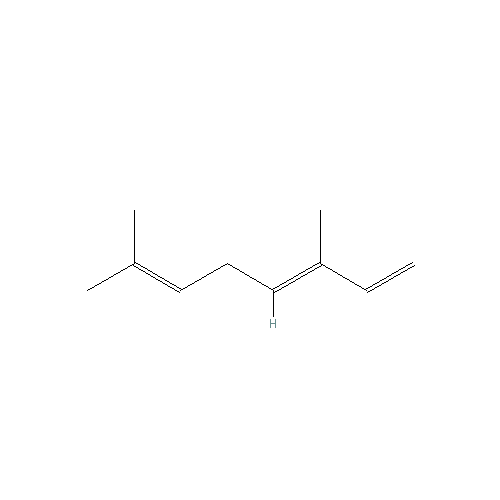
3,7-Dimethyl-1,3,6-octatriene
Ocimene
化学組成 · Constituent
β-Ocimene là một monoterpene polyalkene xuất hiện phong phú trong nhiều tinh dầu hoa và thảo mộc, đặc biệt là taget, jonquil và opopanax. Hợp chất an toàn ở mức sử dụng thông thường.
Trên da. Ocimene hỗn hợp đồng phân chưa pha loãng gây kích ứng vừa cho da thỏ. Thử nghiệm ở 5 phần trăm trên 25 người tình nguyện không gây kích ứng và không gây mẫn cảm.
Độc tính cấp. LD50 cấp tính trên chuột qua đường uống vượt 5 g/kg. LD50 cấp tính qua da trên thỏ vượt 5 g/kg.
Ung thư. Ocimene ức chế rất yếu sự tăng sinh tế bào melanoma B16 chuột nhắt với IC50 250 µM (34.0 g/L).
β-Ocimene is a monoterpenoid polyalkene present abundantly in many floral and herbaceous essential oils, particularly taget, jonquil and opopanax. The compound is safe at standard use levels.
Skin. Undiluted mixed-isomer ocimene was moderately irritating to rabbit skin. A 5 percent test on 25 volunteers caused no irritation and no sensitization.
Acute toxicity. Acute oral LD50 in rats exceeded 5 g/kg. Acute dermal LD50 in rabbits exceeded 5 g/kg.
Cancer. Ocimene very weakly inhibited proliferation of mouse B16 melanoma cells with an IC50 of 250 µM (34.0 g/L).
| Vạn thọ · Taget | 16.6 – 69.8 % |
| Thủy tiên vàng · Jonquil | 35.3 % |
| Opopanax | 33.0 % |
| Krachai · Finger root | 22.8 % |
| Húng quế cay · Basil (pungent) | 20.6 % |
| Cần tây (lá) · Celery leaf | 14.1 % |
| Cỏ xanh Phi · African bluegrass | 10.3 – 11.5 % |
| Ngải giấm · Tarragon | tr – 9.5 % |
| Lovage (hạt) · Lovage seed | 9.2 % |
| Hoa oải hương · Lavender | < 9.0 % |
| Neroli | 4.6 – 7.0 % |
| Arina | 7.0 % |
| Lavandin | 3.0 – 7.0 % |
| Lý chua đen (nụ) · Blackcurrant bud | 0.6 – 6.7 % |
| Riềng nếp · Galangal (greater) | 0 – 6.4 % |
| Húng quế thiêng · Basil (holy) | 3.4 – 6.2 % |
| A ngùy · Asafoetida | 0 – 6.1 % |
| Đỗ quyên · Rhododendron | 5.3 % |
| Jamrosa | 7.8 % |
β-Ocimene tồn tại ở hai dạng đồng phân hình học (3E)- và (3Z)-, cả hai đều phổ biến trong thực vật. Hợp chất được thực vật tiết ra như tín hiệu hoá học cho côn trùng và động vật ăn cỏ.
β-Ocimene exists in two geometric isomers, (3E)- and (3Z)-, both common in plants. The compound is released by plants as a chemical signal to insects and herbivores.