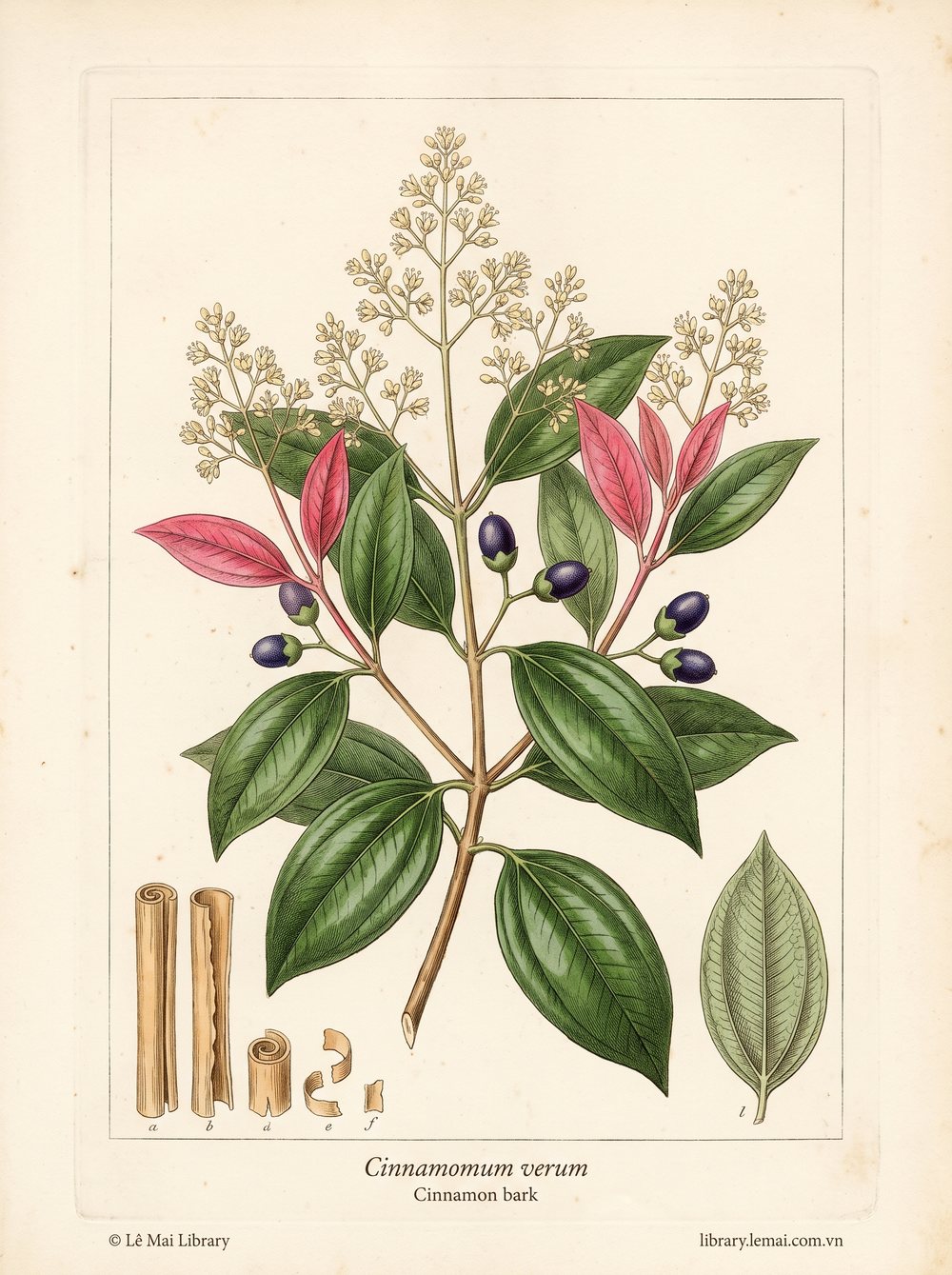
シナモンバーク
Quế (vỏ)
Cinnamomum verum
Ceylon cinnamon, True cinnamon, Cinnamomum zeylanicum
Tương tác thuốc. Có thể ức chế đông máu. Độc bào thai. Nhạy ứng da rủi ro cao. Kích ứng niêm mạc rủi ro thấp.
Chống chỉ định toàn diện: mang thai, cho con bú.
Đường uống: thuốc tiểu đường, thuốc chống đông, trước phẫu thuật lớn, loét dạ dày tá tràng, máu khó đông.
Có GRAS status. Liều uống tối đa người lớn 200 mg mỗi ngày.
Nồng độ tối đa trên da 0.07 phần trăm dựa trên 75.7 phần trăm cinnamaldehyde và ngưỡng dermal 0.05 phần trăm.
Cinnamon bark oil không phototoxic. Tinh dầu chưa pha loãng rất kích ứng, đã có ca trẻ em bị bỏng nặng do tiếp xúc trực tiếp.
Có chemotype safrole hiếm gặp với 11 phần trăm safrole trong bark oil và 52 phần trăm trong leaf oil. Các oil chứa safrole có rủi ro carcinogen.
Drug interactions. May inhibit blood clotting. Embryotoxic. High risk of skin sensitization. Low risk of mucous membrane irritation.
Broad contraindications: pregnancy, breastfeeding.
Oral: diabetes medication, anticoagulant medication, before major surgery, peptic ulcer, hemophilia.
GRAS status. Maximum adult oral dose 200 mg daily.
Maximum dermal use level 0.07 percent based on 75.7 percent cinnamaldehyde and a dermal limit of 0.05 percent.
Cinnamon bark oil is non-phototoxic. Undiluted oil is severely irritating, cases of severe burns in children have been reported from direct skin contact.
A rare safrole chemotype exists with 11 percent safrole in bark oil and 52 percent in leaf oil. Such safrole-containing oils present a carcinogenic risk.
| (E)-Cinnamaldehyde | 63.1 – 75.7 % |
| Eugenol | 2.0 – 13.3 % |
| (E)-Cinnamyl acetate | 0.3 – 10.6 % |
| Linalool | 0.2 – 7.0 % |
| β-Caryophyllene | 1.3 – 5.8 % |
| p-Cymene | 1.7 – 2.5 % |
| 1,8-Cineole | 0.4 – 2.3 % |
| Benzaldehyde | tr – 2.2 % |
| α-Terpineol | 0.4 – 1.4 % |
| Camphor | tr – 1.4 % |
| Terpinen-4-ol | 0.4 – 1.1 % |
| Safrole | 0 – 0.04 % |
| Dioressence | Dior · 1969 · nốt giữa heart |
| Opium | Yves Saint Laurent · 1977 · nốt giữa heart |
| Poison | Dior · 1985 · nốt giữa heart |
| Musc Ravageur | Frédéric Malle · 2000 · nốt đầu top |
| Santal Blush | Tom Ford (Private Blend) · nốt chính main note |
Theo danh sách nốt hương do nhà sản xuất công bố. Tên nước hoa và thương hiệu thuộc chủ sở hữu tương ứng.Based on note lists published by each house. Fragrance names and marks belong to their owners.
Cinnamomum verum (synonym C. zeylanicum) là cây thân gỗ vùng Sri Lanka và Nam Ấn Độ. Đây là cinnamon thật, khác với cassia (Cinnamomum cassia) là Chinese cinnamon.
Tinh dầu bark cất hơi từ vỏ trong sấy khô của cây non. Cây Sri Lanka sản xuất hai chất lượng: premium từ vỏ trong, và chất lượng thứ hai từ vụn vỏ và shoot, chất lượng thứ hai có cinnamaldehyde thấp hơn và eugenol cao đến 20 phần trăm.
Họ Lauraceae. Cùng họ với cassia, camphor, ravensara.
Cinnamomum verum (synonym C. zeylanicum) is a tree of Sri Lanka and southern India. This is true cinnamon, distinct from cassia (Cinnamomum cassia) which is Chinese cinnamon.
The bark oil is steam-distilled from the dried inner bark of young trees. Sri Lankan production yields two qualities: a premium from the inner bark, and a second quality from chippings and shoot bark, the second quality has lower cinnamaldehyde and up to 20 percent eugenol.
Family Lauraceae. Same family as cassia, camphor, ravensara.
Cinnamon bark oil thường bị làm giả bằng cinnamaldehyde tổng hợp và eugenol tự nhiên. Đôi khi cassia oil hoặc các tái cấu trúc tổng hợp được bán dưới tên cinnamon bark. Reconstitution có thể bao gồm cinnamon leaf oil và cinnamaldehyde tổng hợp.
Cinnamon bark oil is frequently adulterated with synthetic cinnamaldehyde and natural eugenol. Occasionally cassia oil or artificially reconstituted oils are sold as cinnamon bark. Reconstitutions may include cinnamon leaf oil and synthetic cinnamaldehyde.