Safrole
1,2-Methylenedioxy-4-allylbenzene
Shikimole
化学組成 · Constituent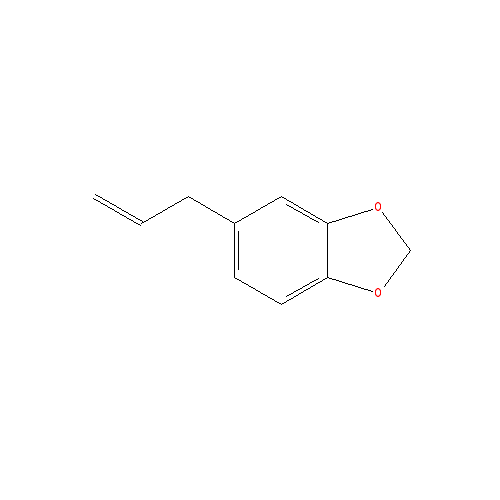
1,2-Methylenedioxy-4-allylbenzene
Shikimole
化学組成 · Constituent
Safrole là chất sinh ung thư gan ở chuột và chuột nhắt. IFRA và EU cấm dùng làm hương liệu. Là cấu tử chính của tinh dầu sassafras, brown camphor và một số dầu Ocotea, các tinh dầu này không phù hợp cho mỹ phẩm.
Trên da. Ở 8 phần trăm trong petrolatum không kích ứng trên người, không gây mẫn cảm trong maximation test trên 25 tình nguyện, không gây độc ánh sáng. Đánh giá lâm sàng độc lập với rủi ro ung thư.
Đường uống. LD50 cấp tính 1.95 g/kg trên chuột, 2.35 g/kg trên chuột nhắt. Uống 750 mg/kg/ngày trong 19 ngày gây chết 9 trên 10 chuột.
Gan và ung thư. Liều dài hạn gây xơ hoá gan, thoái hoá mỡ và tăng sản. Chuột ăn 5.000 và 10.000 ppm trong nghiên cứu hai năm phát triển u lành và u ác. Chuột nhắt ăn 4.000 ppm phát triển u gan. Chó ăn 20 mg/kg trong sáu năm có tổn thương gan vi mô.
Đột biến gen. Safrole và các chất chuyển hoá tạo adduct với DNA gan. Số adduct trên DNA gan người mắc ung thư gan liên quan đến nhai trầu (chứa safrole) thấp hơn nhiều so với chuột nhắt, gợi ý rủi ro thấp hơn ở người.
Liều an toàn đề xuất. NOAEL chuột khoảng 1 mg/kg/ngày. Áp dụng hệ số an toàn 40 để bù cho khác biệt cá nhân, liều tối đa an toàn cho người là 0.025 mg/kg/ngày, tương đương nồng độ trên da 0.05 phần trăm.
Safrole is a hepatocarcinogen in rats and mice. IFRA and the EU prohibit it as a fragrance ingredient. As the principal constituent of sassafras, brown camphor and some Ocotea oils, these oils are unsuitable for cosmetics.
Skin. At 8 percent in petrolatum it was non-irritating on humans, non-sensitizing in a maximation test on 25 volunteers, and non-phototoxic. Dermal evaluation is separate from cancer risk.
Oral. Acute oral LD50 was 1.95 g/kg in rats and 2.35 g/kg in mice. Oral dosing at 750 mg/kg/day for 19 days killed 9 of 10 rats.
Liver and cancer. Long-term dosing causes hepatic fibrosis, fatty degeneration and hyperplasia. Rats fed 5,000 and 10,000 ppm in a two-year study developed benign and malignant tumors. Mice fed 4,000 ppm developed liver tumors. Dogs fed 20 mg/kg for six years showed microscopic hepatic damage.
Mutagenicity. Safrole and its metabolites form adducts with hepatic DNA. The number of adducts in liver DNA of human betel quid chewers with liver cancer was substantially lower than in mice, suggesting lower risk in humans.
Suggested safe dose. Rat NOAEL is approximately 1 mg/kg/day. Applying an uncertainty factor of 40 for interindividual variation gives a human safe daily dose of 0.025 mg/kg, equivalent to a dermal limit of 0.05 percent.
| Sassafras (Vỏ) · Sassafras | 82.8 – 88.8 % |
| Long não nâu · Camphor (brown) | 50 – 60 % |
| Trầu (lá) · Betel | 6.5 – 45.3 % |
| Long não vàng · Camphor (yellow) | 20 % |
| Lá cây Ho (CT camphor) · Ho leaf (camphor CT) | 0.1 – 5.0 % |
| Nhục đậu khấu Đông Ấn · Nutmeg (East Indian) | 0.3 – 3.3 % |
| Vỏ nhục đậu khấu · Mace | 0.2 – 1.9 % |
| Quế (lá) · Cinnamon leaf | 0 – 1.0 % |
| Lá cây Ho (CT linalool) · Ho leaf (linalool CT) | 0.01 – 0.9 % |
| Nhục đậu khấu Tây Ấn · Nutmeg (West Indian) | 0.1 – 0.5 % |
| Ngọc lan tây · Ylang-ylang | 0.4 % |
| Hoa hồi · Anise (star) | 0 – 0.1 % |
| Quế (vỏ) · Cinnamon bark | 0 – 0.04 % |
Sau khi uống, chất chuyển hoá chính là 1,2-dihydroxy-4-allylbenzene, chiếm 65 phần trăm tổng chất chuyển hoá trong nước tiểu người và 45 phần trăm ở chuột. Ở người, đỉnh huyết tương đạt sau 30 phút, thải đôi pha với bán thải 2.5 và 15 giờ, 92 phần trăm thải trong 24 giờ.
1'-Hydroxylation và 2',3'-epoxidation tạo các chất chuyển hoá có khả năng gây ung thư. 1'-Hydroxysafrole là chất sinh ung thư gan mạnh hơn safrole, được chuyển tiếp thành 1'-sulfooxysafrole, được coi là chất chuyển hoá ung thư chính.
Hoạt tính epoxide hydrolase trong gan người biến thiên 20 lần, nhưng ngay người có hoạt tính thấp nhất cũng ngang với trung bình chuột. Vì vậy epoxide bị thuỷ phân nhanh hơn ở gan người, cho biên độ an toàn rộng hơn.
After oral dosing, the principal metabolite is 1,2-dihydroxy-4-allylbenzene, accounting for 65 percent of total urinary metabolites in humans and 45 percent in rats. In humans, peak plasma levels occur at 30 minutes, with biphasic elimination half-lives of 2.5 and 15 hours, and 92 percent excreted in 24 hours.
1'-Hydroxylation and 2',3'-epoxidation lead to potentially carcinogenic compounds. 1'-Hydroxysafrole is a more potent hepatic carcinogen than safrole itself, and is further converted to 1'-sulfooxysafrole, considered the major carcinogenic metabolite.
Epoxide hydrolase activity in human liver varies by 20-fold, but even those with the lowest activity match the rat average. Epoxide hydrolysis is therefore faster in human liver than in rat, allowing a wide margin of safety.
Safrole là một ví dụ điển hình cho việc đánh giá ung thư cần cân nhắc khác biệt loài. Mức độ tạo DNA adduct ở gan người thấp hơn 10 đến 150 lần so với chuột nhắt, và tính sinh ung thư của safrole trên gan chuột nhắt mạnh hơn 8.6 lần so với gan chuột cống.
Safrole nằm trong danh mục List 1 chemical của FDA, là tiền chất có thể được dùng để sản xuất MDMA. Sản phẩm bột rễ sassafras từng là gia vị truyền thống cho bia root beer ở Mỹ trước khi bị cấm năm 1961.
Safrole is a classic case for interspecies cancer risk assessment. DNA adduct formation in human liver is 10 to 150 times lower than in mouse liver, and safrole carcinogenicity is 8.6 times more potent in mouse liver than rat liver.
Safrole is on the FDA's List 1 chemical inventory as a precursor that can be used to manufacture MDMA. Powdered sassafras root was a traditional flavoring for root beer in the United States before being banned in 1961.