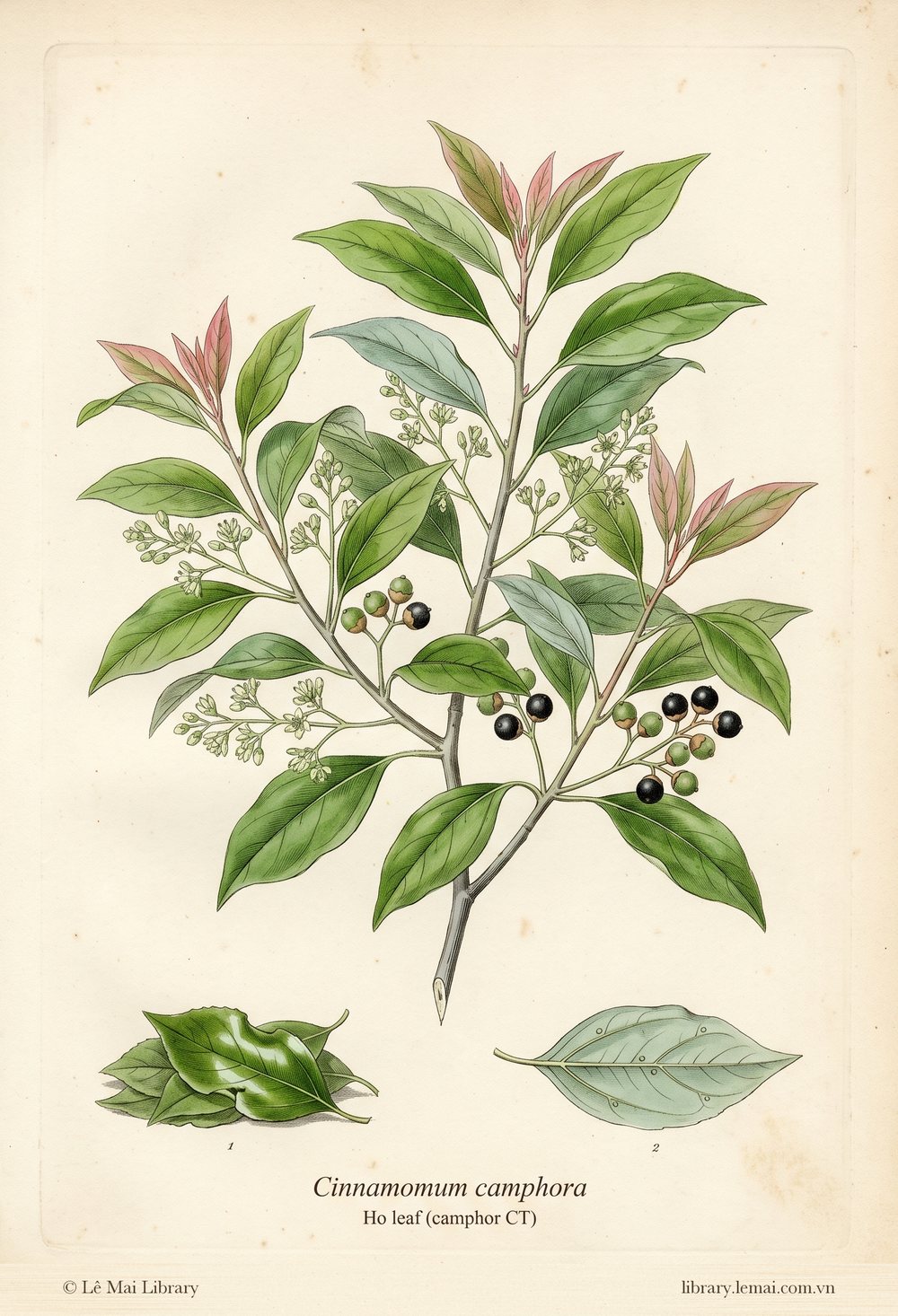
ホー リーフ カンファー CT
Lá cây Ho (CT camphor)
Cinnamomum camphora
Hon-sho, True camphor tree
Tương tác thuốc. Có thể chứa safrole và methyleugenol. Có khả năng độc thần kinh dựa trên hàm lượng camphor cao (42 đến 84 phần trăm).
Chống chỉ định toàn diện: mang thai, cho con bú.
Đường uống: thận trọng với thuốc chuyển hóa qua CYP2E1.
Liều uống tối đa người lớn 28 mg mỗi ngày. Nồng độ tối đa trên da 0.8 phần trăm.
Cơ sở: 5.0 phần trăm safrole và 0.5 phần trăm methyleugenol, với ngưỡng dermal 0.05/0.02 phần trăm và oral 0.025/0.01 mg trên kg trên ngày.
Camphor được cho là độc hơn ở người so với gặm nhấm. LD50 chuột 1.7 g trên kg.
Drug interactions. May contain safrole and methyleugenol. Expected to be neurotoxic based on high camphor content (42 to 84 percent).
Broad contraindications: pregnancy, breastfeeding.
Oral: caution with drugs metabolized by CYP2E1.
Maximum adult oral dose 28 mg daily. Maximum dermal use level 0.8 percent.
Basis: 5.0 percent safrole and 0.5 percent methyleugenol, with dermal limits 0.05/0.02 percent and oral 0.025/0.01 mg per kg per day.
Camphor is thought to be more toxic in humans than rodents. Rat LD50 is 1.7 g per kg.
| Camphor | 42.0 – 84.1 % |
| Linalool | 0.5 – 15.0 % |
| Safrole | 0.1 – 5.0 % |
| Bicyclogermacrene | 0 – 5.0 % |
| α-Caryophyllene | 0.1 – 4.0 % |
| β-Caryophyllene | 0.2 – 3.4 % |
| Spathulenol | 0 – 2.6 % |
| (+)-Limonene | 0 – 2.1 % |
| α-Terpineol | 1.3 – 2.0 % |
| 1,8-Cineole | 1.0 – 1.7 % |
| Methyleugenol | 0 – 0.5 % |
Cinnamomum camphora chemotype 'hon-sho' (true camphor tree), nguồn natural camphor chính. Cây Nhật Bản.
Khác với camphor (brown/white/yellow) là các phân đoạn chưng cất từ crude camphor oil. Ho leaf là tinh dầu trực tiếp từ lá của cùng loài.
Họ Lauraceae.
Cinnamomum camphora 'hon-sho' chemotype (true camphor tree), the main source of natural camphor. Japanese tree.
Distinct from the camphor (brown/white/yellow) fractions distilled from crude camphor oil. Ho leaf is the oil distilled directly from the leaves of the same species.
Family Lauraceae.