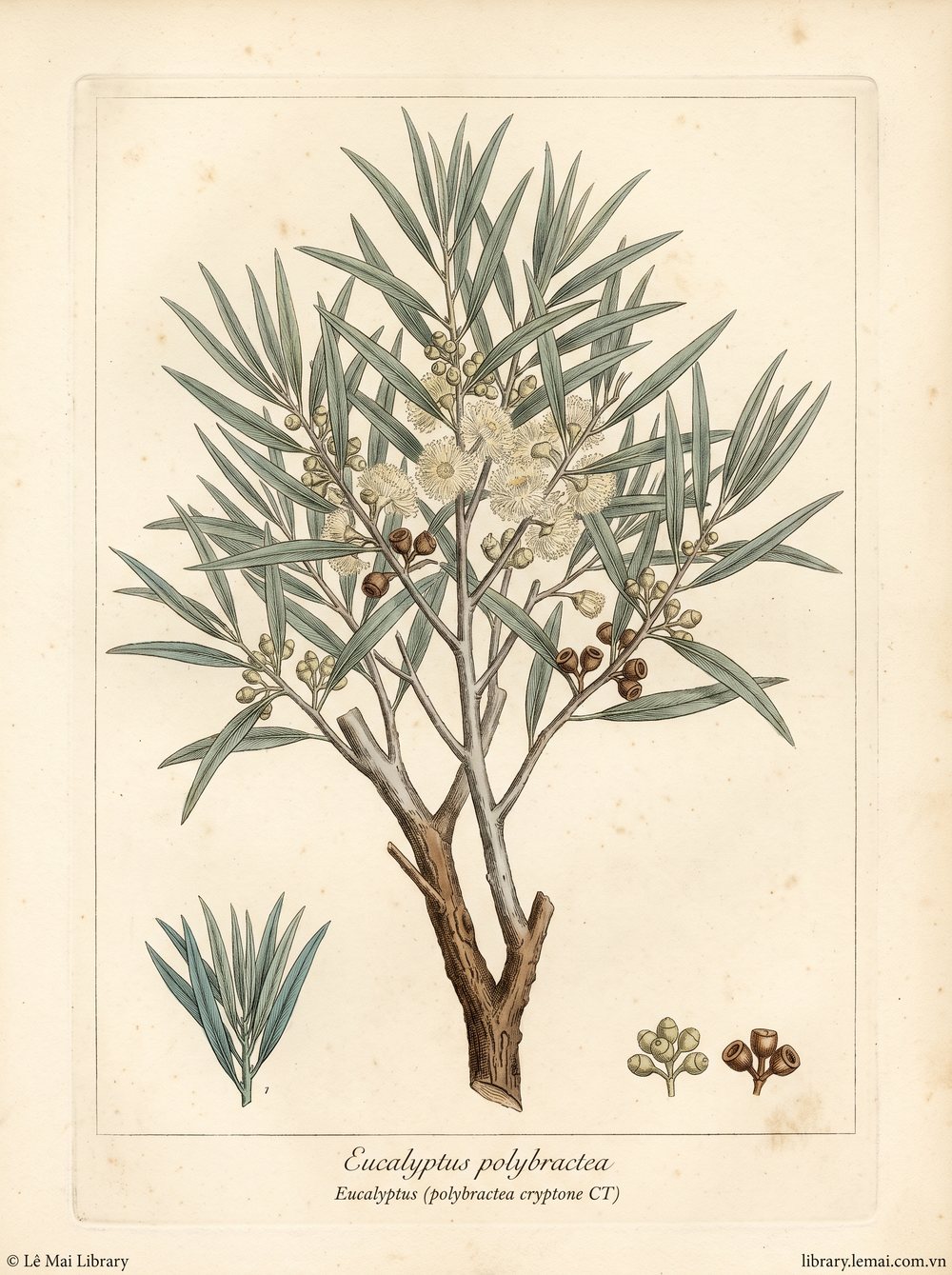
ユーカリ ポリブラクテア クリプトン CT
Bạch đàn polybractea
Eucalyptus polybractea
Blue-leaved mallee (cryptone chemotype)
Không có chống chỉ định cụ thể trong dữ liệu hiện có.
Không có thông tin về phản ứng da hoặc độc tính cấp.
Không chứa carcinogen đã biết.
Chemotype này khác hẳn cineole CT của cùng loài, chỉ 16 phần trăm cineole, thay vào đó có p-cymene, spathulenol, cryptone, phellandral. Không có rủi ro CNS ở trẻ nhỏ như cineole CT.
No specific contraindications in available data.
No information on dermal reactions or acute toxicity.
Contains no known carcinogens.
This chemotype differs markedly from the cineole CT of the same species, only 16 percent cineole, replaced by p-cymene, spathulenol, cryptone, phellandral. No CNS risk in young children unlike the cineole CT.
| p-Cymene | 18.3 % |
| 1,8-Cineole | 16.1 % |
| Spathulenol | 14.3 % |
| Cryptone | 6.3 % |
| Phellandral | 5.7 % |
| α-Phellandrene | 3.6 % |
| Terpinen-4-ol | 3.5 % |
| Cuminaldehyde | 3.3 % |
| (+)-Limonene | 2.1 % |
| (−)-allo-Aromadendrene | 2.0 % |
| α-Pinene | 1.7 % |
| γ-Terpinene | 1.6 % |
| α-Thujene | 1.2 % |
| Carvacrol | 1.1 % |
Cùng cây Eucalyptus polybractea (blue mallee) như chemotype cineole, nhưng chemistry hoàn toàn khác. Chemotype cryptone không có sản xuất commercially significant.
Sản lượng rất giới hạn. Họ Myrtaceae.
Cùng loài có thể có nhiều chemotype trong điều kiện sinh thái khác nhau hoặc do biến thể gen.
Same Eucalyptus polybractea (blue mallee) tree as the cineole chemotype, but with markedly different chemistry. The cryptone chemotype has no commercially significant production.
Very limited availability. Family Myrtaceae.
The same species can express different chemotypes across ecological conditions or via genetic variation.