タイム チモール
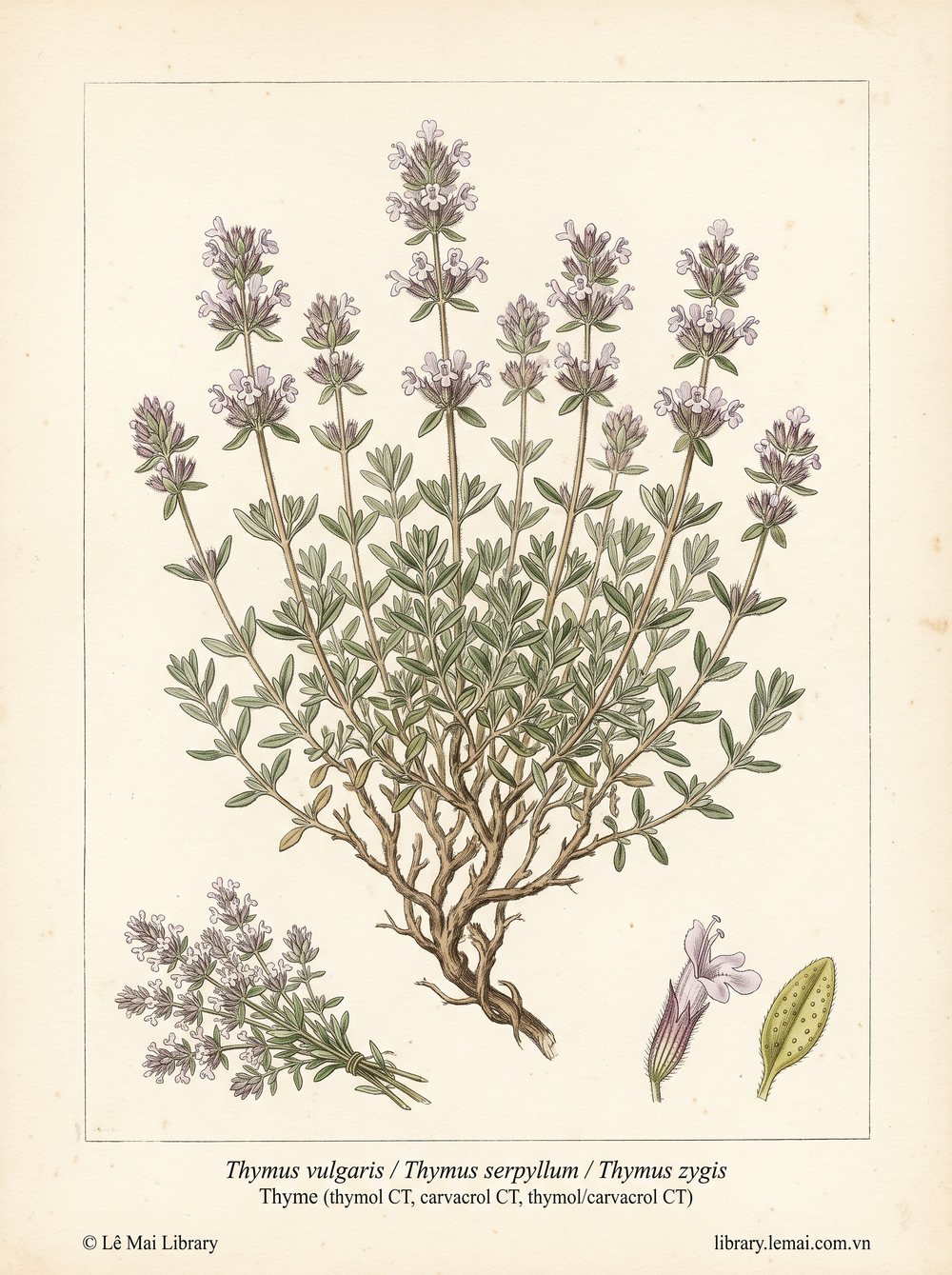
Cỏ xạ hương
Thymus vulgaris / Thymus serpyllum / Thymus zygis
Red thyme, Common thyme
Thymol và/hoặc carvacrol tổng cộng tới 70 phần trăm. Phenol gây kích ứng da và niêm mạc mạnh.
Có thể ức chế kết tập tiểu cầu. Cẩn trọng oral với thuốc chống đông, sau phẫu thuật.
Cảnh báo oral: thuốc tiểu đường.
Khuyến cáo dermal nồng độ thấp. Tránh đường mắt và niêm mạc.
Trong nghiên cứu trên chuột, carvacrol-rich oil (Satureja khuzestanica) 100 mg/kg/ngày trong 21 ngày giảm glucose huyết. Carvacrol và thymol có hoạt tính kháng khuẩn rất mạnh.
Đây là chemotype phổ biến nhất commercial, gọi là 'red thyme' do màu nâu đỏ.
Không khuyến cáo trong thai kỳ và cho con bú do thiếu dữ liệu cụ thể.
Thymol and/or carvacrol together up to 70 percent. Phenol strongly irritates skin and mucous membranes.
May inhibit platelet aggregation. Oral caution with anticoagulants, after surgery.
Oral caution: antidiabetic drugs.
Low dermal concentration recommended. Avoid eyes and mucous membranes.
In rat studies, carvacrol-rich oil (Satureja khuzestanica) at 100 mg/kg/day for 21 days reduced blood glucose. Carvacrol and thymol have very strong antibacterial activity.
This is the most common commercial chemotype, called 'red thyme' from the reddish-brown color.
Not recommended in pregnancy and breastfeeding due to lack of specific data.
| Thymol (thymol CT) | 48.3 – 62.5 % |
| Carvacrol (carvacrol CT) | 30.0 – 65.0 % |
| Thymol + Carvacrol combined | 50.0 – 75.0 % |
| p-Cymene | 10.0 – 28.0 % |
| γ-Terpinene | 3.0 – 18.0 % |
| Linalool | 1.0 – 8.0 % |
| β-Caryophyllene | 1.0 – 6.0 % |
| α-Pinene | 0.5 – 4.0 % |
| Borneol | 0.5 – 4.0 % |
Thymus vulgaris (common thyme), Thymus serpyllum (wild thyme), Thymus zygis (Spanish thyme). Cả ba loài đều cho ra oil phenol-rich tương tự.
Sản xuất chính Tây Ban Nha, Pháp (Provence), Maroc, Italy, Đức.
Thyme là một trong những gia vị cổ điển Địa Trung Hải. Lá khô được dùng cho thịt nướng, súp, sauces. Trong truyền thống ướp xác Ai Cập, thyme là thành phần.
Trong y học truyền thống châu Âu, thyme tincture được dùng cho viêm họng, hô hấp, vệ sinh răng miệng. Listerine từng có thymol làm thành phần chính.
Họ Lamiaceae (Labiatae), cùng họ với oregano, marjoram, rosemary, lavender.
Thymus vulgaris (common thyme), Thymus serpyllum (wild thyme), and Thymus zygis (Spanish thyme). All three species yield similar phenol-rich oils.
Main production: Spain, France (Provence), Morocco, Italy, Germany.
Thyme is one of the classical Mediterranean herbs. Dried leaves are used for grilled meats, soups, and sauces. In Egyptian mummification tradition, thyme was an ingredient.
In European traditional medicine, thyme tincture was used for sore throat, respiratory issues, and oral hygiene. Listerine once had thymol as a main ingredient.
Family Lamiaceae (Labiatae), same family as oregano, marjoram, rosemary, and lavender.
Chemotype xác định bởi điều kiện trồng, chemotype có thể chuyển đổi qua một số thế hệ tự nhiên.
Verify chemotype bằng GC-MS bắt buộc, 'thyme oil' chung chung không đủ. Cần biết chemotype để safety đúng.
Thymol CT là chemotype thông dụng nhất, 'red thyme' commercial. Carvacrol CT giống oregano về chemistry.
Hoạt tính kháng khuẩn của thymol và carvacrol tương đương, mạnh nhất trong các tinh dầu phổ biến.
Chemotype is determined by growing conditions, chemotype can shift through some generations naturally.
Verify chemotype by GC-MS, generic 'thyme oil' is not enough. The chemotype is needed for correct safety.
Thymol CT is the most common chemotype, commercial 'red thyme'. Carvacrol CT is similar to oregano in chemistry.
Antibacterial activity of thymol and carvacrol is comparable, among the strongest in common essential oils.
Hoạt tính kháng khuẩn cực mạnh, hiệu quả với S. aureus (MRSA), Streptococcus, E. coli, Candida. Carvacrol và thymol là benchmark trong nghiên cứu kháng khuẩn essential oil.
Trong cosmetic, thymol CT dùng nồng độ thấp trong sản phẩm trị mụn, kem chống nấm móng tay, mouth wash. Quá nồng gây kích ứng nghiêm trọng.
Trong y học, thymol vẫn được dùng làm preservative trong vaccine, kem đánh răng. Carvacrol đang được nghiên cứu cho biofilm S. aureus.
Đối với Lê Mai brand, thymol CT phù hợp cho wash-off products (soap, shampoo) ở nồng độ thấp. Không khuyến cáo leave-on nồng độ cao.
Extremely strong antibacterial activity, effective against S. aureus (MRSA), Streptococcus, E. coli, Candida. Carvacrol and thymol are benchmarks in essential oil antibacterial research.
In cosmetics, thymol CT is used at low concentrations in acne products, antifungal nail creams, and mouth wash. Excessive levels cause severe irritation.
In medicine, thymol is still used as a preservative in vaccines and toothpaste. Carvacrol is being studied for S. aureus biofilms.
For the Lê Mai brand, thymol CT is suited to wash-off products (soap, shampoo) at low concentrations. Not recommended in high-concentration leave-on products.