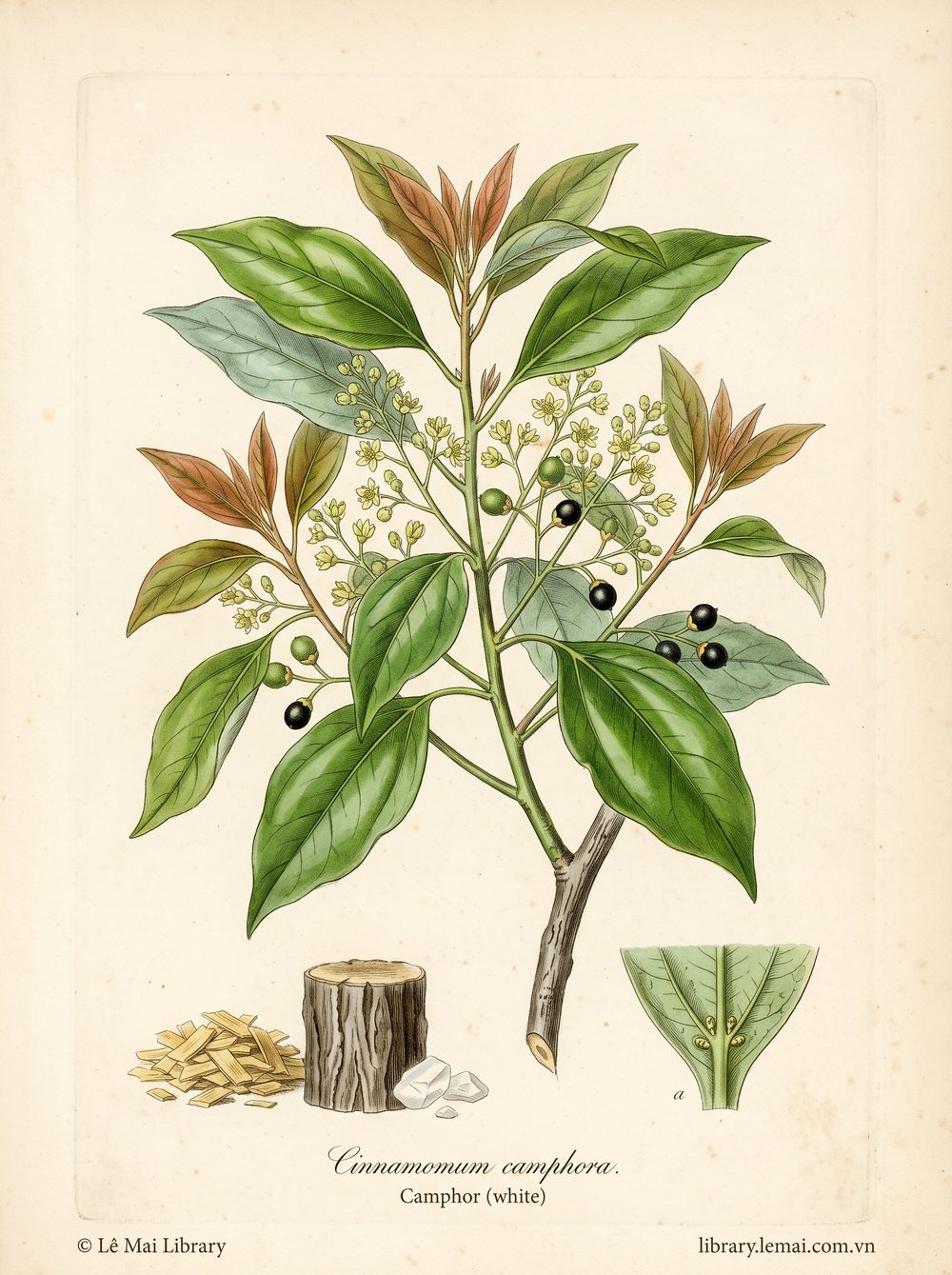
ホワイトカンファー
Long não trắng
Cinnamomum camphora
Hon-sho, True camphor, Laurus camphora
Sản phẩm oxy hóa của (+)-limonene và α-pinene có thể gây nhạy ứng da.
1,8-Cineole có tính chống oxy hóa, làm giảm rủi ro.
Bảo quản chai tối, kín, lạnh. Thêm chất chống oxy hóa cho công thức.
Hàm lượng safrole trong white camphor chỉ ở mức vết, không đủ gây lo ngại carcinogen.
Khả năng không nguy hiểm cho thai kỳ dựa trên dữ liệu các thành tố chính.
Oxidation products of (+)-limonene and α-pinene may sensitize skin.
1,8-Cineole has antioxidant properties, reducing this risk.
Store in dark, sealed, refrigerated container. Add an antioxidant to formulations.
Safrole content in white camphor is only trace, insufficient for carcinogen concern.
Likely not hazardous in pregnancy based on data for the major constituents.
| (+)-Limonene | 44.2 % |
| p-Cymene | 24.2 % |
| α-Pinene | 8.9 % |
| 1,8-Cineole | 6.5 % |
| Sabinene | 4.2 % |
| β-Pinene | 4.0 % |
| Camphene | 3.0 % |
| Camphor | 2.4 % |
| Safrole | tr |
Camphor là tên của cây, tên của tinh dầu, và tên của một thành tố hóa học có trong dầu này và một số dầu khác.
Chất tiết thô từ cây chứa khoảng 50 phần trăm camphor. Dầu camphor được chia thành bốn phân đoạn bằng chưng cất phân đoạn, sau khi tinh thể camphor thô được lọc ra: white (phân đoạn nhẹ), brown (trung bình), yellow (trung bình khác), blue (nặng).
Do quá trình phân đoạn này, không phân đoạn nào có thể được xếp loại là tinh dầu thực sự theo nghĩa nghiêm ngặt. White camphor, phân đoạn dùng phổ biến nhất trong trị liệu, chứa rất ít camphor.
Camphor is the name of the tree, the name of its essential oil, and the name of a chemical constituent found in this and other oils.
The crude exudate contains approximately 50 percent camphor. The oil is separated into four fractions by fractional distillation, after the crude camphor crystals are filtered out: white (a light fraction), brown (medium), yellow (another medium), blue (heavy).
Due to this fractionation process, none of these can be classed strictly as a true essential oil. White camphor, the most widely used therapeutically, contains very little camphor.
White camphor oil không bị làm giả.
White camphor oil is not subject to adulteration.
Cây camphor có năm chemotype: borneol, nerolidol, camphor, 1,8-cineole và linalool. Chỉ ba chemotype cuối có sẵn thương mại. Tinh dầu từ lá của các chemotype này được gọi là ho leaf oil.
The camphor plant exists in five chemotypes: borneol, nerolidol, camphor, 1,8-cineole and linalool. Only the last three are commercially available. Oils from the leaves of these are known as ho leaf oils.