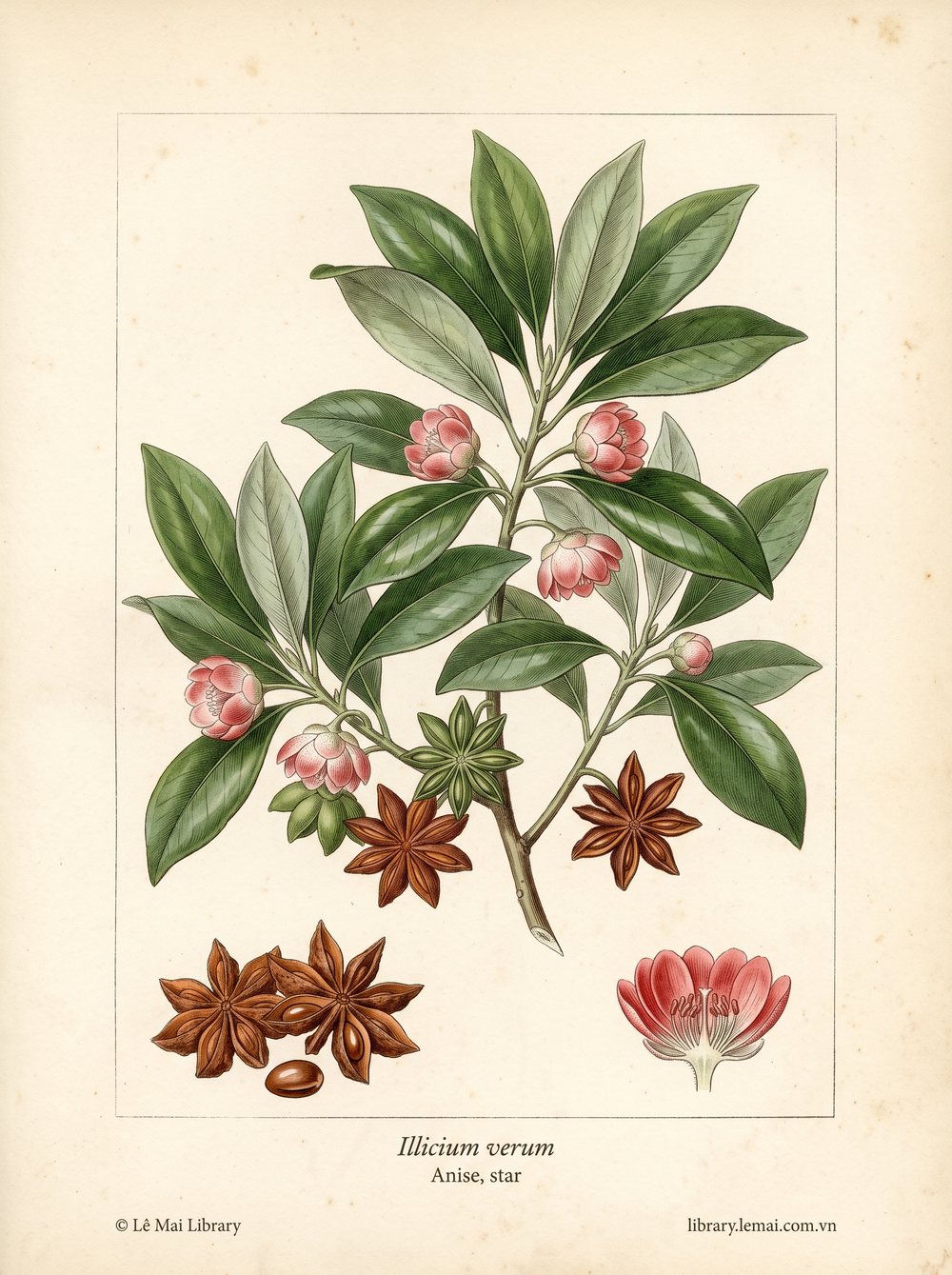
スターアニス
Hoa hồi, Đại hồi
Illicium verum
Chinese star anise, Badian
Có khả năng gây ung thư dựa trên hàm lượng estragole và safrole.
Có hoạt tính estrogen — điều biến hormone sinh sản.
Có thể ức chế đông máu.
Có nhiều ca ngộ độc thần kinh ở trẻ sơ sinh do trà star anise. Tuy nhiên nguyên nhân là sesquiterpene lactone KHÔNG có trong tinh dầu — thường do nhiễm các loài Illicium khác độc hơn (như Japanese star anise Illicium anisatum).
Chống chỉ định mọi đường dùng: mang thai, cho con bú, lạc nội mạc tử cung, ung thư phụ thuộc estrogen, trẻ em dưới 5 tuổi.
Tránh dầu cũ hoặc đã oxi hóa.
Potentially carcinogenic based on estragole and safrole content.
Estrogenic activity — modulates reproductive hormones.
May inhibit blood clotting.
Several cases of infant neurotoxicity from star anise tea have been recorded. However the cause is sesquiterpene lactones NOT present in the essential oil — often due to contamination by other Illicium species (such as Japanese star anise Illicium anisatum).
Contraindicated all routes: pregnancy, breastfeeding, endometriosis, estrogen-dependent cancers, children under 5 years.
Avoid old or oxidized oils.
| (E)-Anethole | 71.2 – 91.8 % |
| Foeniculin | 0.5 – 14.6 % |
| Estragole | 0.3 – 6.6 % |
| Limonene | 0.7 – 5.0 % |
| Linalool | 0.4 – 2.3 % |
| α-Pinene | tr – 2.1 % |
| β-Caryophyllene | 0.5 – 2.0 % |
| Safrole | 0 – 0.1 % |
| (Z)-Anethole | tr – 0.4 % |
Illicium verum là cây thân gỗ nhỏ, họ Illiciaceae, gốc Đông Nam Trung Quốc và Đông Bắc Việt Nam.
Quả có hình ngôi sao 8 cánh đặc trưng. Sấy khô và chưng cất hơi để lấy tinh dầu.
Sản xuất chủ yếu tại Trung Quốc và Việt Nam. Là gia vị quan trọng trong ẩm thực châu Á (phở, bánh canh) và là nguồn shikimic acid để sản xuất Tamiflu.
Illicium verum is a small evergreen tree in the Illiciaceae family, native to southeast China and northeast Vietnam.
Fruits have a distinctive eight-pointed star shape. Dried and steam-distilled for the oil.
Mainly produced in China and Vietnam. Important spice in Asian cuisine (phở, soups) and source of shikimic acid for Tamiflu production.
Star anise oil thường bị giả mạo bằng technical anethole — chứa nồng độ tương đối cao (Z)-anethole, là chất độc hơn so với (E)-anethole.
Cần cảnh giác đặc biệt do rủi ro pha trộn cộng với hàm lượng estragole và safrole tự nhiên.
Star anise oil is commonly adulterated with technical anethole — containing relatively high (Z)-anethole, which is more toxic than (E)-anethole.
Particular vigilance needed due to adulteration risk combined with natural estragole and safrole content.
Commission E (Đức) đề xuất 'liều trung bình hàng ngày' 300 mg tinh dầu star anise — cho rằng đây là liều KHÔNG an toàn.
(E)-Anethole bản thân không gây ung thư trên loài gặm nhấm. Vấn đề là estragole và safrole.
Nhật Bản dùng Illicium anisatum (Japanese star anise) làm hương cúng tế — loài này CỰC ĐỘC, không được nhầm với Illicium verum.
Commission E (Germany) monograph proposes 'average daily dose' of 300 mg star anise oil — this is considered UNSAFE.
(E)-Anethole itself is not carcinogenic in rodents. The concerns are estragole and safrole.
Japan uses Illicium anisatum (Japanese star anise) for incense — this species is HIGHLY TOXIC, must not be confused with Illicium verum.