Estragole
4-Methoxy-1-(2-propenyl)benzene
O-Methyl chavicol · 4-Allyl anisole · 4-Methoxyallylbenzene
化学組成 · Constituent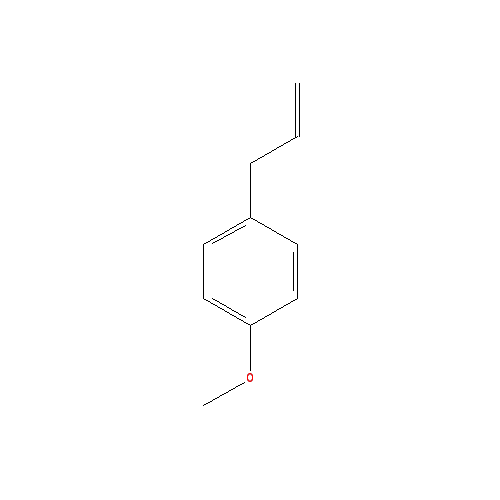
4-Methoxy-1-(2-propenyl)benzene
O-Methyl chavicol · 4-Allyl anisole · 4-Methoxyallylbenzene
化学組成 · Constituent
Estragole là cấu tử chủ đạo trong tinh dầu ngải dấm, húng quế chemotype estragole và ravensara bark. Hợp chất là chất gây ung thư gan ở chuột nhắt và chuột đực thông qua chất chuyển hoá 1'-hydroxyestragole và sulfate ester của nó.
Trên da. Patch test ở 3 phần trăm trên 25 tình nguyện viên không gây kích ứng cũng không gây mẫn cảm. Bôi nguyên chất trên da thỏ gây kích ứng trung bình.
Đường uống. LD50 cấp tính trên chuột nhắt 1.25 g/kg, trên chuột 1.82 g/kg. Liều rất cao gây ức chế thần kinh trung ương.
Mạn tính. Nghiên cứu 90 ngày liều 37.5 đến 600 mg/kg/ngày trên chuột và chuột nhắt cho thấy tác động độc tính chính ở gan và ống mật. Ở 300 và 600 mg/kg, tất cả chuột đực đều có thoái hoá lưỡng bên biểu mô tinh hoàn, gợi ý độc sinh sản nam ở liều cao.
Mạch máu. Estragole ức chế kết tập tiểu cầu mạnh in vitro, hiệu quả ngang aspirin.
Đột biến gen và ung thư. Gây ung thư gan ở chuột nhắt đực và cái cùng chuột đực qua kích hoạt sinh học thành 1'-hydroxyestragole. Lộ trình giải độc qua O-demethylation hiệu quả ở liều thấp, nhưng bị bão hoà ở liều cao.
Estragole is the dominant constituent in tarragon, estragole-CT basil and ravensara bark oils. The compound is a hepatocarcinogen in mice and male rats via the metabolites 1'-hydroxyestragole and its sulfate ester.
Skin. A 3 percent patch test on 25 volunteers produced neither irritation nor sensitization. Applied undiluted to rabbit skin, it was moderately irritating.
Oral. Acute oral LD50 in mice is 1.25 g/kg, in rats 1.82 g/kg. Very high doses induce CNS depression.
Subchronic. A 90-day study at 37.5 to 600 mg/kg/day in rats and mice showed primary toxicity in liver and bile duct. At 300 and 600 mg/kg, all male rats showed bilateral degeneration of testicular germinal epithelium, suggesting male reproductive toxicity at high doses.
Cardiovascular. Estragole shows strong antiplatelet aggregation activity in vitro, reportedly as effective as aspirin.
Mutagenicity and cancer. Estragole is hepatocarcinogenic in male and female mice and in male rats through bioactivation to 1'-hydroxyestragole. The detoxification pathway via O-demethylation is efficient at low doses but is saturated at high doses.
| Ravensara (vỏ) · Ravensara bark | 90.0 – 95.0 % |
| Ngải giấm · Tarragon | 73.3 – 87.3 % |
| Húng quế · Basil (estragole CT) | 73.4 – 87.4 % |
| Vạn thọ Mexico · Marigold (Mexican) | 84.7 % |
| Ngò Pháp · Chervil | 49.9 – 81.3 % |
| Húng quế Madagascar · Basil (Madagascan) | 45.0 – 50.0 % |
| Thông Ponderosa · Pine (ponderosa) | 22.0 % |
| Húng quế thiêng · Basil (holy) | 9.7 – 12.9 % |
| Ravensara (lá) · Ravensara leaf | 2.4 – 11.9 % |
| Hoa hồi · Anise (star) | 0.3 – 6.6 % |
| Thì là đắng · Fennel (bitter) | 2.8 – 6.5 % |
| Thì là ngọt · Fennel (sweet) | 1.1 – 4.8 % |
| Trầu (lá) · Betel | 0 – 4.8 % |
| Sim hồi · Myrtle (aniseed) | 4.4 % |
| Hồi · Anise | 0.3 – 4.0 % |
| Húng quế · Basil (linalool CT) | 0.2 – 2.0 % |
| Cây sim · Myrtle | 0 – 1.4 % |
| Húng quế rậm lông · Basil (hairy) | 0.3 – 0.4 % |
| Tràm trà đen · Tea tree (black) | 0.3 % |
| Húng quế cay · Basil (pungent) | 0.2 % |
| Nguyệt quế Tây Ấn · Bay (West Indian) | tr – 0.1 % |
Sau uống trên chuột, estragole được O-demethyl rộng rãi thành chavicol, phần lớn được bài tiết nguyên dạng. Các con đường khác bao gồm oxi hoá chuỗi bên (qua CYP) để cho 1'-hydroxyestragole và epoxide 2',3', là các chất chuyển hoá tiềm năng gây độc gen.
Ở liều thấp, epoxidation là con đường phụ. Ở liều cao trong chuột cái, dòng chuyển hoá dịch chuyển sang epoxidation, sinh ra nhiều epoxide hơn và giải thích độc tính gan cao hơn. Sulfonation thành 1'-sulfooxyestragole hiệu quả hơn 30 lần ở gan chuột so với gan người, gợi ý biên an toàn rộng cho con người.
Sự khác biệt cá nhân trong các isoform UGT2B7, UGT1A9 và UGT2B15 có thể làm một số người có rủi ro cao hơn so với người khác.
After oral administration in rats, estragole is extensively O-demethylated to chavicol, most of which is excreted unchanged. Other pathways involve oxidation of the allylic side chain by CYP to give 1'-hydroxyestragole and the 2',3'-epoxide, both potentially genotoxic metabolites.
At low doses, epoxidation is minor. At high doses in female rats the metabolic flux shifts toward epoxidation, producing more epoxide and explaining the higher hepatotoxicity. Sulfonation to 1'-sulfooxyestragole is about 30 times more efficient in rat liver than in human liver, suggesting a wide margin of safety in humans.
Individual differences in the isoforms UGT2B7, UGT1A9 and UGT2B15 may make some individuals more at risk than others.
Estragole có cấu trúc gần với safrole và methyleugenol, hai hợp chất cũng có rủi ro ung thư gan. Trong tinh dầu hồi sao và thì là, estragole xuất hiện cùng (E)-anethole với hồ sơ an toàn khác biệt rõ rệt.
Hợp chất ức chế kết tập tiểu cầu, vì vậy tinh dầu chứa nhiều estragole đường uống cần thận trọng khi dùng cùng thuốc chống đông, trước phẫu thuật lớn, sinh đẻ, loét tiêu hoá hoặc các rối loạn chảy máu khác.
Estragole is structurally close to safrole and methyleugenol, two compounds also with hepatocarcinogenic risk. In star anise and fennel oils, estragole appears alongside (E)-anethole, with markedly different safety profiles between the two.
The compound inhibits platelet aggregation, so oral use of estragole-rich oils warrants caution alongside anticoagulant therapy, before major surgery, childbirth, peptic ulcer or other bleeding disorders.