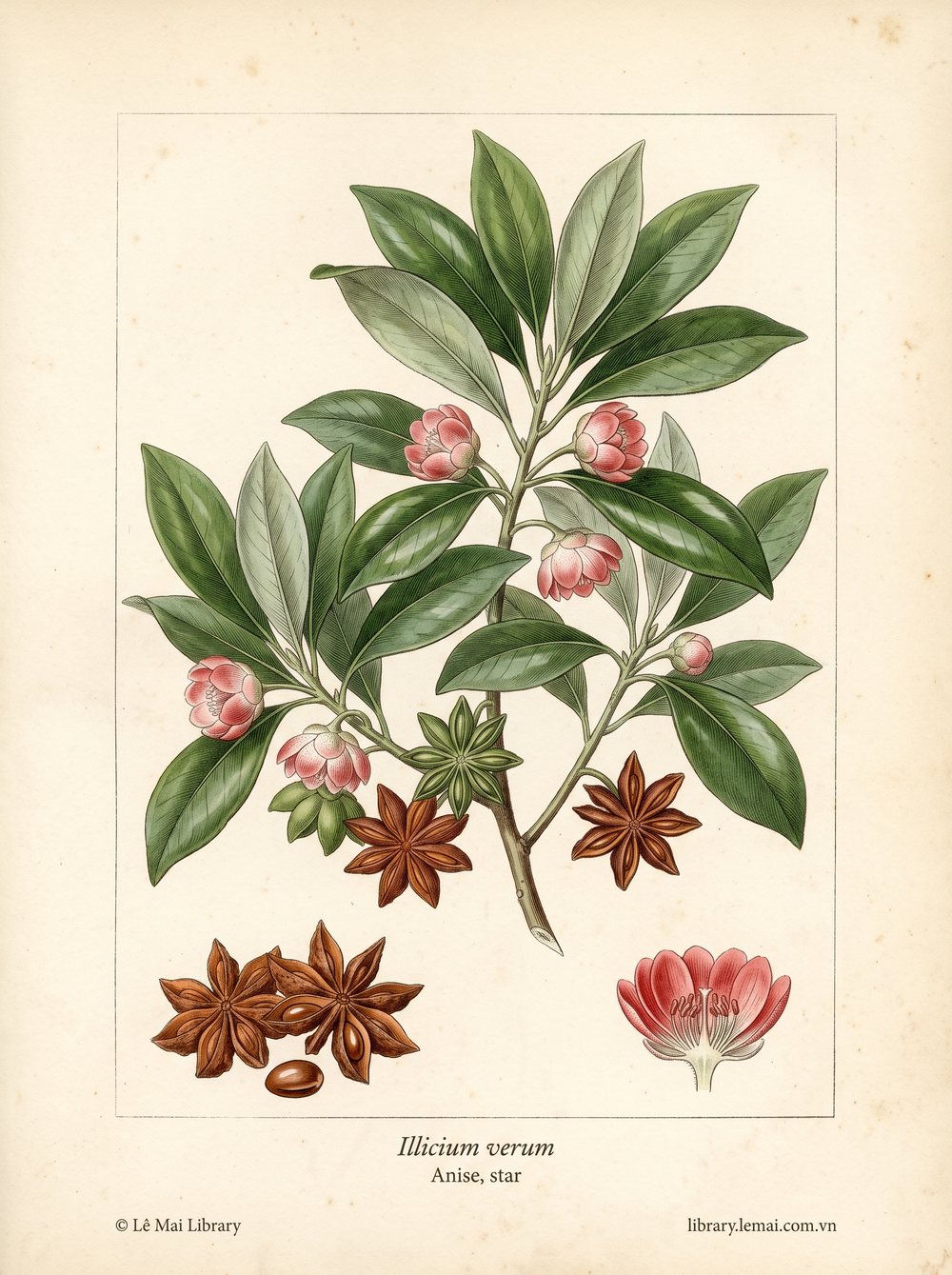
スターアニス
Hoa hồi, Đại hồi
Illicium verum
Chinese star anise, Badian
Potentially carcinogenic based on estragole and safrole content.
Estrogenic activity — modulates reproductive hormones.
May inhibit blood clotting.
Several cases of infant neurotoxicity from star anise tea have been recorded. However the cause is sesquiterpene lactones NOT present in the essential oil — often due to contamination by other Illicium species (such as Japanese star anise Illicium anisatum).
Contraindicated all routes: pregnancy, breastfeeding, endometriosis, estrogen-dependent cancers, children under 5 years.
Avoid old or oxidized oils.
| (E)-Anethole | 71.2 – 91.8 % |
| Foeniculin | 0.5 – 14.6 % |
| Estragole | 0.3 – 6.6 % |
| Limonene | 0.7 – 5.0 % |
| Linalool | 0.4 – 2.3 % |
| α-Pinene | tr – 2.1 % |
| β-Caryophyllene | 0.5 – 2.0 % |
| Safrole | 0 – 0.1 % |
| (Z)-Anethole | tr – 0.4 % |
Illicium verum is a small evergreen tree in the Illiciaceae family, native to southeast China and northeast Vietnam.
Fruits have a distinctive eight-pointed star shape. Dried and steam-distilled for the oil.
Mainly produced in China and Vietnam. Important spice in Asian cuisine (pho, soups) and source of shikimic acid for Tamiflu production.
Star anise oil is commonly adulterated with technical anethole — containing relatively high (Z)-anethole, which is more toxic than (E)-anethole.
Particular vigilance needed due to adulteration risk combined with natural estragole and safrole content.
Commission E (Germany) monograph proposes 'average daily dose' of 300 mg star anise oil — this is considered UNSAFE.
(E)-Anethole itself is not carcinogenic in rodents. The concerns are estragole and safrole.
Japan uses Illicium anisatum (Japanese star anise) for incense — this species is HIGHLY TOXIC, must not be confused with Illicium verum.