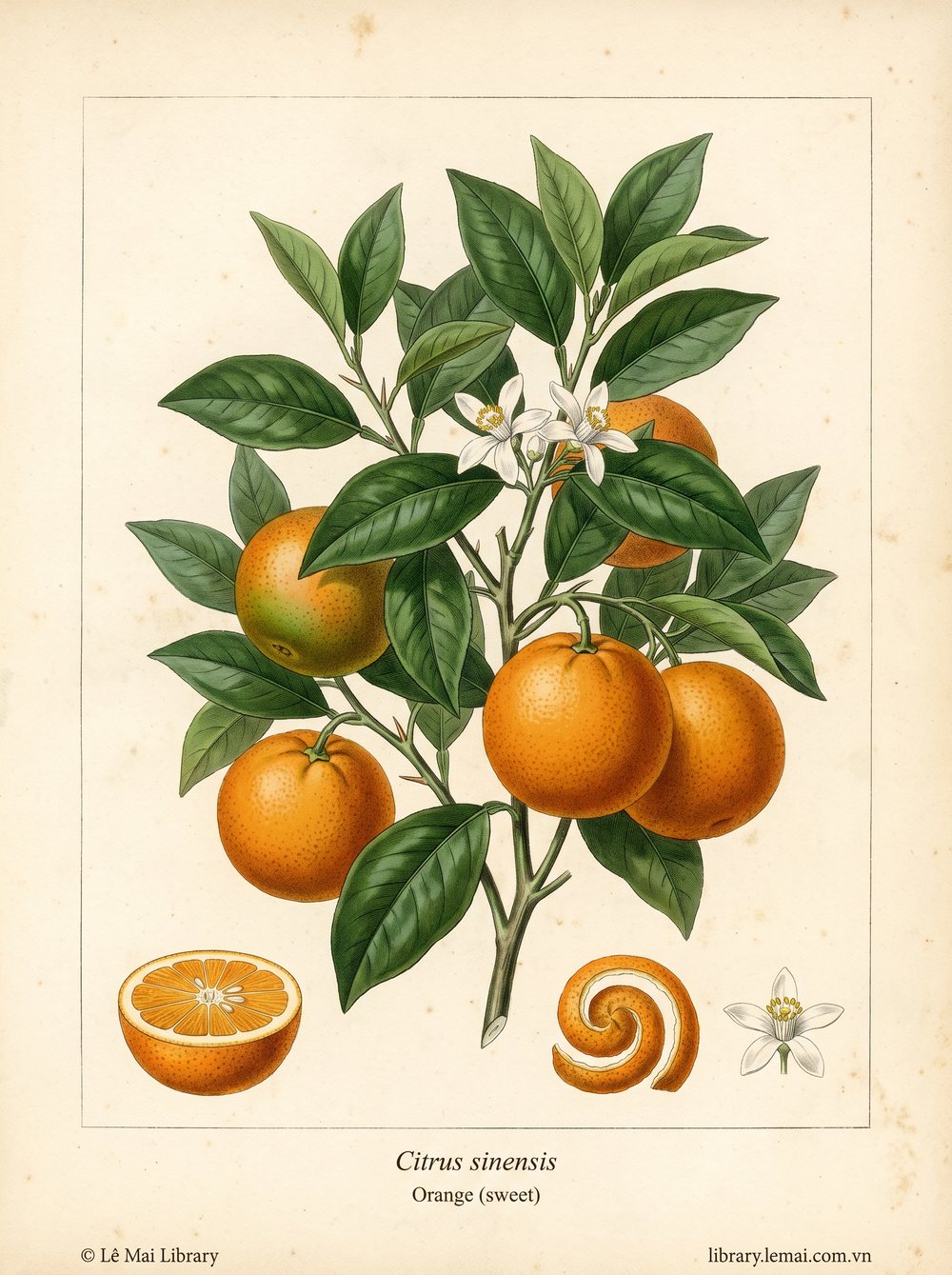
スイートオレンジ
Cam ngọt
Citrus sinensis
Citrus aurantium var. sinensis
Sweet orange oil không phototoxic, khác với bitter orange và các citrus phototoxic khác như bergamot, lemon expressed, lime expressed. Không phát hiện bergapten trong 5 mẫu Citrus sinensis từ các nguồn khác nhau.
Được xếp loại GRAS bởi FDA Hoa Kỳ.
Khả năng kích ứng và nhạy ứng da rất thấp. Ở nồng độ 8 phần trăm và 100 phần trăm thử trên 25 người tình nguyện: không kích ứng. Ở 8 phần trăm: không nhạy ứng. Trong 100 bệnh nhân viêm da tiếp xúc thử với 5 phần trăm Brazilian orange oil: không phản ứng.
Sản phẩm oxy hóa của (+)-limonene (chiếm trên 90 phần trăm) có thể gây nhạy ứng da. Bảo quản chai tối, kín, lạnh, thêm chất chống oxy hóa khi formulation bắt buộc.
Không có dữ liệu cho thấy nguy hiểm trong thai kỳ. Được xem là một trong những tinh dầu an toàn nhất cho phụ nữ mang thai và trẻ em.
Trong nghiên cứu in vitro, sweet orange oil cùng với citral, octanal, decanal gây apoptosis tế bào ung thư bạch cầu HL-60.
Sweet orange oil is not phototoxic, unlike bitter orange and other phototoxic citrus oils such as bergamot, expressed lemon, and expressed lime. No bergapten was detected in 5 samples of Citrus sinensis from different sources.
Classified as GRAS by the US FDA.
Very low skin irritation and sensitization risk. At 8 percent and 100 percent tested on 25 volunteers: not irritating. At 8 percent: not sensitizing. In 100 contact dermatitis patients tested with 5 percent Brazilian orange oil: no reactions.
(+)-Limonene oxidation products (over 90 percent of the oil) may sensitize skin. Store in dark, sealed, refrigerated container; antioxidant addition mandatory during formulation.
No data indicates hazard in pregnancy. Considered among the safest oils for pregnant women and children.
In vitro, sweet orange oil along with citral, octanal, and decanal induces apoptosis of HL-60 leukemia cells.
| (+)-Limonene (American) | 93.2 – 94.9 % |
| (+)-Limonene (Brazilian) | 86.1 – 93.4 % |
| (+)-Limonene (Italian) | 93.7 – 95.9 % |
| (+)-Limonene (Spanish) | 95.6 % |
| (+)-Limonene (Chinese) | 83.9 % |
| β-Myrcene | 0.9 – 3.3 % |
| α-Pinene | 0.6 – 1.0 % |
| Linalool (Chinese CT) | 5.6 % |
| Geranial (Chinese CT) | 1.8 % |
| Neral (Chinese CT) | 1.3 % |
| Sabinene | 0.2 – 1.0 % |
| β-Bisabolene | 0 – 1.5 % |
Citrus sinensis là cây cam ngọt, có nguồn gốc Trung Quốc và Đông Nam Á, được trồng rộng rãi khắp vùng nhiệt đới và cận nhiệt đới.
Tinh dầu ép từ vỏ quả tươi. Là tinh dầu được sản xuất nhiều nhất thế giới về khối lượng, phần lớn là byproduct của ngành nước cam.
Sản xuất chính: Brazil (lớn nhất, chiếm hơn 50 phần trăm), Hoa Kỳ (Florida, California), Tây Ban Nha, Italy, Trung Quốc. Mỗi vùng cho profile mùi hơi khác.
Việt Nam trồng cam ngọt khắp các vùng, Hà Giang, Hà Tĩnh, Bến Tre, Đồng Tháp. Tiềm năng phát triển ngành tinh dầu sweet orange từ byproduct ép cam.
Cam huyết (blood orange), Citrus sinensis cv. Sanguinelli và cv. Moro, là một dòng của sweet orange. Tinh dầu blood orange có mùi giống sweet orange nhưng nồng và sâu hơn nhờ anthocyanin trong vỏ.
Họ Rutaceae, cùng họ với bergamot, lemon, mandarin, lime, grapefruit.
Citrus sinensis is the sweet orange tree, originating from China and Southeast Asia, widely cultivated throughout the tropics and subtropics.
The essential oil is expressed from fresh peel. It is the most-produced essential oil in the world by volume, largely a byproduct of the orange juice industry.
Main production: Brazil (largest, over 50 percent), USA (Florida, California), Spain, Italy, China. Each region produces a slightly different aromatic profile.
Vietnam grows sweet orange across many regions, Hà Giang, Hà Tĩnh, Bến Tre, Đồng Tháp. Potential to develop a domestic sweet orange essential oil industry from juice-extraction byproducts.
Blood orange, Citrus sinensis cv. Sanguinelli and cv. Moro, is a variety of sweet orange. Blood orange oil has a similar aroma to sweet orange but deeper, owing to anthocyanin pigments in the peel.
Family Rutaceae, same family as bergamot, lemon, mandarin, lime, and grapefruit.
Sweet orange oil thường không bị làm giả nhiều do giá rẻ. Tuy nhiên có thể bị trộn với synthetic limonene hoặc hỗn hợp terpene hydrocarbon.
Các nguồn khác nhau cho profile khác nhau: Brazilian có (+)-limonene 86-93%, sản lượng lớn nhất nhưng chemistry biến thiên cao. Italian (Sicilian) có (+)-limonene 94-96% và mùi sạch hơn. Chinese có linalool và citral cao hơn các nguồn khác, profile khác biệt đáng chú ý.
Verify chất lượng bằng GC-MS. Linalool và citral cao là dấu hiệu của Chinese sweet orange (đôi khi cũng có thể là adulteration với cheap citrus byproducts).
Cold-pressed sweet orange tươi có mùi tươi mới, nồng nàn. Oil cũ và oxy hóa có mùi nhựa, gắt, không phù hợp cho cosmetic premium.
Sweet orange oil is not heavily adulterated due to its low price. However it may be mixed with synthetic limonene or terpene hydrocarbon blends.
Different sources have different profiles: Brazilian has (+)-limonene 86-93%, the largest volume but variable chemistry. Italian (Sicilian) has (+)-limonene 94-96% and a cleaner aroma. Chinese has higher linalool and citral than other sources, a notably different profile.
Verify quality by GC-MS. High linalool and citral are markers of Chinese sweet orange (sometimes also adulteration with cheap citrus byproducts).
Fresh cold-pressed sweet orange has a bright, intense aroma. Aged and oxidized oil takes on a resinous, sharp note, unsuited to premium cosmetics.
| Colonia | Acqua di Parma · 1916 · nốt đầu top |
| Eau d'orange verte | Hermès · 1979 · nốt chính main note |
| Orange Sanguine | Atelier Cologne · 2010 · nốt đầu top |
| Néroli Sauvage | Creed · nốt đầu top |
| 4711 Echt Kölnisch Wasser | 4711 · 1799 · nốt đầu top |
Theo danh sách nốt hương do nhà sản xuất công bố. Tên nước hoa và thương hiệu thuộc chủ sở hữu tương ứng.Based on note lists published by each house. Fragrance names and marks belong to their owners.
Hoạt tính chống oxy hóa và chống ung thư đáng kể trong nghiên cứu in vitro, (+)-limonene là một trong những hợp chất chống ung thư được nghiên cứu rộng rãi nhất.
Trong perfumery, sweet orange là note đầu (top note) cho tươi mát. Trong food và beverage flavoring, sweet orange chiếm phần lớn sản lượng.
Trong cosmetic, sweet orange là một trong những citrus oils phù hợp nhất cho leave-on products vì không phototoxic. Có thể dùng trong kem chống nắng, body lotion, perfume không lo ngại tác dụng phụ.
Trong aromatherapy, sweet orange được xem là một trong những tinh dầu 'nâng tâm trạng' (mood-lifting) phổ biến nhất, mùi quen thuộc, tươi mát, ấm áp.
Sweet orange oil là tinh dầu rẻ nhất trong các tinh dầu phổ biến, phù hợp cho sản phẩm volume cao, soap, candle. Tỷ giá Bergamot trên Sweet orange có thể tới 1:20.
Notable in vitro antioxidant and anticarcinogenic activity, (+)-limonene is among the most extensively studied anticancer natural compounds.
In perfumery, sweet orange is a top note for fresh brightness. In food and beverage flavoring, sweet orange dominates production volume.
In cosmetics, sweet orange is among the most suitable citrus oils for leave-on products thanks to its non-phototoxic profile. Can be used in sunscreens, body lotions, and perfume without concern for adverse effects.
In aromatherapy, sweet orange is considered one of the most popular 'mood-lifting' oils, familiar, fresh, and warm.
Sweet orange oil is the cheapest among common essential oils, suited to high-volume products, soap, and candles. Bergamot-to-sweet-orange price ratio can reach 1:20.