α-Pinene
2,6,6-Trimethylbicyclo[3.1.1]hept-2-ene
2-Pinene · Australene
化学組成 · Constituent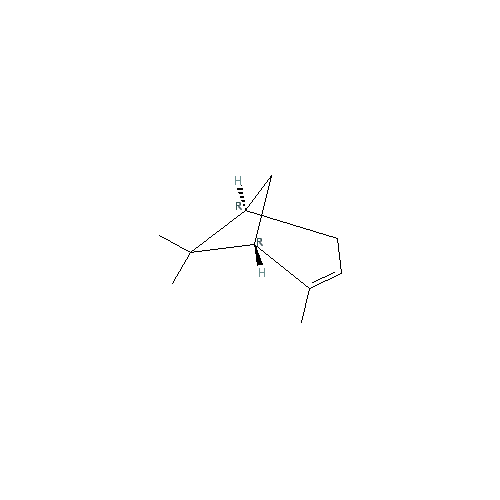
2,6,6-Trimethylbicyclo[3.1.1]hept-2-ene
2-Pinene · Australene
化学組成 · Constituent
α-Pinene occurs in over 400 essential oils and is one of the most widespread monoterpenes. Fresh material poses low risk. Oxidized material forms peroxides that can cause contact dermatitis.
Skin. Patch testing 1,200 dermatitis patients with 5 percent unoxidized α-pinene produced no irritant or allergic reactions. Patch testing at 70 to 80 percent caused irritation in most patients. Oxidized material caused dermatitis in proportion to peroxide content.
Respiratory. Sawmill workers exposed to terpene aerosols showed slightly reduced lung function. α-Pinene vapor irritates eyes, nose and lungs, and affects the central nervous system.
Oral. Acute oral LD50 in rats was 2.1 to 3.7 g/kg. Acute dermal LD50 in rabbits was below 5 g/kg.
Reproductive. Pregnant rats given gavage doses of 3 to 260 mg/kg/day on gestational days 6 to 15 showed no adverse effects at any dose.
Mutagenicity and cancer. Not mutagenic in the Ames test. Did not significantly increase or reduce tumor numbers in a DMBA-induced rat mammary carcinogenesis model. Shows strong antimutagenic activity through PROD inhibition.
Liver. α-Pinene is porphyrigenic and so particularly hazardous to those with defects in hepatic heme synthesis.
After intravenous administration of 0.6 g/kg to humans, about 45 percent of α-pinene was excreted in expired air within two hours. In rabbits, the compound undergoes hydroxylation and glucuronic acid conjugation, with verbenol as a major urinary metabolite.
In humans inhaling α-pinene, 1 to 4 percent was excreted as (Z)- and (E)-verbenol, most within 20 hours after a two-hour exposure. Renal excretion of unchanged α-pinene was below 0.001 percent.
In a case of attempted suicide with pine oil containing 57 percent α-pinene, the major urinary metabolite was bornyl acetate.
North American pine oils usually contain mainly (+)-α-pinene, while European pine oils generally have more (-)-α-pinene.
The principal degradation product of α-pinene reacting with hydroxyl radicals is pinonaldehyde, with smaller amounts of acetone, formaldehyde, campholenealdehyde and acetaldehyde.