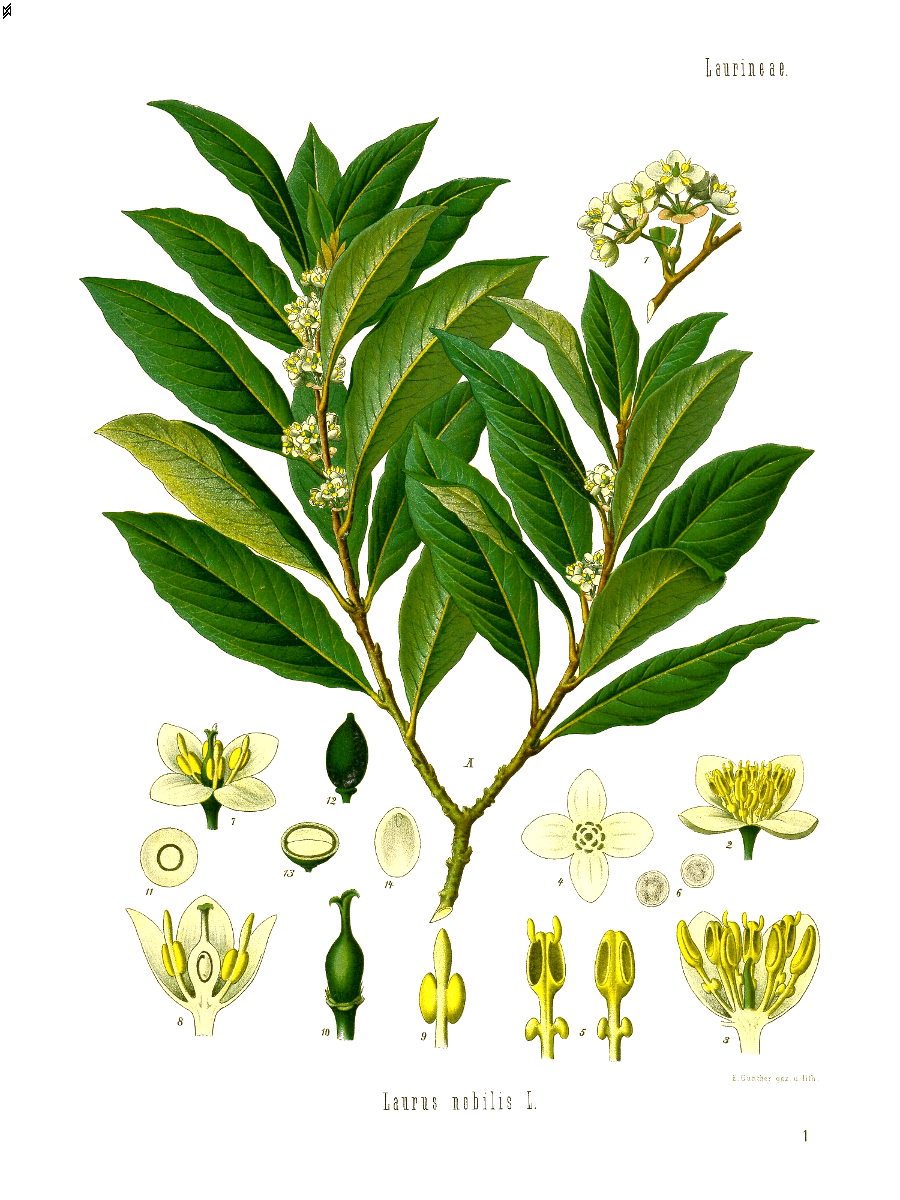
ローレルリーフ
Nguyệt quế (lá)
Laurus nobilis
Bay leaf, Bay laurel, Sweet bay
Moderate risk of skin sensitization. Contact dermatitis reported with undiluted or high-concentration use.
Methyl eugenol may be present in small percentages but is regarded as a potential carcinogen. Dermal levels are limited.
Drug interactions through CYP enzyme inhibition. Use orally with caution.
Not recommended for individuals on anticoagulant or antidiabetic medication.
| 1,8-Cineole | 38.1 – 56.7 % |
| α-Terpinyl acetate | 7.8 – 13.6 % |
| Sabinene | 4.9 – 11.5 % |
| Linalool | 3.5 – 8.7 % |
| α-Pinene | 3.8 – 8.2 % |
| β-Pinene | 2.6 – 5.0 % |
| Methyl eugenol | 0.9 – 4.2 % |
| α-Terpineol | 1.4 – 2.9 % |
Laurus nobilis is a Mediterranean evergreen tree. The dark green leaves have a distinctive aromatic character and are a famous culinary herb.
The essential oil is distilled from fresh leaves. Produced mainly in Turkey, Morocco, and Spain.
In ancient Greek culture, laurel wreaths made from Laurus nobilis leaves were awarded to Olympic victors.
Methyl eugenol content determines the safety tier. Turkish-sourced oil typically contains lower methyl eugenol than some other sources.
GC-MS analysis is required to determine exact methyl eugenol content.
Same plant but laurel berry oil and laurel leaf oil differ markedly in chemistry and safety.
Not to be confused with bay rum oil (Pimenta racemosa, West Indian bay) in letter B, a botanically distinct species.