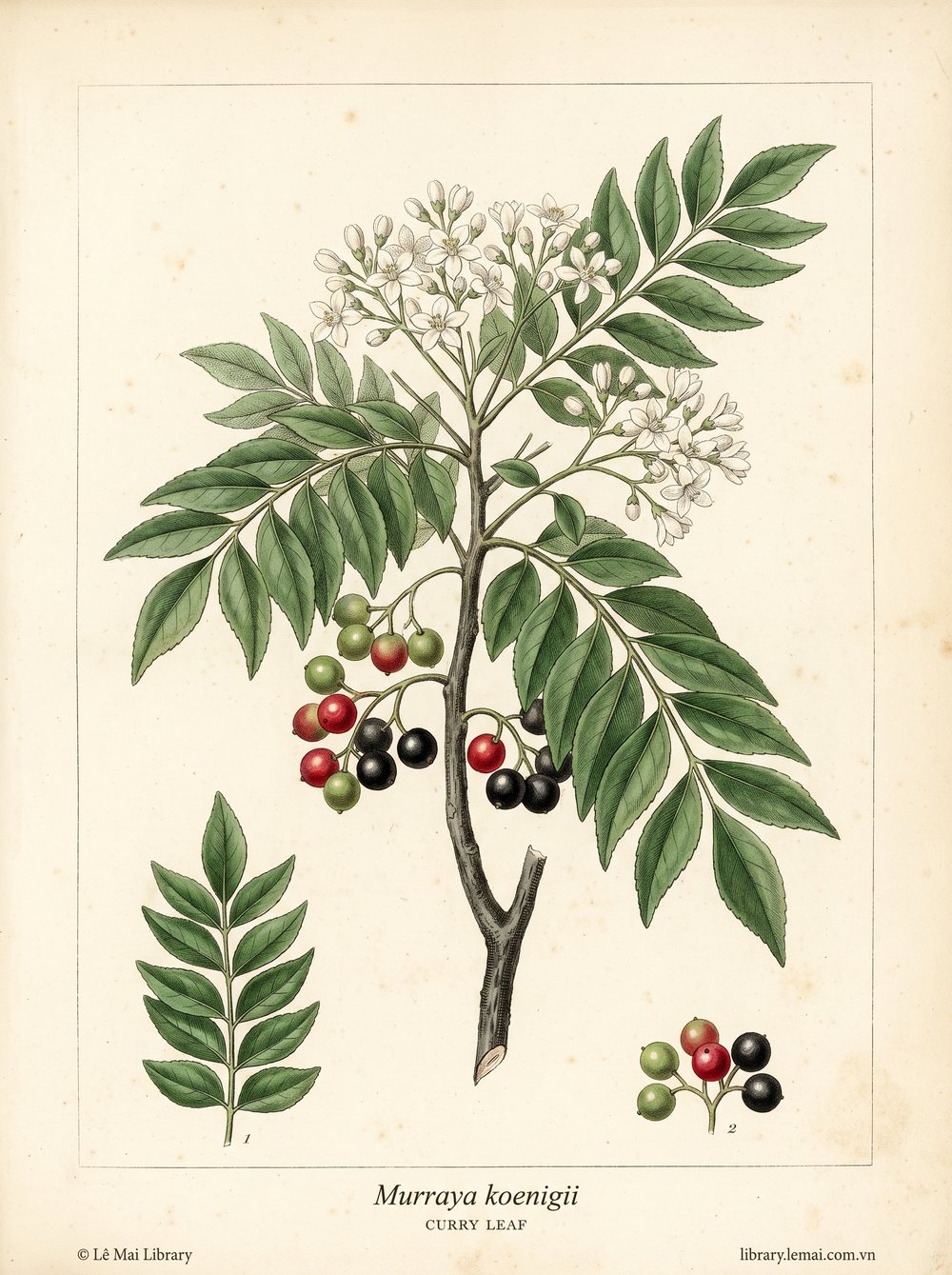
カレーリーフ
Lá cà ri
Murraya koenigii
Oxidation products of α-pinene and (+)-limonene may sensitize skin.
Store in dark, sealed, refrigerated container. Add an antioxidant to formulations.
No information on dermal reactions or acute toxicity for curry leaf oil or β-phellandrene.
Malaysian research recorded curry leaf oil (rich in β-caryophyllene and α-caryophyllene) shows anticarcinogenic activity against MCF-7 breast cancer cells in vitro.
| β-Phellandrene | 24.4 % |
| α-Pinene | 17.5 % |
| β-Caryophyllene | 7.3 % |
| Terpinen-4-ol | 6.1 % |
| (+)-Limonene | 5.1 % |
| γ-Terpinene | 4.9 % |
| α-Phellandrene | 4.8 % |
| Sabinene | 4.1 % |
| β-Pinene | 3.7 % |
| α-Terpinene | 2.8 % |
| β-Myrcene | 2.3 % |
| (E)-β-Ocimene | 1.8 % |
| α-Terpineol | 1.6 % |
| α-Thujene | 1.6 % |
Murraya koenigii is a small tree of South Asia. The leaves are an essential spice in Indian and Sri Lankan cuisine, particularly south Indian, curry, sambar, rasam.
The oil is steam-distilled from the leaves. Limited availability.
Family Rutaceae. Same family as citrus and Cape May, unrelated to 'curry powder' (curry powder is a spice blend).