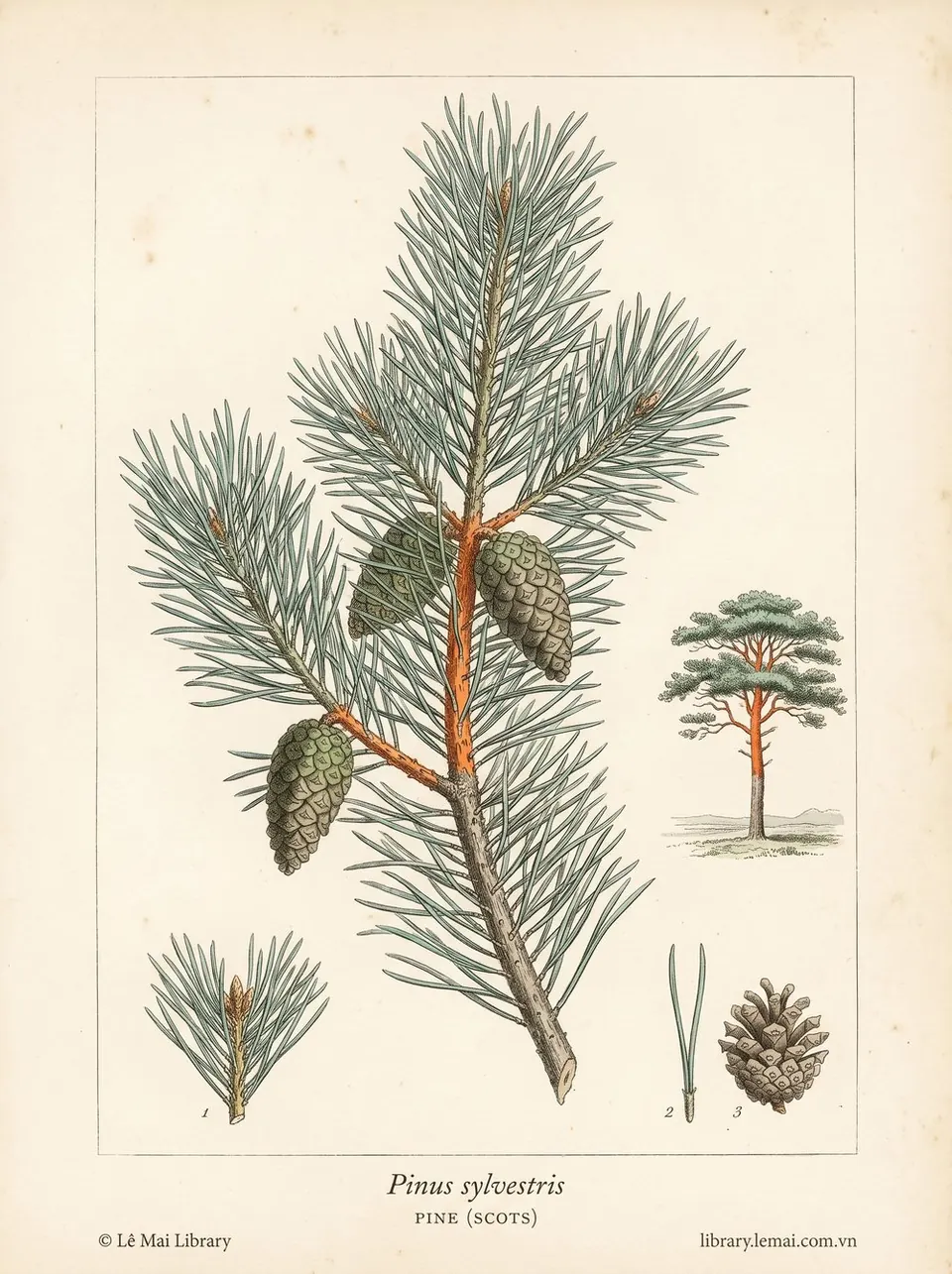
スコッチパイン
Thông Scotland
Pinus sylvestris
Scotch pine, Forest pine
Scots pine essential oil is steam-distilled from the needles of Pinus sylvestris, a pine native to Europe, Scandinavia and Russia that grows up to 35m, with production centered in Russia, Finland and Eastern Europe. Its main components are α-pinene (30 to 50%) and β-pinene (10 to 25%). In perfumery it is the standard forest note, and it is common in bath products. Oxidized oil may sensitize skin.
Updated 4 Nov 2026 · Lê Mai Team
Scots pine is classified as GRAS by the US FDA. The most common pine oil in commercial use.
α-Pinene and β-pinene dominant. Oxidation products may sensitize skin.
Store properly with antioxidant when formulating.
No data indicates hazard in pregnancy.
| α-Pinene | 30.0 – 50.0 % |
| β-Pinene | 10.0 – 25.0 % |
| δ-3-Carene | 5.0 – 15.0 % |
| (+)-Limonene | 3.0 – 10.0 % |
| β-Myrcene | 2.0 – 8.0 % |
| Camphene | 2.0 – 6.0 % |
Pinus sylvestris is native to Europe, Scotland, Scandinavia, Russia, parts of North Asia. Trees grow to 35m.
Main production: Russia, Finland, Eastern Europe.
Family Pinaceae.
| Antaeus | Chanel · 1981 · heart |
| Fille en Aiguilles | Serge Lutens · 2009 · main note |
| Gypsy Water | heart |
| Hinoki | main note |
| Series 3 Incense: Zagorsk | main note |
Based on note lists published by each house. Fragrance names and marks belong to their owners.
In perfumery, Scots pine is the standard 'forest' note. Also common in cleaning and bath products.
In aromatherapy, valued for its fresh pine scent.