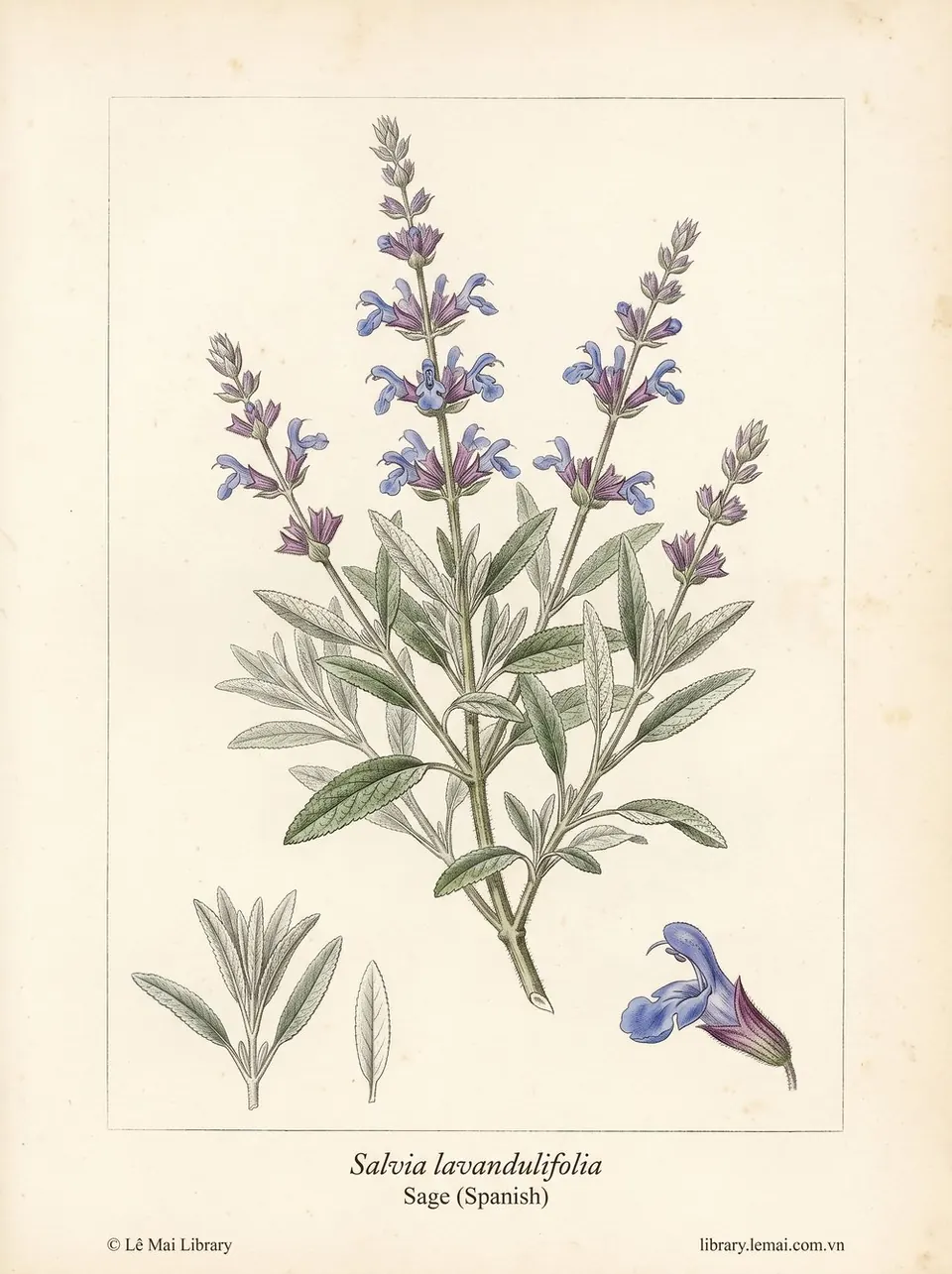
スパニッシュセージ
Xô thơm Tây Ban Nha
Salvia lavandulifolia
Lavender-leaved sage
Spanish sage essential oil is steam-distilled from the leaves of Salvia lavandulifolia, a lavender-leaved member of the mint family produced mainly in its Spanish homeland. Its main components are camphor (about 15 to 30%) and 1,8-cineole (about 10 to 30%); with very little thujone, it is a safer choice than Dalmatian sage in cosmetics. Use care with children and avoid the face of children under 6.
Updated 4 Nov 2026 · Lê Mai Team
Camphor 15-30 percent. Caution with children.
Very low thujone (under 1 percent), markedly safer than Dalmatian sage.
1,8-Cineole 10-30 percent. Avoid near face of children under 6.
Low skin sensitization risk.
| Camphor | 15.0 – 30.0 % |
| 1,8-Cineole | 10.0 – 30.0 % |
| α-Pinene | 5.0 – 12.0 % |
| Camphene | 3.0 – 12.0 % |
| β-Pinene | 3.0 – 10.0 % |
| Borneol | 3.0 – 8.0 % |
| α-Thujone | 0 – 1.0 % |
Salvia lavandulifolia is a Spanish sage with leaves resembling lavender, hence 'lavender-leaved sage'.
Main production: Spain.
Family Lamiaceae.
A safer alternative to Dalmatian sage in many cosmetic applications due to very low thujone.
In aromatherapy, Spanish sage has been studied for memory enhancement (similar to rosemary).