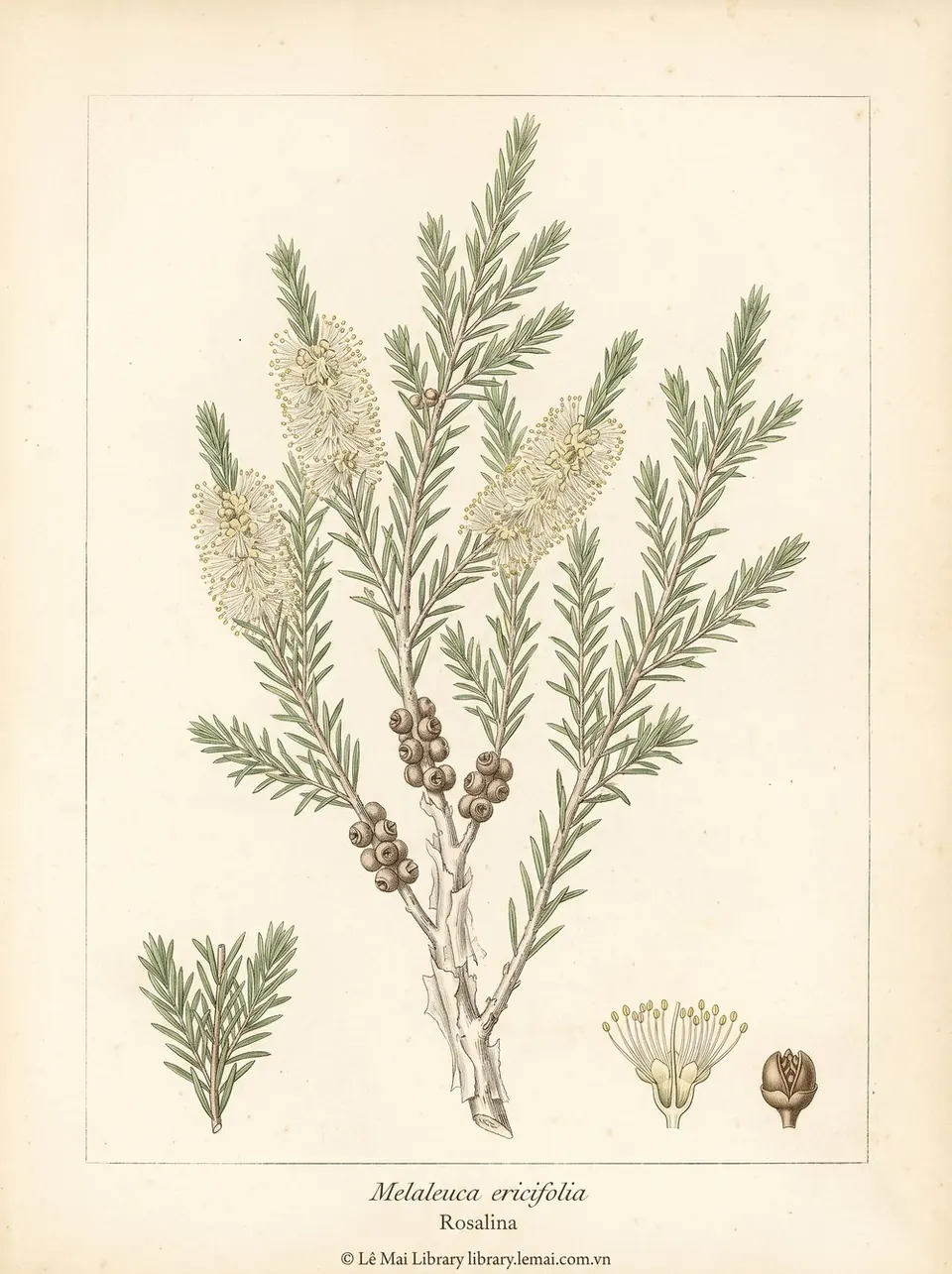
ロザリナ
Rosalina, Hoa hồng oải hương
Melaleuca ericifolia
Lavender tea tree, Swamp paperbark tree
Rosalina essential oil is steam-distilled from the leaves of Melaleuca ericifolia, a myrtle-family species from the wetlands of New South Wales and Victoria, Australia, also called lavender tea tree. Its main components are linalool (about 35 to 55%) and 1,8-cineole (about 18 to 26%), pairing a lavender-like and tea tree-like character. It has less cineole than tea tree or niaouli; oxidized linalool may sensitize, so store it sealed.
Updated 4 Nov 2026 · Lê Mai Team
Linalool and 1,8-cineole dominant. Low skin sensitization risk.
Linalool oxidation products may sensitize. Store properly.
No data indicates hazard in pregnancy.
| Linalool | 35.0 – 55.0 % |
| 1,8-Cineole | 18.0 – 26.0 % |
| α-Pinene | 5.0 – 10.0 % |
| Terpinolene | 2.0 – 5.0 % |
| (+)-Limonene | 1.5 – 5.0 % |
| (+)-Aromadendrene | 1.5 – 4.0 % |
| α-Terpineol | 1.5 – 4.0 % |
Melaleuca ericifolia is an Australian Melaleuca species, wetlands of New South Wales and Victoria.
The name 'lavender tea tree' reflects its combination of linalool (like lavender) plus 1,8-cineole (like tea tree).
Family Myrtaceae.
Safer than niaouli cineole CT and true tea tree for children due to lower cineole.
In Australian aromatherapy, rosalina is preferred for children's formulations.