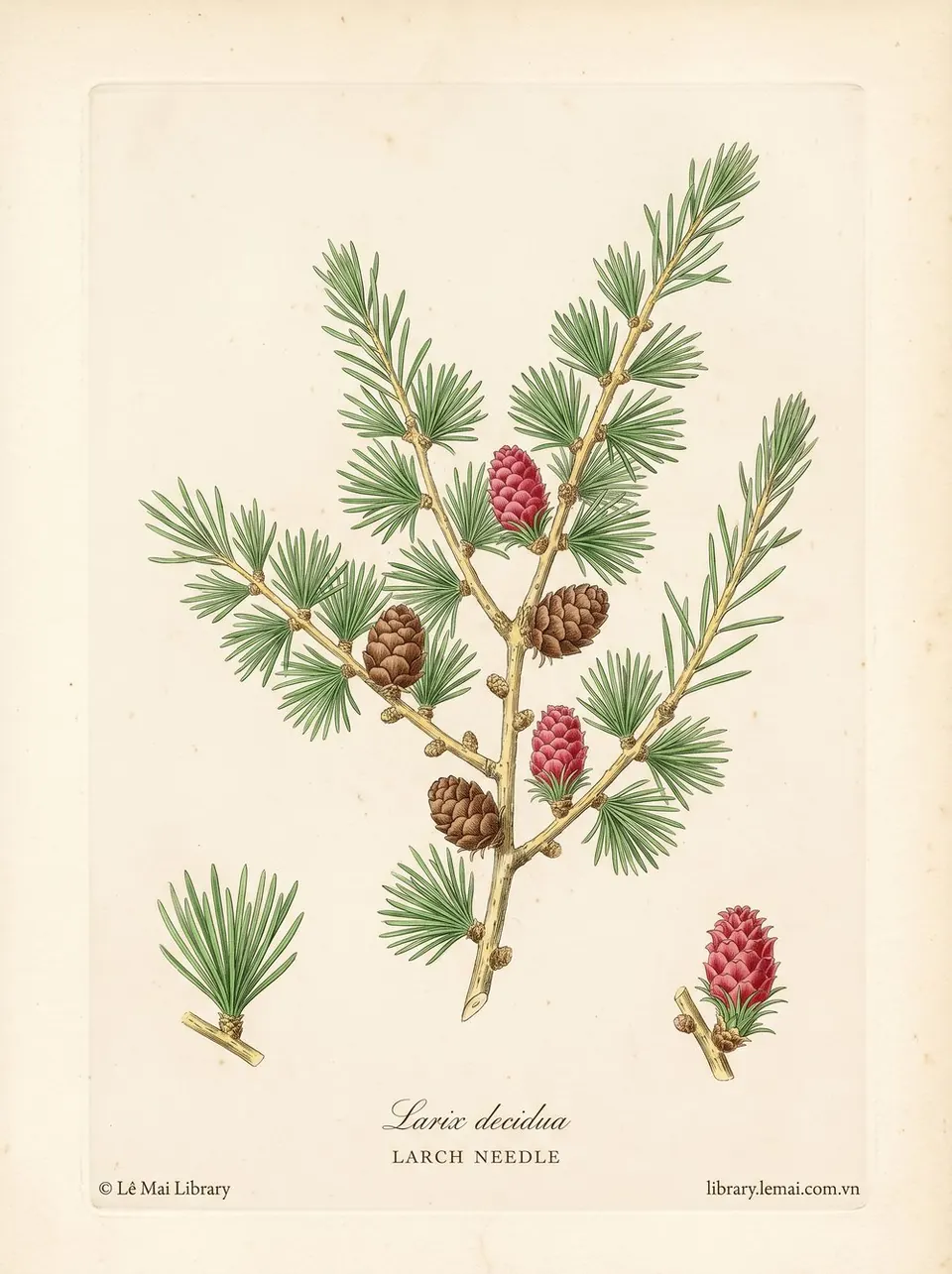
ラーチニードル
Thông rụng lá
Larix decidua
European larch
Larch needle essential oil is steam-distilled from the fresh needles of Larix decidua, a pine-family larch of the Alps and Carpathians that drops its needles in autumn; it is produced mainly in Austria, France and northern Italy. It smells typically coniferous, warm and resinous, like a fresh forest; its main components are α-pinene (about 30 to 45%) and β-pinene (about 11 to 25%). Store it dark, sealed and chilled; it suits candles, soap and room scents.
Updated 4 Nov 2026 · Lê Mai Team
Oxidation products of α-pinene and δ-3-carene may sensitize skin.
Store in dark, sealed, refrigerated container. Add antioxidant when used in formulation.
No data suggests hazard in pregnancy.
| α-Pinene | 30.0 – 45.0 % |
| β-Pinene | 11.0 – 25.0 % |
| δ-3-Carene | 5.0 – 16.0 % |
| Bornyl acetate | 2.0 – 9.0 % |
| (+)-Limonene | 3.0 – 7.0 % |
| Camphene | 2.0 – 5.0 % |
Larix decidua is a deciduous larch native to the Alps and Carpathians. Unlike pine, the needles fall in autumn.
The oil is distilled from fresh needles. Produced mainly in Austria, France, and northern Italy.
Family Pinaceae.
Typical conifer scent, warm and resinous. Used in perfumery for fresh forest notes.
Distinct from larch turpentine (Venice turpentine), an oleoresin obtained from the trunk of the same species.