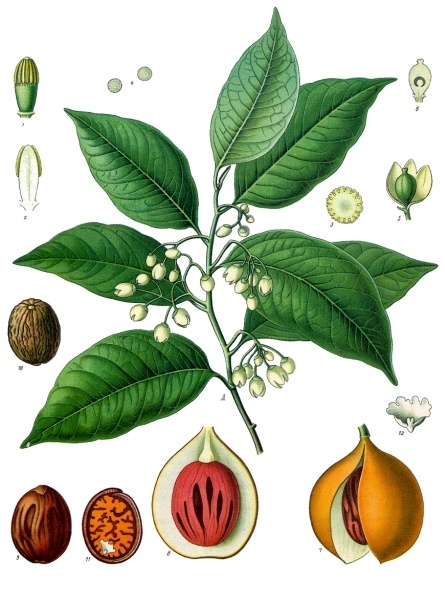
メース
Vỏ nhục đậu khấu
Myristica fragrans
Contains myristicin and elemicin. High doses can produce psychoactive effects, nausea, and hallucinations.
Avoid large oral doses. Dermal levels should be kept low.
Not recommended in pregnancy and breastfeeding.
Mace and nutmeg come from the same fruit, with mace being the outer aril and nutmeg the inner seed. Similar chemistry but different proportions.
| Sabinene | 21.0 – 42.0 % |
| α-Pinene | 10.0 – 25.0 % |
| β-Pinene | 10.0 – 22.0 % |
| Myristicin | 1.0 – 12.0 % |
| (+)-Limonene | 1.0 – 6.0 % |
| Terpinen-4-ol | 1.0 – 6.0 % |
| γ-Terpinene | 1.0 – 5.0 % |
| Elemicin | 0.5 – 4.5 % |
| Safrole | 0.1 – 3.2 % |
Mace is the aril surrounding the nutmeg seed within the Myristica fragrans fruit. When the fruit ripens, the bright red aril is separated and dried.
Main production: Indonesia (Banda Islands, historically), Grenada (West Indian), Sri Lanka. Mace is traditional in Indonesian, Middle Eastern, and Caribbean spice cuisines.
Family Myristicaceae.
Mace oil has lower safrole and myristicin than nutmeg oil. However both carry psychoactive risk at high doses.
In cosmetics it is used at very low concentrations as a fragrance fixative. Spicy, warm aroma.