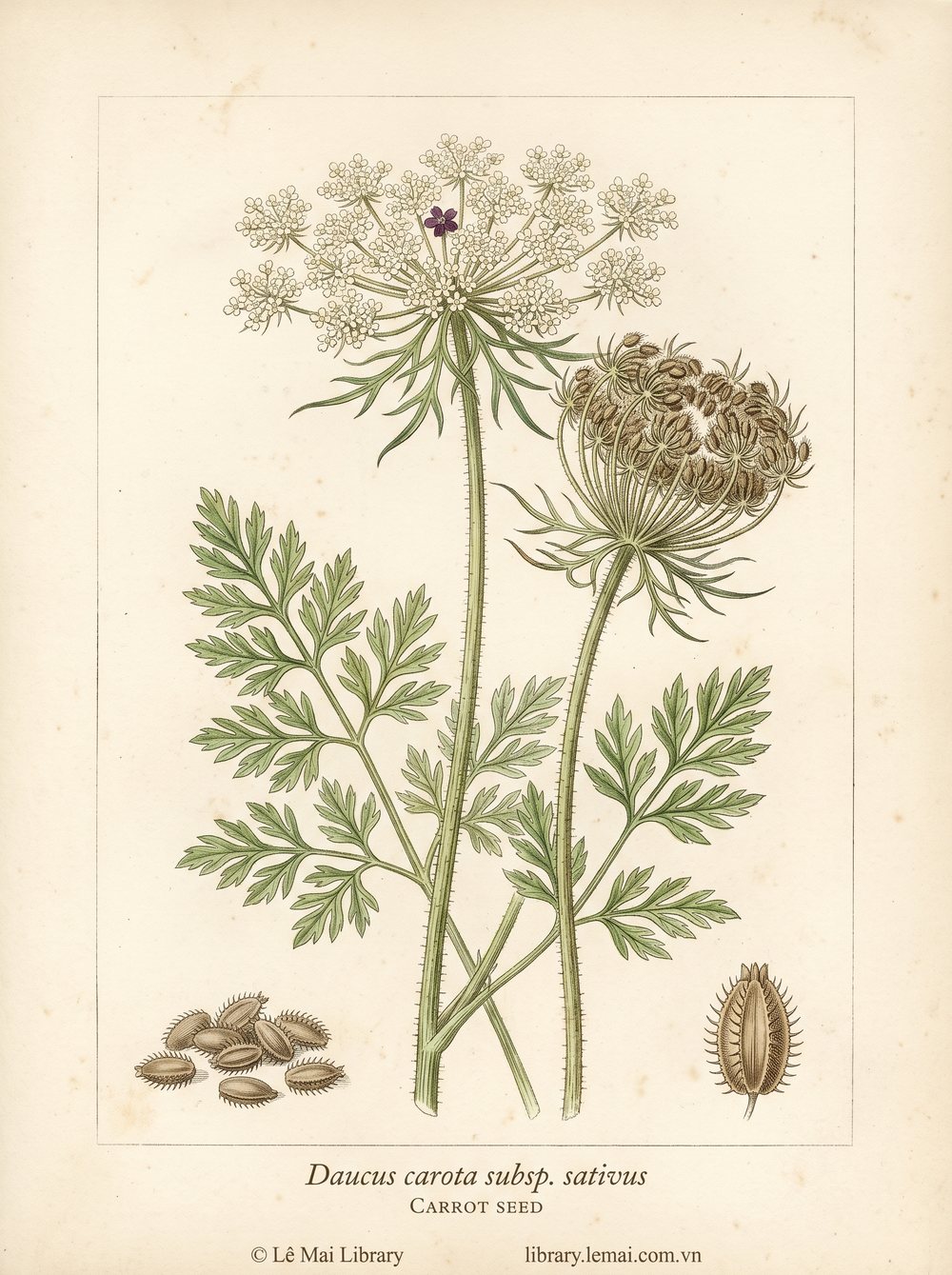
キャロットシード
Hạt cà rốt
Daucus carota subsp. sativus
May interfere with gestation.
Broad contraindications: pregnancy, breastfeeding.
GRAS status. No skin irritation or sensitization at tested levels. Non-phototoxic.
Rat studies show carrot seed oil prevents embryo implantation and blocks progesterone synthesis at 2.5 to 5 mL per kg subcutaneous. Wild carrot has a traditional reputation as a contraceptive.
The amounts used in Chinese research were very high. A NOAEL for reproductive toxicity has not been firmly established.
| Carotol | 36.1 – 73.1 % |
| α-Pinene | 0.9 – 11.2 % |
| Dauca-4,8-diene | 1.6 – 5.9 % |
| β-Caryophyllene | 0.7 – 5.6 % |
| (E)-Dauc-8-en-4β-ol | 1.7 – 4.1 % |
| Sabinene | 0 – 3.9 % |
| Geranyl acetate | 0 – 3.7 % |
| β-Bisabolene | 1.5 – 3.1 % |
| Caryophyllene oxide | 0.3 – 2.8 % |
| (E)-β-Farnesene | 1.6 – 2.5 % |
| Geraniol | 0 – 2.2 % |
| (E)-α-Bergamotene | 0.9 – 1.9 % |
| Daucol | 1.2 – 1.7 % |
| (−)-Limonene | 0.4 – 1.5 % |
| β-Pinene | 0.3 – 1.5 % |
| β-Myrcene | 0.4 – 1.3 % |
Daucus carota subsp. sativus is the domestic carrot, the cultivated form of wild carrot. The oil is steam-distilled from the seeds, not the root.
Family Apiaceae. IFRA notes carrot seed oil may contain up to 0.5 percent methyleugenol, but commercial oil typically does not contain meaningful amounts.
Absolutes and CO2 extracts of carrot seed are also produced.