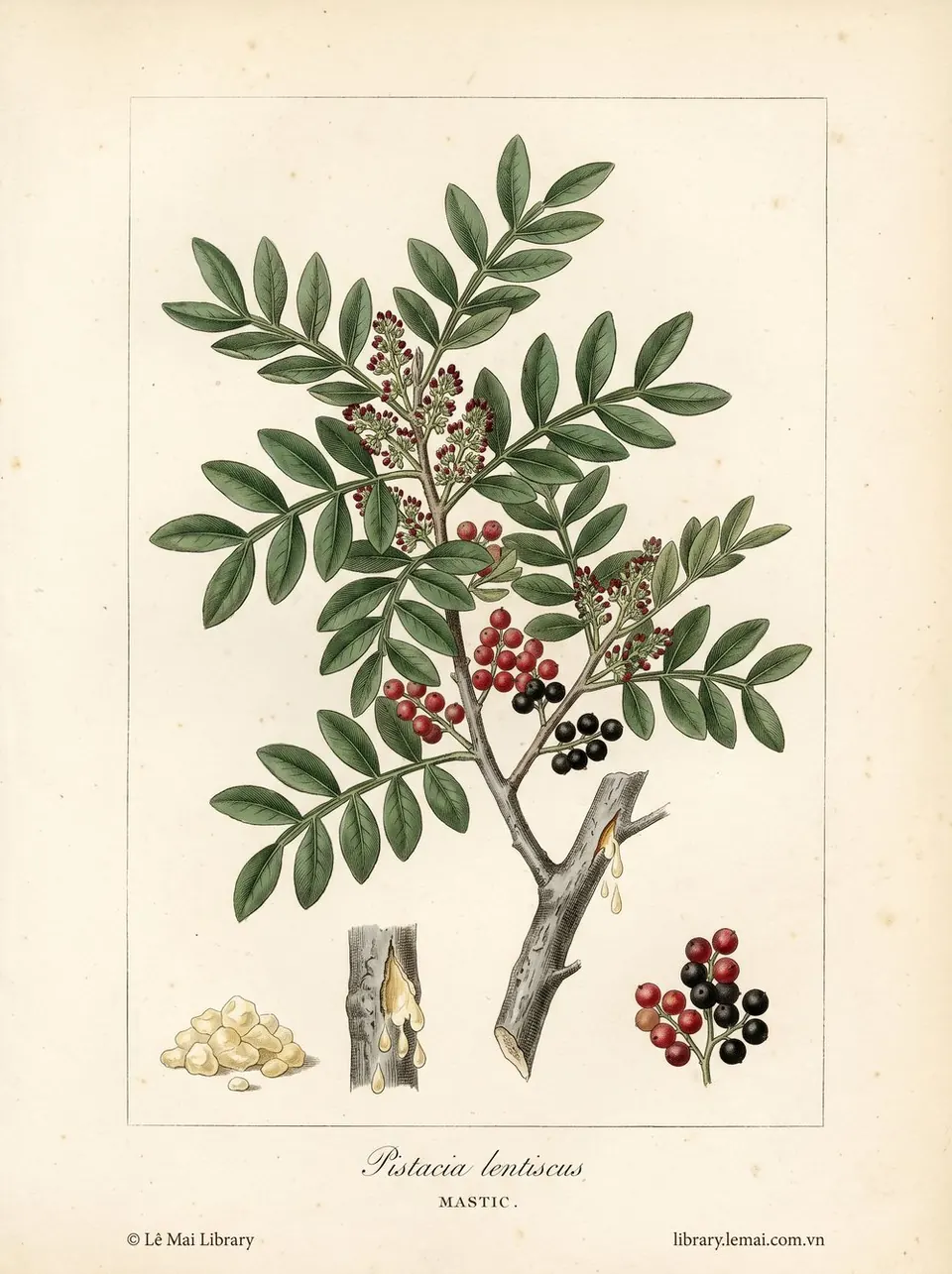
マスティック
Nhựa thông Mastic
Pistacia lentiscus
Mastic gum, Chios mastic
Mastic essential oil is steam-distilled from the mastic gum of Pistacia lentiscus, a Mediterranean shrub in the cashew family; the island of Chios in Greece is the traditional source, with EU PDO status. It smells fresh and resinous, slightly piney; its main components are α-pinene (about 50 to 70%) and β-myrcene. Its risk of skin sensitization is low, and it suits perfume, candles and room fragrance.
Updated 6 Nov 2026 · Lê Mai Team
Low risk of skin sensitization. α-Pinene dominant.
Monoterpene oxidation products may sensitize skin. Store properly.
No data indicates hazard in pregnancy.
| α-Pinene | 50.0 – 70.0 % |
| β-Myrcene | 10.0 – 15.0 % |
| β-Pinene | 2.0 – 5.0 % |
| (+)-Limonene | 2.0 – 4.0 % |
| α-Terpinolene | 1.0 – 3.0 % |
Pistacia lentiscus is a Mediterranean shrub. When the trunk bark is tapped, a thick white resin flows out, called mastic gum.
Chios (Greece) is the main traditional source. Chios mastic carries EU PDO (Protected Designation of Origin) certification.
The essential oil is distilled from the resin. Small-scale production.
Family Anacardiaceae, same family as pistachio and mango.
The raw resin has been used since antiquity as chewing gum and as an aromatic ingredient.
Mastic essential oil is used in perfumery for a fresh resin note, slightly piney.