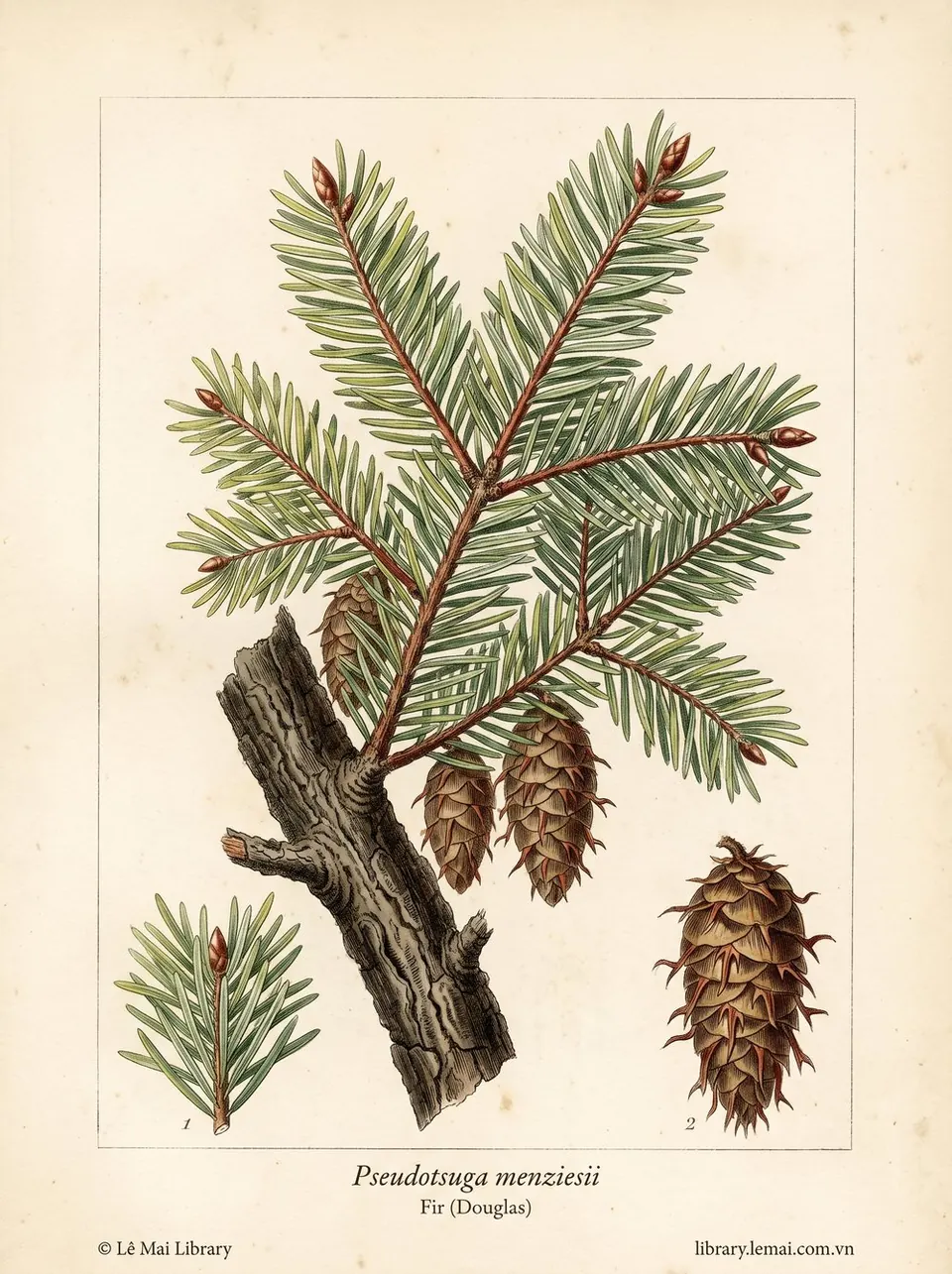
ダグラスファー
Linh sam Douglas
Pseudotsuga menziesii
Douglas fir essential oil is steam-distilled from oleoresin collected from the felled wood of Pseudotsuga menziesii, a giant pine-family tree of northwestern North America that can reach 80 to 100 meters, produced mainly in the United States and Canada. Its main components are camphene (16.7%) and α-pinene (13%). It showed no irritation at 8% and suits candles, room scents and soap.
Updated 6 Nov 2026 · Lê Mai Team
Oxidation products of (+)-limonene, α-pinene and δ-3-carene may sensitize skin.
Store in dark, sealed, refrigerated container. Add an antioxidant.
No irritation or sensitization at 8 percent test level. Non-phototoxic.
IFRA recommends essential oils from the Pinaceae family (including Pinus and Abies genera) be used only when peroxide levels are kept to the lowest practicable level.
| Camphene | 16.7 % |
| α-Pinene | 13.0 % |
| β-Pinene | 11.6 % |
| Bornyl acetate | 10.0 % |
| Terpinolene | 9.1 % |
| Sabinene | 7.4 % |
| Terpinen-4-ol | 4.6 % |
| Santene | 3.5 % |
| (+)-Limonene | 3.4 % |
| γ-Terpinene | 3.2 % |
| Tricyclene | 2.3 % |
| Citronellol | 2.1 % |
| δ-3-Carene | 2.0 % |
| α-Terpinene | 2.0 % |
Pseudotsuga menziesii is a giant tree of northwestern North America. It can grow 80 to 100 meters tall, one of the tallest in North America.
The oil is steam-distilled from oleoresin collected from felled wood. Produced mainly in the USA and Canada.
Family Pinaceae. Despite the 'Douglas fir' name, it is not in the Abies (true fir) genus, Pseudotsuga is its own genus. David Douglas was the British botanist who first recorded the tree in 1827.