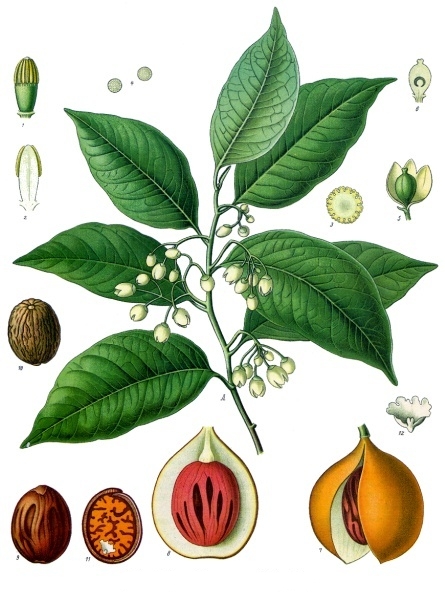
ウェストインディアンナツメグ
Nhục đậu khấu Tây Ấn
Myristica fragrans
Grenadian nutmeg
West Indian has lower safrole than East Indian but is still not safe at high doses.
Myristicin and elemicin still present. High doses can cause hallucinations and nausea.
Not recommended in pregnancy and breastfeeding.
Oral caution, only at very low doses if used at all.
| Sabinene | 42.0 – 57.0 % |
| α-Pinene | 1.6 – 12.6 % |
| β-Pinene | 7.8 – 12.1 % |
| Terpinen-4-ol | 3.0 – 6.4 % |
| γ-Terpinene | 1.7 – 4.7 % |
| (+)-Limonene | 2.9 – 4.4 % |
| α-Terpinene | 0.8 – 4.2 % |
| β-Myrcene | 2.2 – 3.4 % |
| Elemicin | 1.2 – 1.4 % |
West Indian nutmeg refers to oil from the Caribbean, particularly Grenada, where nutmeg is the national commercial crop ('Spice Island').
Grenada started cultivating nutmeg in the 19th century after trees were brought from Indonesia. Slightly different chemistry due to different soil and climate.
Family Myristicaceae.
West Indian nutmeg oil is considered 'safer' than East Indian due to lower safrole and methyl eugenol, but still carries psychoactive risk at high doses.
In cosmetics and food flavoring, West Indian is preferred for non-food applications.