β-Ocimene
3,7-Dimethyl-1,3,6-octatriene
Ocimene
化学組成 · Constituent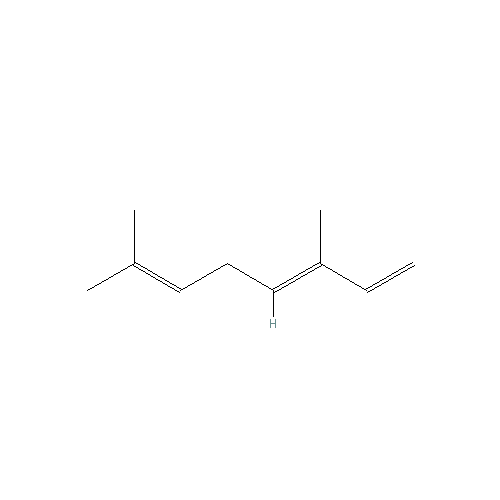
3,7-Dimethyl-1,3,6-octatriene
Ocimene
化学組成 · Constituent
β-Ocimene is a monoterpenoid polyalkene present abundantly in many floral and herbaceous essential oils, particularly taget, jonquil and opopanax. The compound is safe at standard use levels.
Skin. Undiluted mixed-isomer ocimene was moderately irritating to rabbit skin. A 5 percent test on 25 volunteers caused no irritation and no sensitization.
Acute toxicity. Acute oral LD50 in rats exceeded 5 g/kg. Acute dermal LD50 in rabbits exceeded 5 g/kg.
Cancer. Ocimene very weakly inhibited proliferation of mouse B16 melanoma cells with an IC50 of 250 µM (34.0 g/L).
| Taget | 16.6 – 69.8 % |
| Jonquil | 35.3 % |
| Opopanax | 33.0 % |
| Finger root | 22.8 % |
| Basil (pungent) | 20.6 % |
| Celery leaf | 14.1 % |
| African bluegrass | 10.3 – 11.5 % |
| Tarragon | tr – 9.5 % |
| Lovage seed | 9.2 % |
| Lavender | < 9.0 % |
| Neroli | 4.6 – 7.0 % |
| Arina | 7.0 % |
| Lavandin | 3.0 – 7.0 % |
| Blackcurrant bud | 0.6 – 6.7 % |
| Galangal (greater) | 0 – 6.4 % |
| Basil (holy) | 3.4 – 6.2 % |
| Asafoetida | 0 – 6.1 % |
| Rhododendron | 5.3 % |
| Jamrosa | 7.8 % |
β-Ocimene exists in two geometric isomers, (3E)- and (3Z)-, both common in plants. The compound is released by plants as a chemical signal to insects and herbivores.