d-3-Carene
3,7,7-Trimethylbicyclo[4.1.0]hept-3-ene
3-Carene · Δ3-Carene · Isodiprene
化学組成 · Constituent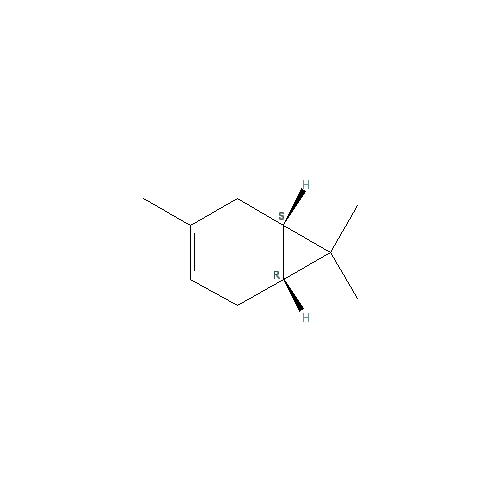
3,7,7-Trimethylbicyclo[4.1.0]hept-3-ene
3-Carene · Δ3-Carene · Isodiprene
化学組成 · Constituent
d-3-Carene không độc khi tươi mới, nhưng peroxide hình thành khi tiếp xúc không khí và ánh sáng gây mẫn cảm da đáng kể. Đây là cấu tử chính chịu trách nhiệm cho dị ứng tinh dầu thông.
Trên da. d-3-Carene tươi chưng cất, không oxi hoá, không gây phản ứng ở 25–30 phần trăm. Ở 50 phần trăm có phản ứng yếu trong một số ca, và ở 70–80 phần trăm gây kích ứng cho đa số bệnh nhân chưa mẫn cảm tinh dầu thông.
Mẫn cảm. d-3-Carene chỉ gây dị ứng sau khi oxi hoá. Peroxide của d-3-carene chịu trách nhiệm chính cho hoạt tính dị ứng của tinh dầu thông. Hợp chất được xếp loại A, chất gây dị ứng tiếp xúc đáng kể.
Đường uống. LD50 cấp tính chuột 4.8 g/kg; LD50 da thỏ vượt 5 g/kg.
Hô hấp. Hít vào gây giảm tần số hô hấp phụ thuộc liều ở chuột do kích ứng cảm giác. Ở 1.900 mg/m3 gây co thắt phế quản ở chuột lang. Giới hạn nghề nghiệp Thuỵ Điển cho terpene hít là 150 mg/m3.
Khuyến nghị sử dụng chất chống oxi hoá kết hợp với tinh dầu giàu d-3-carene, bảo quản trong tủ lạnh, kín và tránh ánh sáng.
d-3-Carene is non-toxic when fresh, but the peroxides that form on air and light exposure are significantly sensitizing. This is the principal constituent responsible for turpentine allergy.
Skin. Fresh, unoxidized d-3-carene gave no reactions at 25–30 percent. At 50 percent weak reactions occurred in some cases, and at 70–80 percent it irritated most patients not sensitized to turpentine.
Sensitization. d-3-Carene is allergenic only after autoxidation. Its peroxides are primarily responsible for the allergenic activity of turpentine oil. The compound is classified Category A, a significant contact allergen, when oxidized.
Oral. Acute oral LD50 in rats is 4.8 g/kg; rabbit dermal LD50 exceeds 5 g/kg.
Respiratory. Inhalation causes dose-dependent reduction in respiratory frequency in mice through sensory irritation. At 1,900 mg/m3 it caused bronchoconstriction in guinea pigs. Swedish occupational exposure limit for inhaled terpenes is 150 mg/m3.
Use antioxidants with d-3-carene-rich oils, store refrigerated, sealed and away from light.
| Xô thơm Blue Mountain · Sage (blue mountain) | 38.1 % |
| Lý chua đen (nụ) · Blackcurrant bud | 12.6 – 35.0 % |
| Thông Scotland · Pine (Scots) | 0.4 – 31.8 % |
| Thông lùn · Pine (dwarf) | 0.5 – 30.1 % |
| Linh sam Canada (kim) · Fir needle (Canadian) | 0 – 27.3 % |
| Tiêu trắng · Pepper (white) | 25.2 % |
| Bách · Cypress | 15.2 – 21.5 % |
| Thông Ponderosa · Pine (ponderosa) | 17.2 % |
| Tiêu đen · Pepper (black) | tr – 15.5 % |
| Thông rụng lá · Larch needle | 14.0 % |
| Đương quy · Angelica root | 4.5 – 13.0 % |
| Thông xám · Pine (grey) | 7.3 – 12.7 % |
| Linh sam Siberia (kim) · Fir needle (Siberian) | 12.2 % |
| Galbanum | 2.0 – 12.1 % |
| Vân sam Hemlock · Spruce (hemlock) | 11.5 % |
| Húng quế cay · Basil (pungent) | 0 – 10.9 % |
| Nhựa thông · Turpentine | 0 – 10.3 % |
| Hoa thủy tiên · Narcissus | 6.6 – 8.4 % |
| Thông đỏ · Pine (red) | 4.2 – 7.3 % |
| Vân sam Na Uy · Spruce (Norway) | 2.5 – 5.8 % |
| Vân sam đỏ · Spruce (red) | 5.4 % |
| Ravensara (lá) · Ravensara leaf | 4.9 – 5.0 % |
d-3-Carene chuyển hoá chủ yếu qua hydroxyl hoá ở thỏ, tạo các metabolite m-mentha-4,6-dien-8-ol, 3-caren-9-ol, 3-carene-9-carboxylic acid và 3-carene-9,10-dicarboxylic acid. Microsome gan và phổi người tạo ra d-3-carene-10-ol và d-3-carene epoxide.
Hít ở người với 10, 225 và 450 mg/m3, hấp thu phổi khoảng 70 phần trăm ở liều cao. Khoảng 3 phần trăm liều bài tiết qua phổi không đổi, dưới 0.001 phần trăm qua nước tiểu. Bán huỷ máu kéo dài, gợi ý ái lực cao với mô mỡ.
d-3-Carene is primarily metabolized by hydroxylation in rabbits, yielding m-mentha-4,6-dien-8-ol, 3-caren-9-ol, 3-carene-9-carboxylic acid and 3-carene-9,10-dicarboxylic acid. Human liver and lung microsomes form d-3-carene-10-ol and d-3-carene epoxide.
Inhalation in humans at 10, 225 and 450 mg/m3 showed about 70 percent pulmonary uptake at higher exposures. About 3 percent of the dose was eliminated unchanged through the lungs, less than 0.001 percent in urine. A long blood half-life suggests adipose tissue affinity.
d-3-Carene đối kháng phụ thuộc liều với co thắt tử cung do oxytocin trên chuột, hoạt tính có ý nghĩa tham khảo trong hỗ trợ thai phụ chuyển dạ.
Tinh dầu giàu d-3-carene cần đặc biệt chú ý đến chất lượng và độ tươi để tránh peroxide gây mẫn cảm.
d-3-Carene dose-dependently antagonizes oxytocin-induced uterine contractions in rats, an activity of theoretical interest in labor support.
d-3-Carene-rich oils require particular attention to quality and freshness to avoid sensitizing peroxides.