d-3-Carene
3,7,7-Trimethylbicyclo[4.1.0]hept-3-ene
3-Carene · Δ3-Carene · Isodiprene
化学組成 · Constituent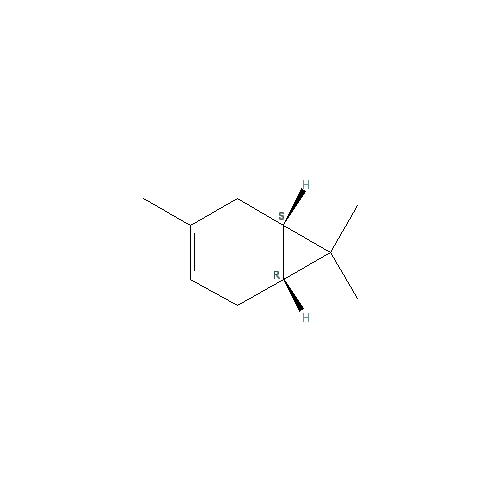
3,7,7-Trimethylbicyclo[4.1.0]hept-3-ene
3-Carene · Δ3-Carene · Isodiprene
化学組成 · Constituent
d-3-Carene is non-toxic when fresh, but the peroxides that form on air and light exposure are significantly sensitizing. This is the principal constituent responsible for turpentine allergy.
Skin. Fresh, unoxidized d-3-carene gave no reactions at 25–30 percent. At 50 percent weak reactions occurred in some cases, and at 70–80 percent it irritated most patients not sensitized to turpentine.
Sensitization. d-3-Carene is allergenic only after autoxidation. Its peroxides are primarily responsible for the allergenic activity of turpentine oil. The compound is classified Category A, a significant contact allergen, when oxidized.
Oral. Acute oral LD50 in rats is 4.8 g/kg; rabbit dermal LD50 exceeds 5 g/kg.
Respiratory. Inhalation causes dose-dependent reduction in respiratory frequency in mice through sensory irritation. At 1,900 mg/m3 it caused bronchoconstriction in guinea pigs. Swedish occupational exposure limit for inhaled terpenes is 150 mg/m3.
Use antioxidants with d-3-carene-rich oils, store refrigerated, sealed and away from light.
| Sage (blue mountain) | 38.1 % |
| Blackcurrant bud | 12.6 – 35.0 % |
| Pine (Scots) | 0.4 – 31.8 % |
| Pine (dwarf) | 0.5 – 30.1 % |
| Fir needle (Canadian) | 0 – 27.3 % |
| Pepper (white) | 25.2 % |
| Cypress | 15.2 – 21.5 % |
| Pine (ponderosa) | 17.2 % |
| Pepper (black) | tr – 15.5 % |
| Larch needle | 14.0 % |
| Angelica root | 4.5 – 13.0 % |
| Pine (grey) | 7.3 – 12.7 % |
| Fir needle (Siberian) | 12.2 % |
| Galbanum | 2.0 – 12.1 % |
| Spruce (hemlock) | 11.5 % |
| Basil (pungent) | 0 – 10.9 % |
| Turpentine | 0 – 10.3 % |
| Narcissus | 6.6 – 8.4 % |
| Pine (red) | 4.2 – 7.3 % |
| Spruce (Norway) | 2.5 – 5.8 % |
| Spruce (red) | 5.4 % |
| Ravensara leaf | 4.9 – 5.0 % |
d-3-Carene is primarily metabolized by hydroxylation in rabbits, yielding m-mentha-4,6-dien-8-ol, 3-caren-9-ol, 3-carene-9-carboxylic acid and 3-carene-9,10-dicarboxylic acid. Human liver and lung microsomes form d-3-carene-10-ol and d-3-carene epoxide.
Inhalation in humans at 10, 225 and 450 mg/m3 showed about 70 percent pulmonary uptake at higher exposures. About 3 percent of the dose was eliminated unchanged through the lungs, less than 0.001 percent in urine. A long blood half-life suggests adipose tissue affinity.
d-3-Carene dose-dependently antagonizes oxytocin-induced uterine contractions in rats, an activity of theoretical interest in labor support.
d-3-Carene-rich oils require particular attention to quality and freshness to avoid sensitizing peroxides.