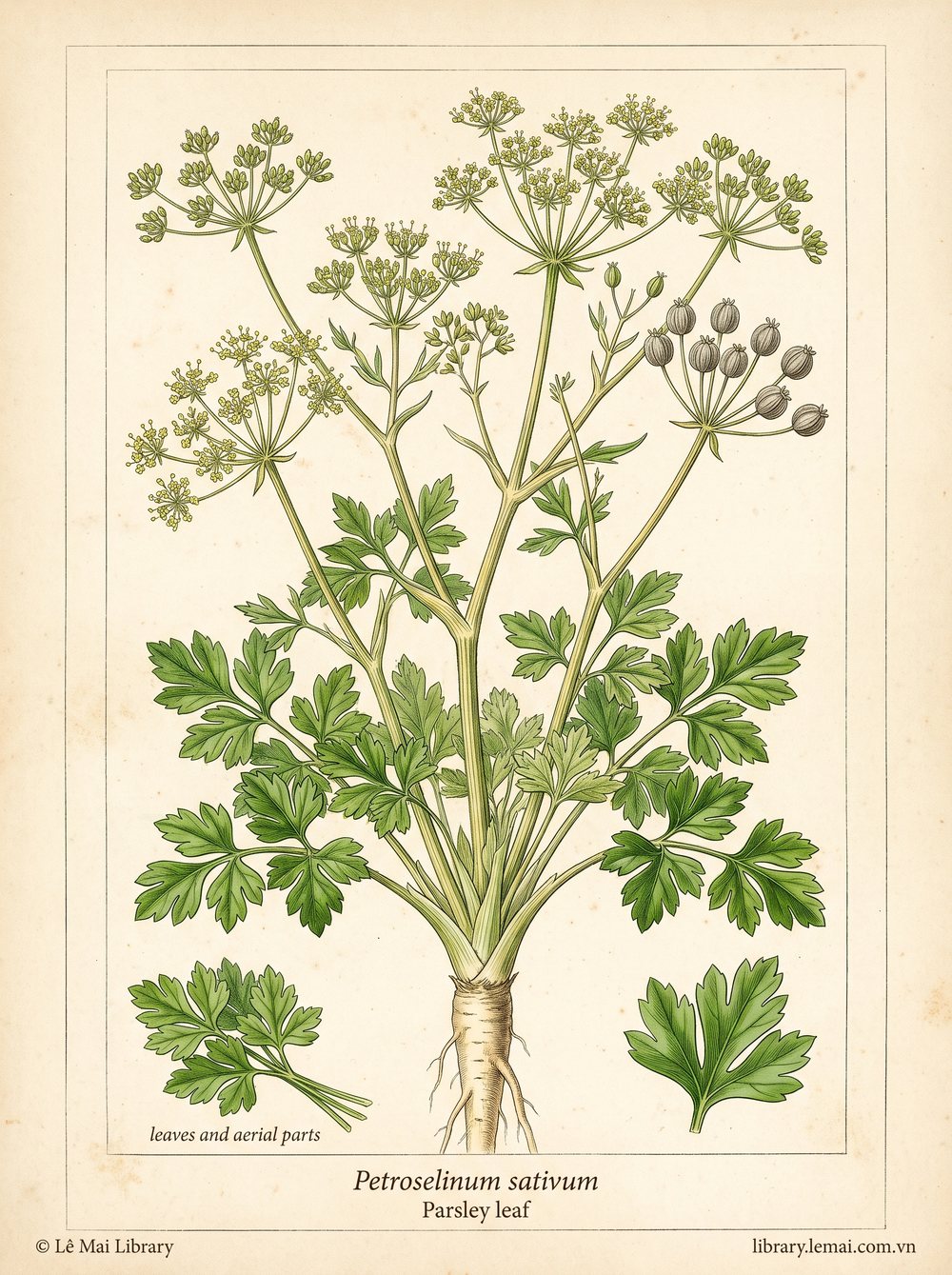
パセリリーフ
Ngò tây (lá)
Petroselinum sativum
Petroselinum crispum
Apiole và myristicin có hàm lượng thấp hơn parsley seed nhưng vẫn cần thận trọng.
Chống chỉ định trong thai kỳ và cho con bú do tác dụng kích thích tử cung của apiole.
Khuyến cáo nồng độ dermal thấp.
Apiole and myristicin lower than in parsley seed but caution still required.
Contraindicated in pregnancy and breastfeeding due to apiole's uterine-stimulating effect.
Low dermal concentration recommended.
| Myristicin | 30.0 – 60.0 % |
| β-Phellandrene | 10.0 – 25.0 % |
| 1,3,8-p-Menthatriene | 5.0 – 15.0 % |
| Apiole | 2.0 – 10.0 % |
| Myrcene | 2.0 – 6.0 % |
Petroselinum sativum là cây gia vị quen thuộc toàn cầu. Lá tươi dùng làm rau gia vị cho salad, súp, sốt.
Tinh dầu chưng cất từ lá tươi, sản lượng nhỏ.
Họ Apiaceae (Umbelliferae), cùng họ với celery, anise, fennel.
Petroselinum sativum is a globally familiar culinary herb. Fresh leaves are used as a salad, soup, and sauce garnish.
The essential oil is distilled from fresh leaves, small-scale production.
Family Apiaceae (Umbelliferae), same family as celery, anise, and fennel.
Trong ẩm thực Việt Nam, parsley không phổ biến như mùi tây (cilantro). Trong ẩm thực Tây, parsley là gia vị cơ bản.
Tinh dầu chủ yếu cho perfumery green note.
In Vietnamese cuisine, parsley is less common than cilantro. In Western cuisine, parsley is a foundational herb.
Essential oil is mainly for perfumery green notes.