Myristicin
3-Methoxy-4,5-(methylenedioxy)-1-(2-propenyl)benzene
Methoxysafrole · 3-Methoxy-4,5-(methylenedioxy)allylbenzene
化学組成 · Constituent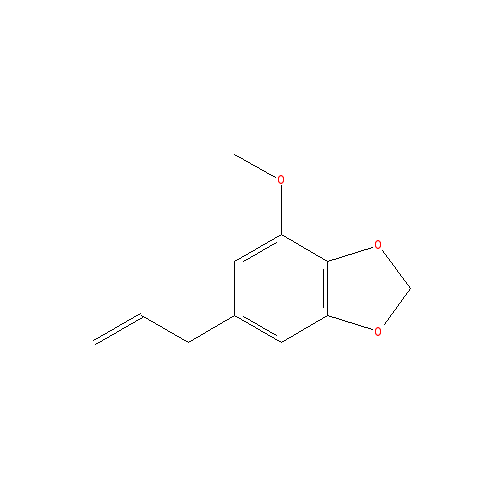
3-Methoxy-4,5-(methylenedioxy)-1-(2-propenyl)benzene
Methoxysafrole · 3-Methoxy-4,5-(methylenedioxy)allylbenzene
化学組成 · Constituent
Myristicin là phenylpropenoid ether xuất hiện ở mức cao trong parsnip, parsley seed và nutmeg. Hợp chất ức chế MAO, cảm ứng nhiều enzyme CYP và glutathione S-transferase, gợi ý các tương tác thuốc tiềm năng.
Độc tính cấp. LD100 đường uống trên mèo là 570 mg/kg. Myristicin được tin là đặc biệt độc cho mèo. Mùi nhục đậu khấu đuổi mèo.
Tương tác thuốc. Myristicin là chất ức chế MAO mức trung bình ở loài gặm nhấm. Vì vậy, tinh dầu giàu myristicin cần thận trọng đường uống với người dùng MAOI, SSRI, pethidine và các thuốc giao cảm gián tiếp.
Thần kinh. Myristicin có thể tái tạo nhiều đặc tính tâm thần của bột nhục đậu khấu và tăng mức serotonin trong não chuột. Một con đường chuyển hoá đề xuất chuyển myristicin thành TMA hoặc MMDA, các chất gây ảo giác đã biết. Tuy nhiên, không có bằng chứng myristicin chuyển hoá in vivo thành chúng. Liều uống 400 mg ở người không gây hiệu ứng tâm thần.
Gan. Myristicin được phát hiện có 'hoạt tính bảo vệ gan đặc biệt mạnh' ở chuột, chống tổn thương gan do lipopolysaccharide hoặc D-galactosamine.
Đột biến gen. Không độc gen trên tế bào buồng trứng hamster Trung Quốc. Trong hai nghiên cứu 32P post-labelling, mức tạo DNA adduct thấp nhưng có thể có ý nghĩa ở chuột nhắt sơ sinh và trưởng thành. Tạo adduct yếu hơn safrole 3 đến 4 lần.
Ung thư. Trong assay novel cho chất gây ung thư, myristicin yếu gây ung thư gan ở chuột đực. Không gây ung thư ở chuột nhắt với liều phúc mạc 912 mg. Hợp chất ức chế u do benzo[a]pyrene ở chuột nhắt và độc tế bào ung thư neuroblastom SK-N-SH qua cơ chế apoptotic.
Myristicin is a phenylpropenoid ether present at high levels in parsnip, parsley seed and nutmeg. The compound inhibits MAO and induces several CYP enzymes and glutathione S-transferase, suggesting potential drug interactions.
Acute toxicity. Cat oral LD100 is 570 mg/kg. Myristicin is believed to be especially toxic to cats. The odor of nutmeg repels cats.
Drug interactions. Myristicin is a moderate MAO inhibitor in rodents. Oral use of myristicin-rich oils therefore warrants caution in those taking MAOIs, SSRIs, pethidine and indirect sympathomimetics.
Neurological. Myristicin can reproduce many psychotropic properties of ground nutmeg and increases serotonin levels in rat brain. A proposed metabolic pathway converts myristicin to TMA or MMDA, known hallucinogens. However, there is no evidence of in vivo conversion to either. A 400 mg oral human dose produces no psychotropic effect.
Liver. Myristicin was found to possess 'extraordinarily potent hepatoprotective activity' in rats against liver damage caused by lipopolysaccharide or D-galactosamine.
Mutagenicity. Non-genotoxic in Chinese hamster ovary cells. In two 32P post-labelling studies, low but possibly significant DNA adduct formation was reported in newborn and adult mice. Adduct binding is 3 to 4 times weaker than safrole.
Cancer. In a novel carcinogen assay, myristicin is weakly hepatocarcinogenic in male rats. Not carcinogenic in mice given an ip dose of 912 mg. The compound inhibits benzo[a]pyrene-induced tumors in mice and is cytotoxic to neuroblastoma SK-N-SH cells through an apoptotic mechanism.
| Củ cải Pastinaca · Parsnip | 17.2 – 40.1 % |
| Ngò tây (hạt) · Parsley seed | 0.7 – 37.9 % |
| Nhục đậu khấu Đông Ấn · Nutmeg (East Indian) | 3.3 – 13.5 % |
| Ngò tây (lá) · Parsley leaf | 1.9 – 8.8 % |
| Vỏ nhục đậu khấu · Mace | 1.3 – 5.9 % |
| Sugandha | 2.5 % |
| Nhục đậu khấu Tây Ấn · Nutmeg (West Indian) | 0.5 – 0.9 % |
Trong chuột, nhóm methylenedioxy của myristicin đặc biệt nhạy cảm với phân cắt, tạo các dẫn xuất catechol. Các sản phẩm rượu và acid carboxylic oxi hoá cũng được nhận diện trong nước tiểu chuột.
Trong gan người, chất chuyển hoá chính là 5-allyl-1-methoxy-2,3-dihydroxybenzene, với CYP3A4 và CYP1A2 là enzyme chính. Myristicin cảm ứng glutathione S-transferase đến 14 lần và là chất cảm ứng CYP P448 mạnh.
Đồ uống không cồn, đặc biệt cola, là nguồn nhập myristicin chính cho người.
In rats, the methylenedioxy group of myristicin is particularly susceptible to cleavage, producing catechol derivatives. Alcohol and carboxylic acid oxidation products were also identified in rat urine.
In human liver, the major metabolite is 5-allyl-1-methoxy-2,3-dihydroxybenzene, with CYP3A4 and CYP1A2 as the primary enzymes. Myristicin induces glutathione S-transferase up to 14-fold and is a potent inducer of CYP P448.
Non-alcoholic drinks, especially cola, are a major source of human myristicin intake.
Tổng nhập myristicin từ tinh dầu và gia vị trong thực phẩm không gây tác dụng phụ đáng kể ở người trong điều kiện bình thường. Tuy nhiên, do tác động vào hoạt tính MAO và CYP, tinh dầu giàu myristicin cần thận trọng hoặc tránh hoàn toàn với người dùng thuốc kê đơn.
Total myristicin intake from essential oils and spices in food does not cause significant adverse effects in humans under normal conditions. However, due to its actions on MAO and CYP activity, myristicin-rich oils should be used cautiously or avoided in people taking prescription drugs.