α-Phellandrene
2-Methyl-5-(1-methylethyl)-1,3-cyclohexadiene
p-Mentha-1,5-diene
化学組成 · Constituent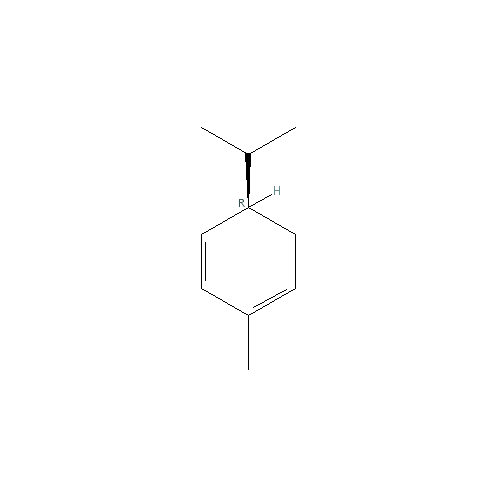
2-Methyl-5-(1-methylethyl)-1,3-cyclohexadiene
p-Mentha-1,5-diene
化学組成 · Constituent
α-Phellandrene là monoterpene hydrocarbon dễ bị oxi hoá. Dạng tươi ít rủi ro, dạng đã oxi hoá có thể gây mẫn cảm da.
Trên da. Dạng nguyên chất gây kích ứng trung bình trên da thỏ. Ở 4 và 8 phần trăm trên 25 tình nguyện không kích ứng. Ở 8 phần trăm không gây mẫn cảm. Ở 4 phần trăm có một phản ứng dương tính trên 25 tình nguyện, được cho là do tự oxi hoá. Ở 5 phần trăm gây mẫn cảm cho 4 trên 11 bệnh nhân viêm da đã mẫn cảm với tinh dầu tea tree.
Đường uống. LD50 cấp tính trên chuột 5.7 g/kg, mức cao. LD50 da trên thỏ vượt 5 g/kg. Uống quá liều có thể gây nôn và tiêu chảy.
Đột biến gen và ung thư. Không gây độc gen ở tế bào hamster. Có báo cáo thúc đẩy hình thành u trên da chuột đã xử lý với chất sinh ung thư DMBA, nhưng bản thân không phải chất sinh ung thư.
α-Phellandrene is a monoterpene hydrocarbon prone to oxidation. Fresh material poses low risk, while oxidized material can become a skin sensitizer.
Skin. Undiluted material was moderately irritating to rabbit skin. At 4 and 8 percent on 25 volunteers it was not irritating. At 8 percent it was not sensitizing. At 4 percent one positive reaction occurred in 25 volunteers, attributed to autoxidation. At 5 percent it sensitized 4 of 11 dermatitis patients already sensitized to tea tree oil.
Oral. Acute oral LD50 in rats was 5.7 g/kg, a high value. Acute dermal LD50 in rabbits exceeded 5 g/kg. Oral overdose can cause vomiting and diarrhea.
Mutagenicity and cancer. Not genotoxic in Chinese hamster ovary cells. Reports indicate promotion of tumor formation on the skin of mice pretreated with the primary carcinogen DMBA, although α-phellandrene itself is not carcinogenic.
| Nghệ vàng (lá) · Turmeric leaf | 53.4 % |
| Thì là (lá) · Dill weed | 18.2 – 30.2 % |
| Đương quy · Angelica root | 7.5 – 20.0 % |
| Tiêu hồng · Pepper (pink) | 5.3 – 17.3 % |
| Bạch đàn bạc hà · Eucalyptus (peppermint) | 16.9 % |
| Nhựa Elemi · Elemi | 4.3 – 15.1 % |
| Nghệ vàng (củ) · Turmeric rhizome | 0.7 – 12.8 % |
| Goldenrod | 11.9 % |
| Nhựa thông · Turpentine | 0 – 8.0 % |
| Tía tô đất Úc · Lemon balm (Australian) | 7.1 % |
| Thì là (hạt) Ấn Độ · Dill seed (Indian) | tr – 6.5 % |
| Nhục đậu khấu Đông Ấn · Nutmeg (East Indian) | 0.4 – 5.8 % |
| Peta | 5.5 % |
α-Phellandrene được chuyển hoá ở cừu theo ít nhất hai con đường. Một con đường là khử và oxi hoá tạo các axit phellandric và phellanduric. Con đường kia là hydroxyl hoá và liên hợp glucuronide. Cả p-cymene và carvotanacetone đều được tìm thấy trong dạng liên hợp.
α-Phellandrene is metabolized in sheep along at least two pathways. One involves reduction and oxidation yielding phellandric and phellanduric acids. The other involves hydroxylation and glucuronide conjugation. Both p-cymene and carvotanacetone are found in the conjugate.
α-Phellandrene chia sẻ rủi ro oxi hoá điển hình của nhóm monoterpene như α-pinene và 3-carene. Tinh dầu giàu α-phellandrene nên bảo quản lạnh, đậy kín.
α-Phellandrene shares the typical oxidation risk of the monoterpene group, like α-pinene and 3-carene. Oils high in α-phellandrene should be refrigerated and kept tightly sealed.