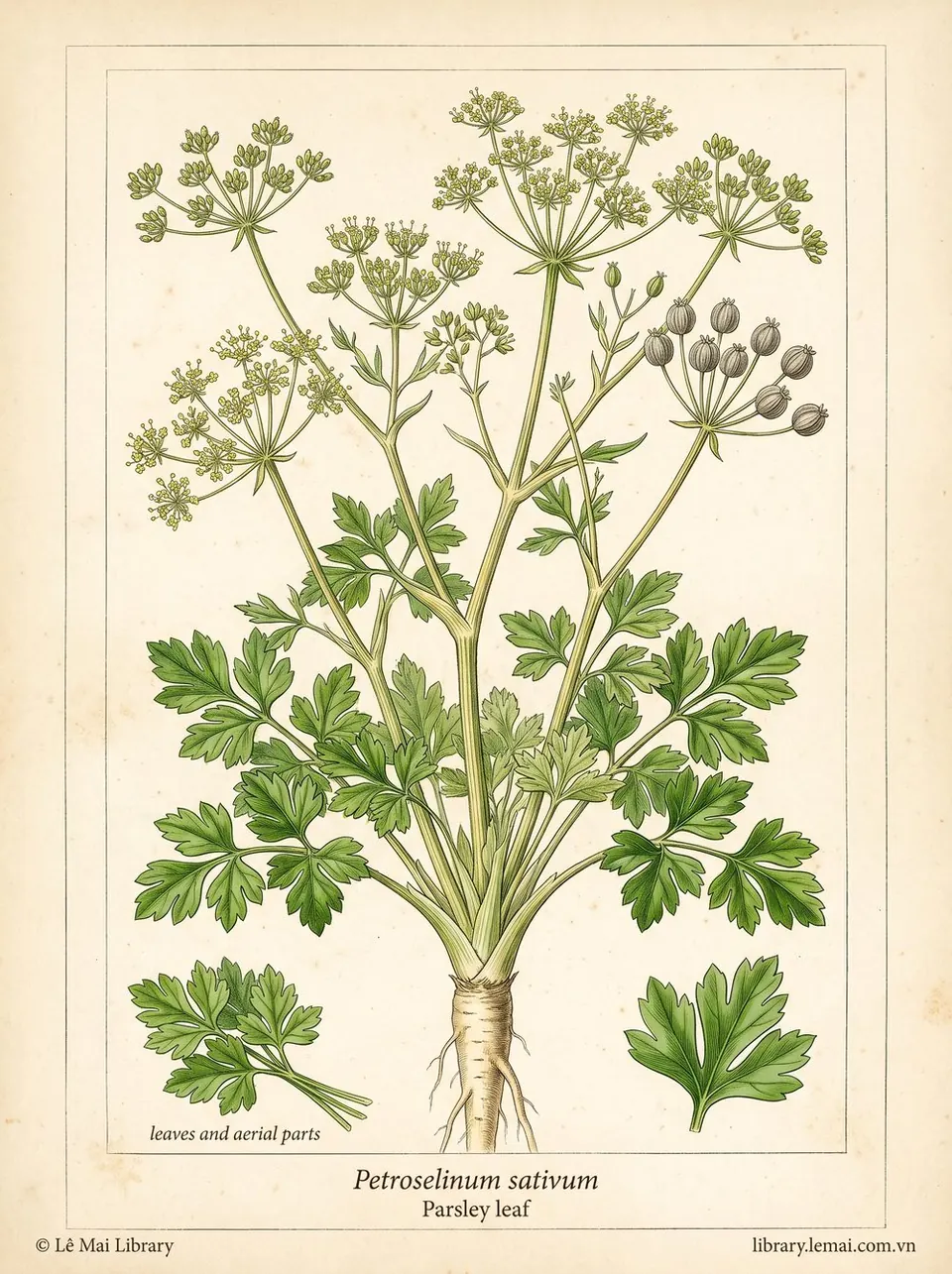
パセリリーフ
Ngò tây (lá)
Petroselinum sativum
Petroselinum crispum
Parsley leaf essential oil is steam-distilled from the fresh leaves of Petroselinum sativum, a member of the carrot family alongside celery, anise and fennel. It smells fresh, green and herbal and is used mainly for green notes in perfumery; its main components are myristicin and β-phellandrene. It contains apiole, so it is contraindicated in pregnancy and breastfeeding and should be used at low concentrations on skin.
Updated 4 Nov 2026 · Lê Mai Team
Apiole and myristicin lower than in parsley seed but caution still required.
Contraindicated in pregnancy and breastfeeding due to apiole's uterine-stimulating effect.
Low dermal concentration recommended.
| Myristicin | 30.0 – 60.0 % |
| β-Phellandrene | 10.0 – 25.0 % |
| 1,3,8-p-Menthatriene | 5.0 – 15.0 % |
| Apiole | 2.0 – 10.0 % |
| Myrcene | 2.0 – 6.0 % |
Petroselinum sativum is a globally familiar culinary herb. Fresh leaves are used as a salad, soup, and sauce garnish.
The essential oil is distilled from fresh leaves, small-scale production.
Family Apiaceae (Umbelliferae), same family as celery, anise, and fennel.
In Vietnamese cuisine, parsley is less common than cilantro. In Western cuisine, parsley is a foundational herb.
Essential oil is mainly for perfumery green notes.