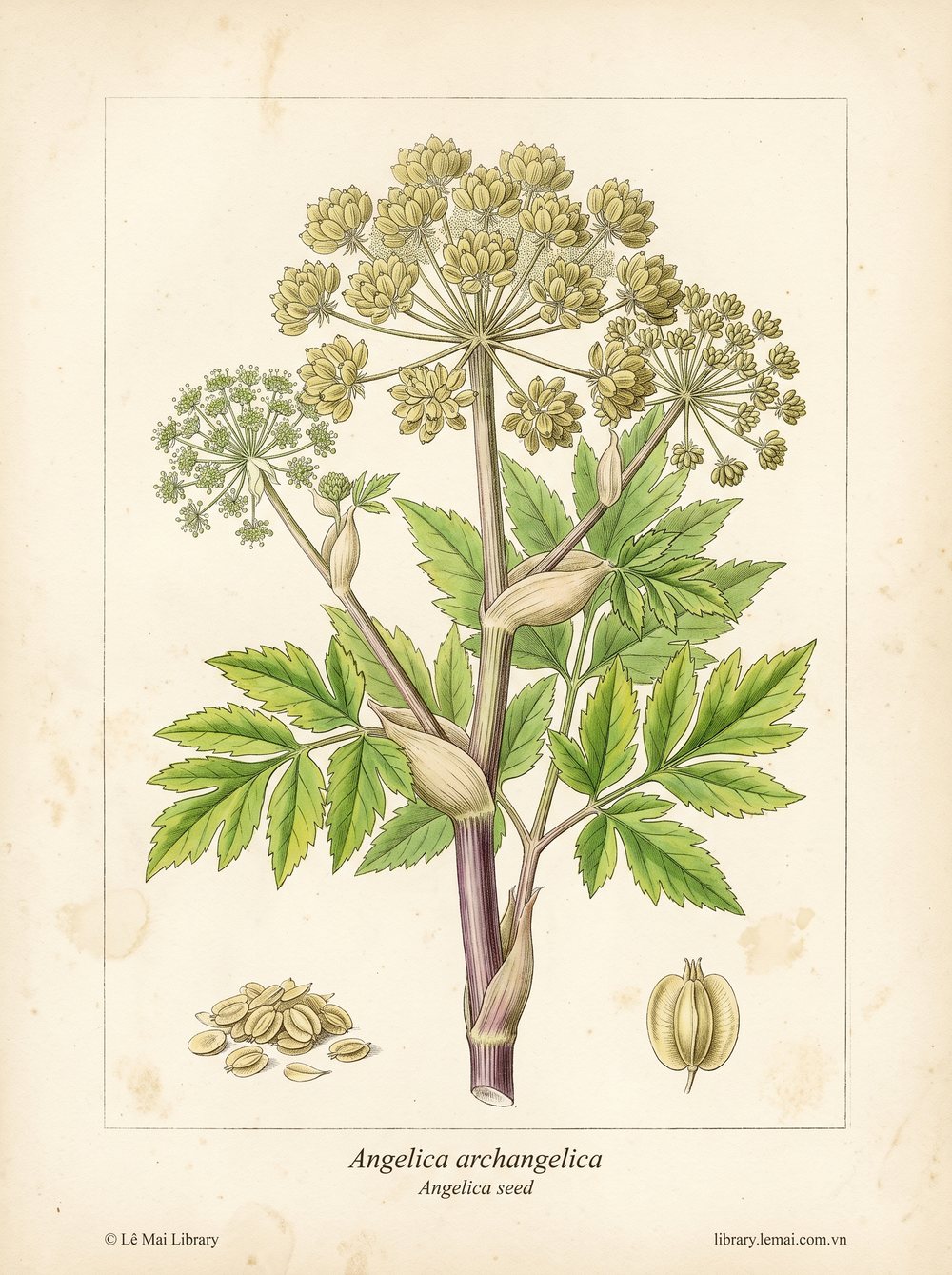
アンジェリカ種子
Đương quy (hạt)
Angelica archangelica
Chưa ghi nhận nguy hại cho angelica seed oil.
Khác với root oil, seed oil KHÔNG chứa furocoumarin — không phototoxic.
Thử trên 25 tình nguyện viên ở nồng độ 1%, không kích ứng cũng không dị ứng. Hơi kích ứng nhẹ trên thỏ ở nồng độ undiluted.
Tránh dùng dầu cũ hoặc đã oxi hóa.
No known hazards for angelica seed oil.
Unlike root oil, seed oil contains NO furocoumarins — not phototoxic.
Tested at 1% on 25 volunteers, neither irritating nor sensitizing. Mildly irritating to rabbits when undiluted.
Avoid old or oxidized oils.
| β-Phellandrene | 35.4 – 72.1 % |
| Limonene | 2.3 – 38.7 % |
| α-Pinene | 8.8 – 9.2 % |
| β-Caryophyllene | 0.1 – 3.3 % |
| β-Myrcene | 1.5 – 2.9 % |
| α-Phellandrene | 2.7 – 2.8 % |
| α-Caryophyllene | 0.7 – 1.1 % |
Hạt thu hoạch từ Angelica archangelica đã trồng 2 năm. Cây ra hoa và kết hạt ở năm thứ 2.
Sáu loại psoralen đã được phát hiện trong hạt (bao gồm bergapten, imperatorin, methoxsalen), nhưng không xuất hiện trong tinh dầu sau chưng cất.
Sản xuất chính tại Pháp, Đức, Hungary, Ba Lan.
Seeds harvested from 2-year-old Angelica archangelica plants. The plant flowers and seeds in its second year.
Six psoralens have been found in the seeds (including bergapten, imperatorin, methoxsalen), but none are reported in the essential oil after distillation.
Mainly produced in France, Germany, Hungary, Poland.
Limonene và β-phellandrene có thể polymer hóa khi bảo quản không đúng — biến thành chất nhớt, mất giá trị thương mại.
Cần thêm chất chống oxi hóa khi pha chế để kéo dài tuổi thọ.
Limonene and β-phellandrene may polymerize when stored improperly — becoming viscous and losing commercial value.
Add antioxidants when blending to extend shelf life.
Seed oil rẻ hơn root oil. Có thể được dùng làm chất pha trộn với root oil.
Hoạt tính chống ung thư đã ghi nhận trong nghiên cứu tế bào — angelica seed oil có độc tính tế bào trên dòng ung thư tuyến tụy và vú chuột.
Seed oil is cheaper than root oil. May be used as adulterant of root oil.
Anticarcinogenic activity recorded in cell studies — angelica seed oil cytotoxic to human pancreas and mouse breast cancer cell lines.