ミルラ
Mộc dược
Commiphora myrrha
Somalian myrrh, Commiphora molmol
Furanoeudesma-1,3-diene và furanodiene là thành phần chính. β-Elemene và furanodiene có hoạt tính antiangiogenic (ức chế sự hình thành mạch máu mới).
Có khả năng fetotoxic do β-elemene và furanodiene content. Liên hệ giữa tác dụng antiangiogenic và độc tính sinh sản đã được ghi nhận.
CHỐNG CHỈ ĐỊNH NGHIÊM NGẶT trong thai kỳ và cho con bú, qua mọi đường dùng (dermal, oral, inhalation).
Không kích ứng trên chuột và lợn ở nồng độ cao. Trên 25 người tình nguyện ở 8 phần trăm: không kích ứng hoặc nhạy ứng. Tuy nhiên một aromatherapist 65 tuổi với nhiều nhạy ứng phản ứng với cả 1 và 5 phần trăm myrrh oil.
Myrrh oil không phototoxic. Furanodiene có hoạt tính bảo vệ gan trong nghiên cứu trên chuột, giảm tổn thương gan do D-galactosamine/lipopolysaccharide hoặc TNF-α gây ra.
Không chứa carcinogen đã biết.
Furanoeudesma-1,3-diene and furanodiene are the main constituents. β-Elemene and furanodiene have antiangiogenic activity (inhibiting new blood vessel formation).
Potentially fetotoxic due to β-elemene and furanodiene content. The link between antiangiogenic effects and reproductive toxicity is documented.
STRICTLY CONTRAINDICATED in pregnancy and breastfeeding, by all routes (dermal, oral, inhalation).
Not irritating to mice or pigs at high concentrations. In 25 volunteers at 8 percent: not irritating or sensitizing. However, a 65-year-old aromatherapist with multiple sensitivities reacted to both 1 percent and 5 percent myrrh oil.
Myrrh oil is not phototoxic. Furanodiene shows hepatoprotective activity in mouse studies, reducing liver injury induced by D-galactosamine/lipopolysaccharide or TNF-α.
Contains no known carcinogens.
| Furanoeudesma-1,3-diene | 34.0 % |
| Furanodiene | 19.7 % |
| Lindestrene | 12.0 % |
| β-Elemene | 8.7 % |
| Germacrene B | 4.3 % |
| Germacrene D | 3.2 % |
| δ-Elemene | 2.1 % |
| 2-Methoxyfuranodiene | 2.1 % |
| Isofuranogermacrene (curzerene) | 2.0 % |
| T-Cadinol | 1.6 % |
| β-Caryophyllene | 1.3 % |
| β-Bourbonene | 1.2 % |
| γ-Cadinene | 1.2 % |
| Furanoeudesma-1,4-diene | 1.2 % |
| γ-Elemene | 1.1 % |
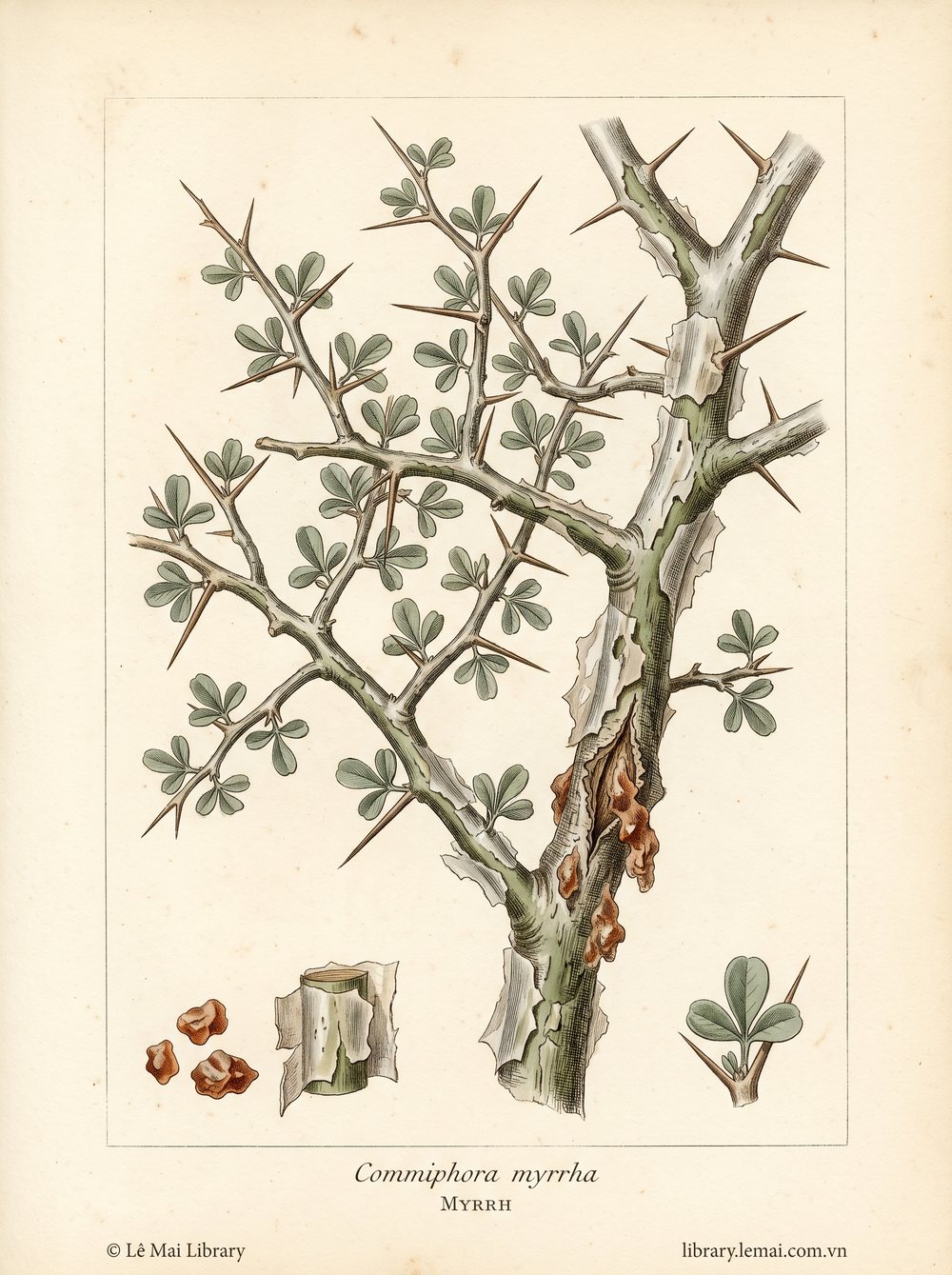
Commiphora myrrha là cây gỗ nhỏ vùng bán hoang mạc Somalia, Ethiopia, Yemen, Sudan, Kenya. Cây có gai, lá nhỏ.
Khi vỏ thân bị tổn thương, bằng tự nhiên hoặc do người chích, nhựa vàng nhạt chảy ra, đặc lại trên không khí thành các khối resin nâu đỏ. Đây là gum oleoresin myrrh.
Resin khô được thu hoạch, làm sạch, rồi chưng cất hơi để chiết tinh dầu. Năng suất khoảng 3-8 phần trăm trên khối lượng resin.
Sản xuất chính Somalia, Ethiopia. Somalian myrrh được coi là chuẩn về mùi và chất lượng.
Họ Burseraceae, cùng họ với frankincense (Boswellia), elemi, palo santo, linaloe wood.
Commiphora myrrha is a small tree from the semi-arid regions of Somalia, Ethiopia, Yemen, Sudan, and Kenya. Thorny tree with small leaves.
When the trunk bark is damaged, naturally or by tapping, pale yellow sap flows out, hardening in air into reddish-brown resin lumps. This is gum oleoresin myrrh.
Dried resin is harvested, cleaned, then steam-distilled for the essential oil. Yield is approximately 3-8 percent of resin weight.
Main production: Somalia, Ethiopia. Somalian myrrh is regarded as the aromatic and quality standard.
Family Burseraceae, same family as frankincense (Boswellia), elemi, palo santo, and linaloe wood.
Myrrh oil thường bị làm giả với commiphora myrrh từ các loài Commiphora khác (Commiphora gileadensis, Commiphora wightii). Mỗi loài cho profile khác, Somalian là chuẩn.
Resin gốc (gum oleoresin) là sản phẩm quan trọng riêng, thường dùng trong incense và y học truyền thống. Tinh dầu chưng cất là một sản phẩm phụ.
Myrrh oil có hoạt tính chống oxy hóa mạnh, vượt α-tocopherol trong test singlet oxygen.
Verify chất lượng bằng GC-MS, chuẩn Somalian có furanoeudesma-1,3-diene và lindestrene đặc trưng.
Myrrh oil is often adulterated with myrrh from other Commiphora species (Commiphora gileadensis, Commiphora wightii). Each species yields a different profile, Somalian is the benchmark.
The raw resin (gum oleoresin) is an important product in its own right, often used in incense and traditional medicine. The distilled essential oil is a secondary product.
Myrrh oil has strong antioxidant activity, exceeding α-tocopherol in singlet oxygen tests.
Verify quality by GC-MS, the Somalian standard has characteristic furanoeudesma-1,3-diene and lindestrene.
| Opium | Yves Saint Laurent · 1977 · nốt đáy base |
| La Myrrhe | Serge Lutens · 1995 · nốt chính main note |
| Eau Noire | Dior · 2004 · nốt đáy base |
| Hermessence Myrrhe Églantine | Hermès · 2018 · nốt chính main note |
| Gold Man | Amouage · nốt giữa heart |
Theo danh sách nốt hương do nhà sản xuất công bố. Tên nước hoa và thương hiệu thuộc chủ sở hữu tương ứng.Based on note lists published by each house. Fragrance names and marks belong to their owners.
Myrrh có lịch sử văn hóa lâu đời. Trong Kinh Thánh, myrrh là một trong ba quà tặng của các nhà thông thái tới Jesus sơ sinh. Tại Ai Cập cổ đại, myrrh được dùng trong ướp xác và nghi lễ tôn giáo.
Trong y học truyền thống Trung Quốc (TCM), myrrh (没药 mò yào) được dùng cho tuần hoàn máu, đau khớp, vết thương. Thường dùng kết hợp với frankincense.
Trong nha khoa truyền thống, myrrh tincture được dùng cho viêm nướu và loét miệng. Hoạt tính kháng khuẩn rõ rệt.
Trong perfumery, myrrh là note base resin quan trọng, đặc biệt trong nước hoa oriental, amber, và unisex hiện đại.
Trong cosmetic, myrrh dùng phổ biến trong sản phẩm chăm sóc da chống lão hóa (anti-ageing), kem mắt, lotion cho da khô. Lưu ý chống chỉ định thai kỳ rất quan trọng.
Myrrh has a long cultural history. In the Bible, myrrh was one of the three gifts of the Magi to the infant Jesus. In ancient Egypt, myrrh was used in mummification and religious rites.
In Traditional Chinese Medicine, myrrh (没药 mò yào) is used for blood circulation, joint pain, and wounds. Often combined with frankincense.
In traditional dentistry, myrrh tincture has been used for gingivitis and mouth ulcers. Notable antibacterial activity.
In perfumery, myrrh is an important resinous base note, particularly in oriental, amber, and modern unisex fragrances.
In cosmetics, myrrh is widely used in anti-ageing skin care, eye creams, and lotions for dry skin. The pregnancy contraindication is very important to observe.