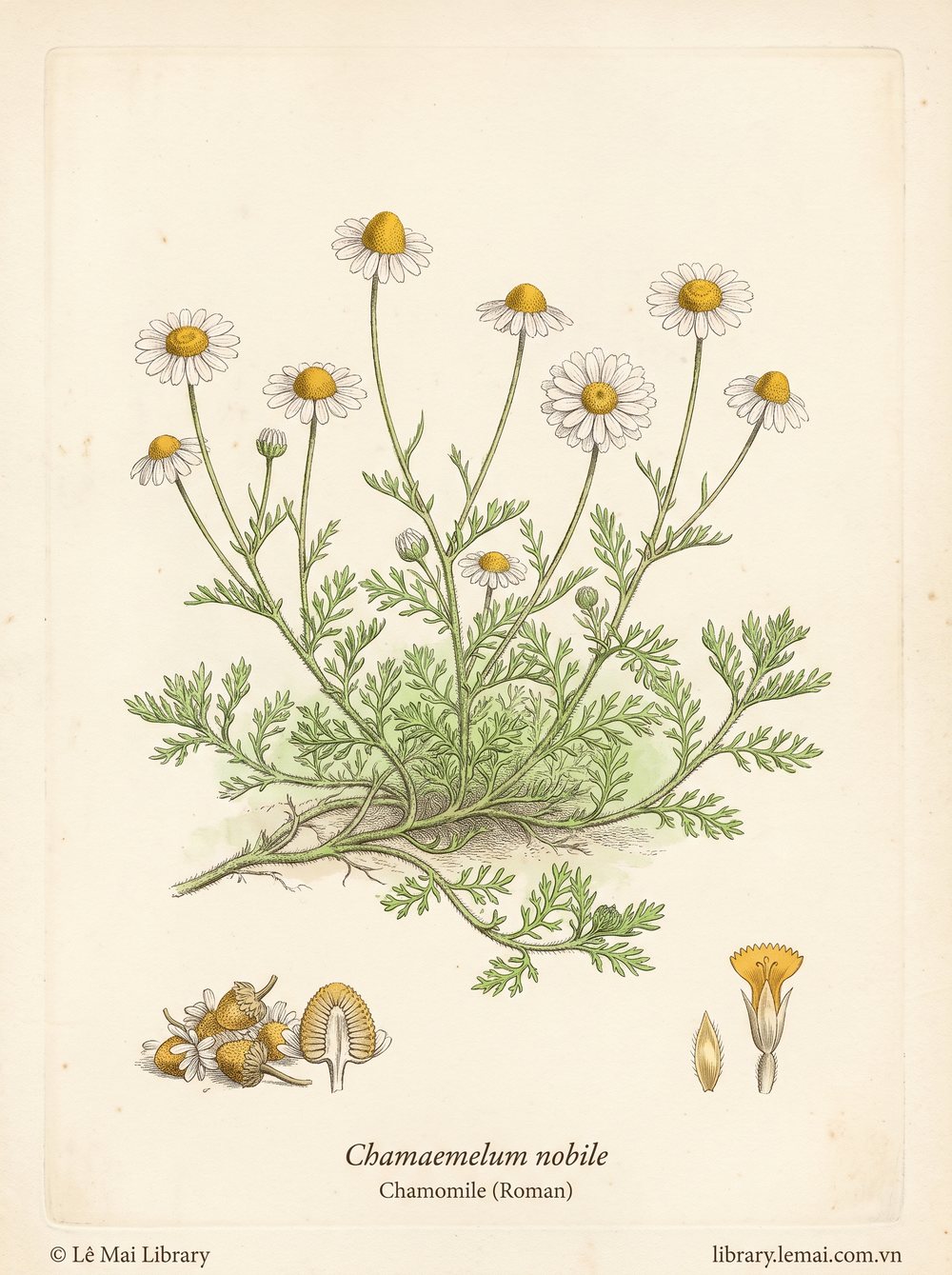
ローマンカモミール
Cúc La Mã
Chamaemelum nobile
Anthemis nobilis
Không có chống chỉ định cụ thể trong dữ liệu hiện có.
Có GRAS status. Không kích ứng hay nhạy ứng ở liều thử nghiệm. Không phototoxic.
Trên cơ sở kiến thức hiện tại, khả năng không gây nguy hiểm nào trong aromatherapy.
Khoảng 80 phần trăm thành tố là ester angelate và butyrate, khác hẳn với chamomile German giàu sesquiterpene.
No specific contraindications in available data.
GRAS status. No irritation or sensitization at tested levels. Non-phototoxic.
On current knowledge, unlikely to present any hazard in aromatherapy.
Around 80 percent of constituents are angelate and butyrate esters, markedly different from sesquiterpene-rich German chamomile.
| Isobutyl angelate | 0 – 37.4 % |
| Butyl angelate | 0 – 34.9 % |
| 3-Methylpentyl angelate | 0 – 22.7 % |
| Isobutyl butyrate | 0 – 20.5 % |
| Isoamyl angelate | 8.4 – 17.9 % |
| 2-Methyl-2-propenyl angelate | 0 – 13.1 % |
| 3-Methylpentyl isobutyrate | 0 – 12.5 % |
| Camphene | 0 – 6.0 % |
| Borneol | 0 – 5.0 % |
| α-Pinene | 1.1 – 4.5 % |
| α-Terpinene | 0 – 4.5 % |
| Chamazulene | 0 – 4.4 % |
| Entirely Aurner | Aesop · nốt chính main note |
| White Smoke | Perfumer H · nốt giữa heart |
| Aqua Allegoria Mandarine Basilic | Guerlain · nốt giữa heart |
| Camomille Satin | Dries Van Noten · nốt đầu top |
Theo danh sách nốt hương do nhà sản xuất công bố. Tên nước hoa và thương hiệu thuộc chủ sở hữu tương ứng.Based on note lists published by each house. Fragrance names and marks belong to their owners.
Chamaemelum nobile là cây thảo nhiều năm vùng Tây Âu (Anh, Pháp, Bỉ). Hoa giống chamomile German nhưng hơi to hơn.
Họ Asteraceae. Tên botanical synonym Anthemis nobilis vẫn phổ biến trong sách cũ.
Có biến động lớn trong thành phần tinh dầu theo origin và thu hoạch, nhưng phần lớn luôn là ester angelate và butyrate.
Chamaemelum nobile is a perennial herb of Western Europe (UK, France, Belgium). The flowers resemble German chamomile but are slightly larger.
Family Asteraceae. The botanical synonym Anthemis nobilis remains common in older literature.
Composition varies significantly by origin and harvest, but is always dominated by angelate and butyrate esters.
Dễ oxy hóa. Bảo quản trong điều kiện tối, lạnh. Có thể bị làm giả bằng isobutyl angelate và bisabolol.
Prone to oxidation. Store in light-tight, cold conditions. May be adulterated with isobutyl angelate and bisabolols.