Borneol
1,7,7-Trimethylbicyclo[2.2.1]heptan-2-ol
Bornyl alcohol · 2-Bornanol · Camphol · Borneo camphor
化学組成 · Constituent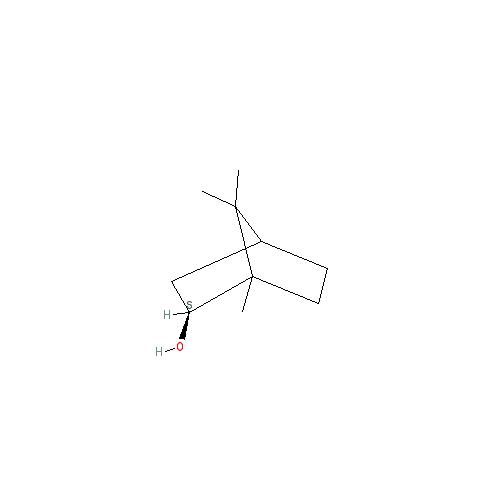
1,7,7-Trimethylbicyclo[2.2.1]heptan-2-ol
Bornyl alcohol · 2-Bornanol · Camphol · Borneo camphor
化学組成 · Constituent
Borneol là alcohol monoterpene phổ biến trong tinh dầu thông và họ bạc hà. Hợp chất ít rủi ro độc tính.
Trên da. Patch test ở 20 phần trăm trên 23 nam tình nguyện không kích ứng. (-)-Borneol không gây mẫn cảm ở 25 tình nguyện ở 8 phần trăm và 23 tình nguyện ở 20 phần trăm. Có hai mẫn cảm nhẹ trong nhóm 25 khi thử ở mức cao hơn.
Đường uống. LD50 cấp tính chuột 6.5 g/kg, LD50 da thỏ vượt 2 g/kg. LD50 đường uống chuột nhắt 1.06 g/kg.
Thần kinh. Cảnh báo trong y văn cũ về buồn nôn, choáng, chóng mặt và co giật không có cơ sở; cả (+)- và (-)-borneol có hoạt tính GABAergic, chống chỉ co giật.
Đột biến gen. Không gây đột biến trong Ames test với hoặc không có S9. Không gây đột biến trong E. coli. Bảo vệ chống tổn thương DNA do hydrogen peroxide ở liều thấp 0.5–2.0 mM.
Borneol is a monoterpene alcohol common in pine and Lamiaceae oils. The compound presents very low toxicity risk.
Skin. A 20 percent patch test on 23 male volunteers showed no irritation. (-)-Borneol caused no sensitization in 25 volunteers at 8 percent and 23 volunteers at 20 percent. Two mild sensitizations occurred in a 25-volunteer panel at higher levels.
Oral. Acute oral LD50 in rats is 6.5 g/kg, rabbit dermal LD50 exceeds 2 g/kg. Mouse oral LD50 is 1.06 g/kg.
Neurological. Older literature warnings about nausea, dizziness and convulsions lack support; both (+)- and (-)-borneol have GABAergic activity, anticonvulsant rather than convulsant.
Mutagenicity. Non-mutagenic in the Ames test with and without S9. Non-mutagenic in E. coli. Protective against hydrogen peroxide DNA damage at low doses of 0.5–2.0 mM.
| Xô thơm Dalmatia · Sage (Dalmatian) | 1.5 – 23.9 % |
| Cỏ xạ hương · Thyme (borneol CT) | 20.0 % |
| Mộc lan đại · Inula | 15.3 % |
| Cỏ xanh Phi · African bluegrass | 6.4 – 9.5 % |
| Hương thảo · Rosemary | 2.0 – 15.6 % |
| Long não Borneo · Camphor (Borneo) | 8.3 % |
| Ngải Tansy · Tansy | 7.8 % |
| Ngải nam · Southernwood | 7.3 % |
| Sả Java · Citronella | 0 – 6.6 % |
| Xô thơm Tây Ban Nha · Sage (Spanish) | 1.5 – 6.4 % |
| Kinh giới Tây Ban Nha · Marjoram (Spanish) | 3.8 – 5.9 % |
| Cúc La Mã · Chamomile (Roman) | 0 – 5.0 % |
(+)- và (-)-borneol được bài tiết chủ yếu dưới dạng bornyl glucuronide. Tỷ lệ ở thỏ khoảng 22 phần trăm, chó 50–75 phần trăm và người khoảng 80 phần trăm.
Both (+)- and (-)-borneol are excreted largely as bornyl glucuronides. The proportion is about 22 percent in rabbits, 50–75 percent in dogs and about 80 percent in humans.
Borneol là cấu tử quan trọng trong y học cổ truyền Đông Á. (-)-Borneol (Ngai camphor) được dùng truyền thống trong Trung y, trong khi (+)-borneol (Borneo camphor) là dạng phổ biến trong tự nhiên.
Borneol is an important constituent in East Asian traditional medicine. (-)-Borneol (Ngai camphor) is traditional in Chinese medicine, while (+)-borneol (Borneo camphor) is the form most common in nature.