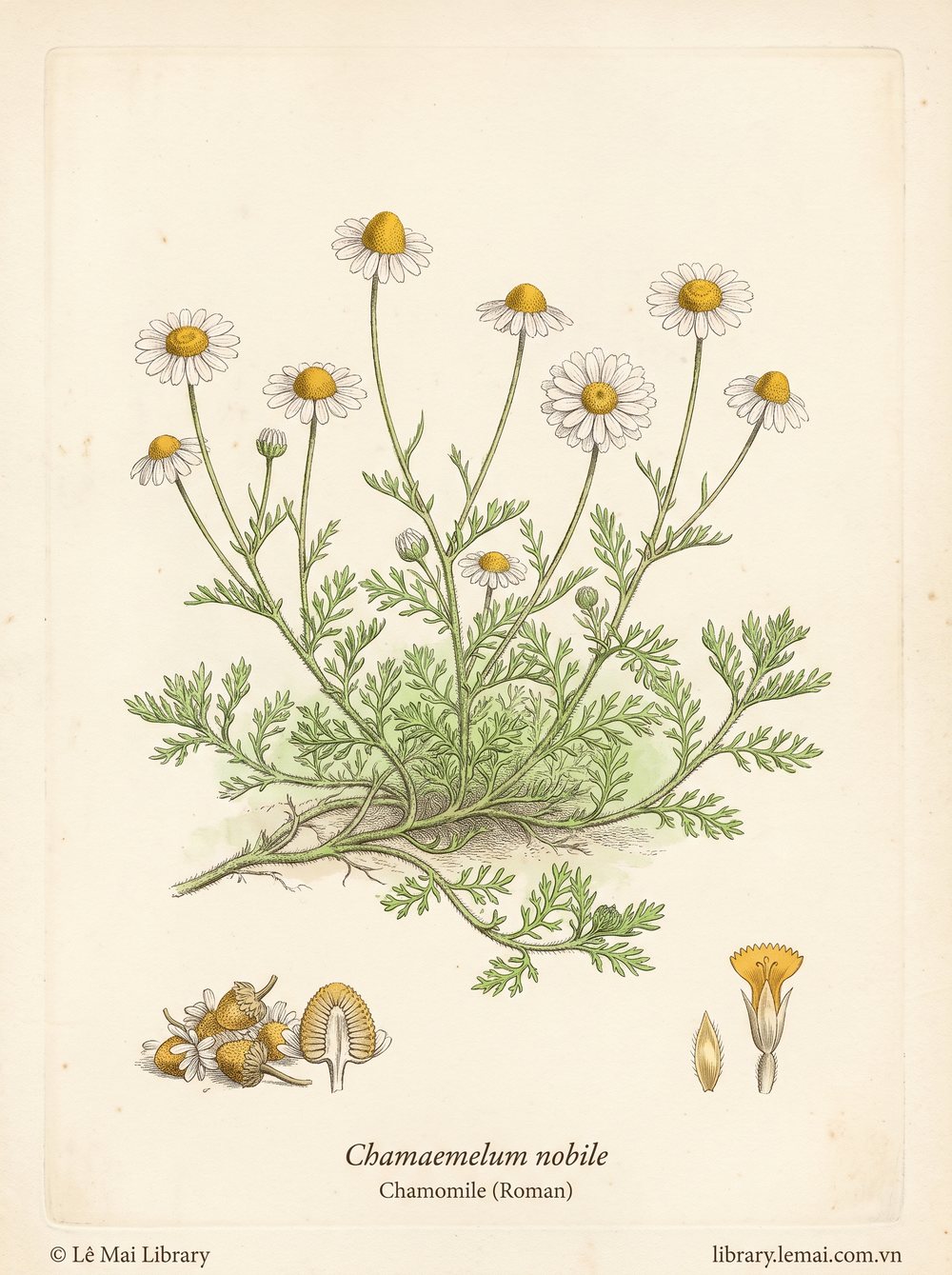
ローマンカモミール
Cúc La Mã
Chamaemelum nobile
Anthemis nobilis
No specific contraindications in available data.
GRAS status. No irritation or sensitization at tested levels. Non-phototoxic.
On current knowledge, unlikely to present any hazard in aromatherapy.
Around 80 percent of constituents are angelate and butyrate esters, markedly different from sesquiterpene-rich German chamomile.
| Isobutyl angelate | 0 – 37.4 % |
| Butyl angelate | 0 – 34.9 % |
| 3-Methylpentyl angelate | 0 – 22.7 % |
| Isobutyl butyrate | 0 – 20.5 % |
| Isoamyl angelate | 8.4 – 17.9 % |
| 2-Methyl-2-propenyl angelate | 0 – 13.1 % |
| 3-Methylpentyl isobutyrate | 0 – 12.5 % |
| Camphene | 0 – 6.0 % |
| Borneol | 0 – 5.0 % |
| α-Pinene | 1.1 – 4.5 % |
| α-Terpinene | 0 – 4.5 % |
| Chamazulene | 0 – 4.4 % |
Chamaemelum nobile is a perennial herb of Western Europe (UK, France, Belgium). The flowers resemble German chamomile but are slightly larger.
Family Asteraceae. The botanical synonym Anthemis nobilis remains common in older literature.
Composition varies significantly by origin and harvest, but is always dominated by angelate and butyrate esters.
Prone to oxidation. Store in light-tight, cold conditions. May be adulterated with isobutyl angelate and bisabolols.