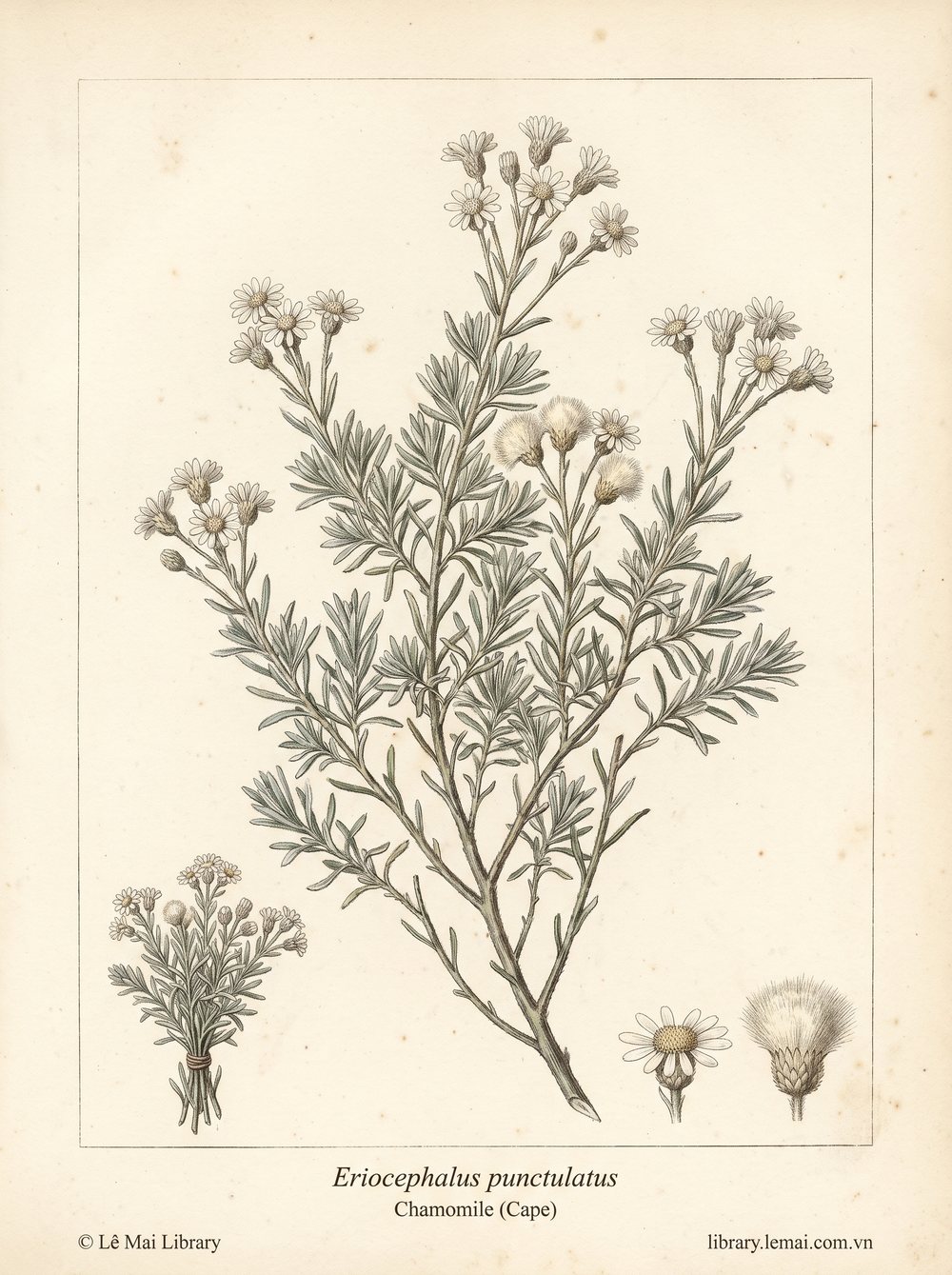
ケープカモミール
Cúc Mũi
Eriocephalus punctulatus
Không có chống chỉ định cụ thể trong dữ liệu hiện có.
Không có thông tin về phản ứng da hoặc độc tính cấp cho Cape chamomile hoặc các thành tố chính.
Khoảng 80 phần trăm thành tố là ester tương tự như Roman chamomile. Khả năng tinh dầu này có độc tính thấp tương tự.
No specific contraindications in available data.
No information on dermal reactions or acute toxicity for Cape chamomile or its major constituents.
Approximately 80 percent of constituents are esters similar to Roman chamomile. The oil is likely to share Roman's low toxicity.
| 2-Methylbutyl 2-methylpropanoate | 23.7 % |
| Linalyl acetate | 14.1 % |
| 2-Methylpropyl 2-methylpropanoate | 8.1 % |
| 2-Methylbutyl 3-methylbutanoate | 6.1 % |
| 3-Methylbutyl angelate | 2.9 % |
| 3-Methylbutyl 2-methylpropanoate | 2.3 % |
| α-Copaene | 2.1 % |
| p-Cymene | 1.6 % |
| Terpinen-4-ol | 1.5 % |
| 2-Methylpropyl 2-methylbutanoate | 1.4 % |
| Borneol | 1.1 % |
| 2-Methylpropyl angelate | 1.0 % |
Eriocephalus punctulatus là cây bụi nhỏ đặc hữu vùng Cape, Nam Phi. Hoa nhỏ trắng quanh tâm vàng giống chamomile thông thường, mặc dù không cùng chi.
Sản lượng giới hạn. Dễ oxy hóa, bảo quản trong điều kiện tối lạnh.
Họ Asteraceae. Cùng họ nhưng khác chi với chamomile German (Matricaria) và Roman (Chamaemelum).
Eriocephalus punctulatus is a small shrub endemic to the Cape region of South Africa. Small white-petaled flowers around a yellow center, resembling ordinary chamomile despite a different genus.
Limited availability. Prone to oxidation, store in dark, cold conditions.
Family Asteraceae. Same family but different genus from German chamomile (Matricaria) and Roman (Chamaemelum).