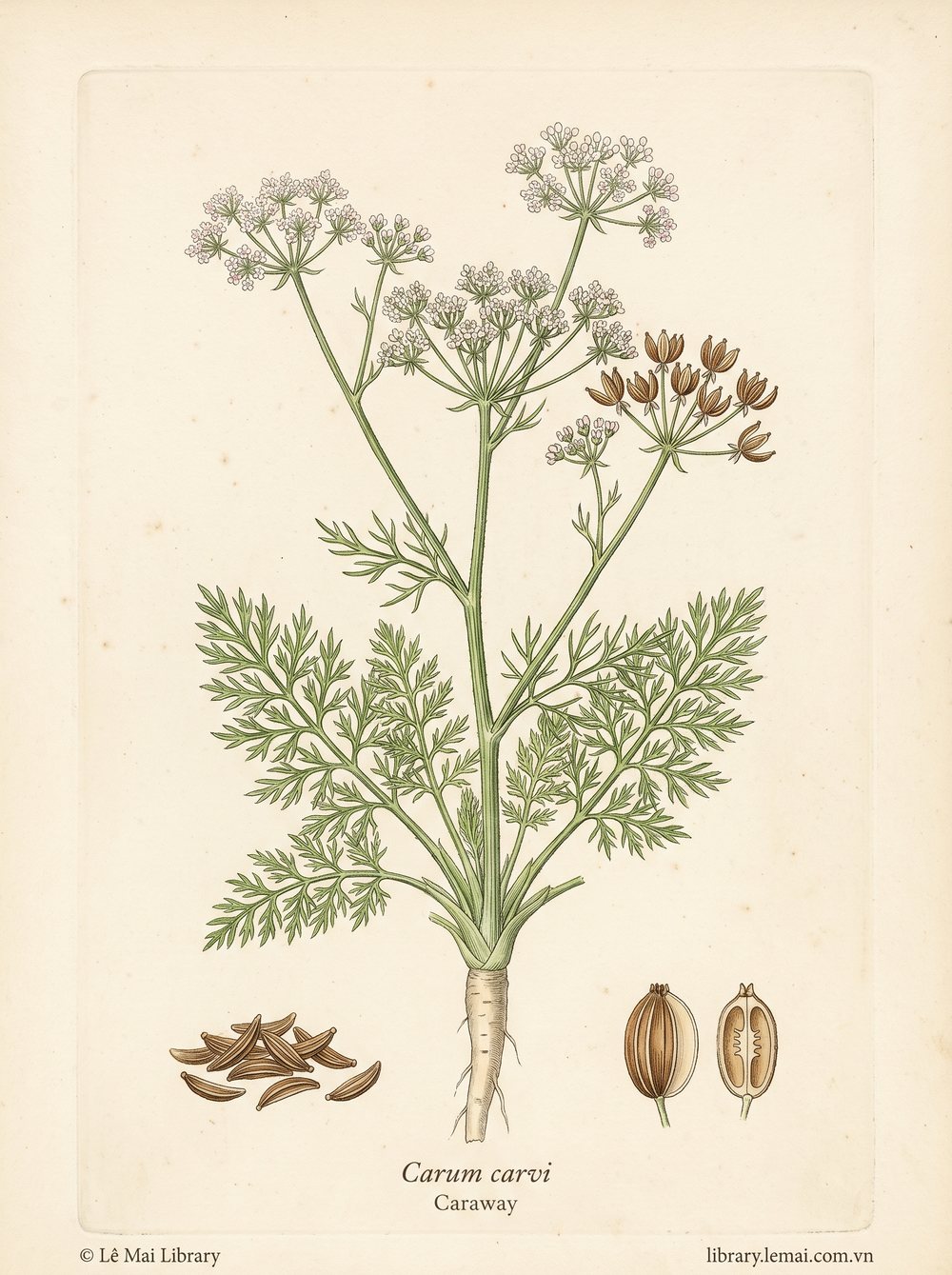
キャラウェイ
Thì là Tây
Carum carvi
Sản phẩm oxy hóa của (+)-limonene có thể gây nhạy ứng da.
Bảo quản chai tối, kín, lạnh. Thêm chất chống oxy hóa cho công thức.
Có hiệu ứng phototoxic ở mức thấp, không đáng kể.
Caraway oil không cần giới hạn cụ thể về (+)-carvone vì ngưỡng dermal của (+)-carvone là 23 phần trăm cho độc tính.
Có GRAS status. Capsule caraway được dùng trong điều trị rối loạn tiêu hóa, thường kết hợp với peppermint oil.
Oxidation products of (+)-limonene may sensitize skin.
Store in dark, sealed, refrigerated container. Add an antioxidant to formulations.
Low-level phototoxic effects reported, not considered significant.
Caraway oil requires no specific restriction for (+)-carvone as the dermal threshold for (+)-carvone is 23 percent for toxicity.
GRAS status. Caraway capsules are used in gastrointestinal treatment, often paired with peppermint oil.
| (+)-Carvone | 47.3 – 59.5 % |
| (+)-Limonene | 36.9 – 48.8 % |
| β-Myrcene | 0.2 – 1.0 % |
Carum carvi là cây thảo hai năm, vùng Bắc Âu và Tây Á. Hạt nhỏ, hơi cong, mang hương vị đặc trưng.
Tinh dầu cất hơi từ hạt. Họ Apiaceae, cùng họ với caraway, anise, fennel, dill, họ thực vật giàu apiol và carvone.
Hạt caraway là gia vị phổ biến trong ẩm thực Đức, Áo, Hungary, Skandinavia.
Carum carvi is a biennial herb of northern Europe and western Asia. The small, slightly curved seeds carry a distinctive flavor.
The oil is steam-distilled from the seeds. Family Apiaceae, same family as anise, fennel, dill, a botanical family rich in apiol and carvone.
Caraway seeds are a common spice in German, Austrian, Hungarian and Scandinavian cuisines.
Có thể bị làm giả bằng carvone và limonene tổng hợp.
May be adulterated with synthetic carvone and limonene.
Caraway oil ức chế đáng kể khối u da do DMBA và croton oil gây ra ở chuột thí nghiệm. (+)-Carvone không phải chất gây ung thư ở loài gặm nhấm, và cả carvone và (+)-limonene đều có hoạt tính chống ung thư.
Caraway oil significantly inhibited DMBA-induced and croton oil-induced skin tumors in mice. (+)-Carvone is not a rodent carcinogen, and both carvone and (+)-limonene display anticarcinogenic activity.