Citral
3,7-Dimethyl-2,6-octadienal
Geranial (E-isomer) · Neral (Z-isomer)
化学組成 · Constituent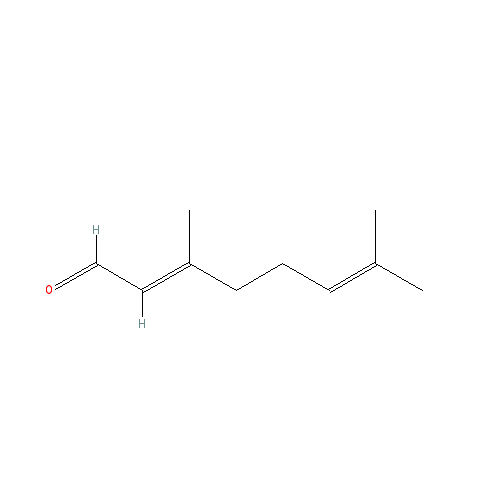
3,7-Dimethyl-2,6-octadienal
Geranial (E-isomer) · Neral (Z-isomer)
化学組成 · Constituent
Citral là hỗn hợp hai đồng phân geranial (E) và neral (Z), thường tỷ lệ 60:40 đến 65:35 trong tự nhiên. Hợp chất là cấu tử chính của lemongrass, lemon myrtle và melissa.
Trên da. Patch test cumulative 21 ngày ở 8 phần trăm gây kích ứng nhẹ. Patch test 48 giờ ở 1–8 phần trăm trong 12 panel cho không phản ứng. Trên 100 bệnh nhân viêm da với 1 phần trăm có hai phản ứng kích ứng. Citral gây viêm da khi da tiếp xúc dung dịch tẩy rửa nóng.
Mẫn cảm. Maximation test các mẫu citral khác nhau ở 8 phần trăm gây 32 phần trăm mẫn cảm; ở 5 phần trăm 32–64 phần trăm; ở 4 phần trăm 12–36 phần trăm; ở 2 phần trăm 8.3 phần trăm. Citral được xếp là chất mẫn cảm vừa.
Trong các nghiên cứu lâm sàng, bệnh nhân nhạy hương liệu phản ứng cao hơn nhiều với citral. Trong các bệnh nhân nhạy Peru balsam, phản ứng chéo cũng xảy ra.
Đường uống. LD50 cấp tính chuột 4.96 g/kg; LD50 da thỏ 2.25 g/kg.
Mắt. Citral đường uống và tiêm dưới da trên chuột gây tăng nhãn áp; có liên quan đến quá sản tuyến tiền liệt benh.
Sinh sản. Liều cao 60 mg/kg/ngày trên chuột mang thai gây giảm trọng lượng thai. Hợp chất có hoạt tính estrogen yếu in vitro.
Khuyến nghị IFRA cho leave-on là 0.6 phần trăm, nhưng có thể tăng đến 1.4 phần trăm khi kết hợp với d-limonene 5–10 lần lượng citral để giảm mẫn cảm.
Citral is a mixture of geranial (E) and neral (Z) isomers, typically 60:40 to 65:35 in nature. The compound is the major constituent of lemongrass, lemon myrtle and melissa.
Skin. A 21-day cumulative patch test at 8 percent was marginally irritant. A 48-hour patch test at 1–8 percent across 12 panels caused no reactions. In 100 dermatitis patients at 1 percent, two irritant reactions occurred. Citral causes contact dermatitis when skin contacts hot cleaning solutions containing it.
Sensitization. Maximation testing of various citral samples at 8 percent gave 32 percent sensitization; at 5 percent 32–64 percent; at 4 percent 12–36 percent; at 2 percent 8.3 percent. Citral is classified as a moderate sensitizer.
In clinical studies, fragrance-sensitive patients react far more to citral. Peru balsam sensitive patients also cross-react.
Oral. Acute oral LD50 in rats is 4.96 g/kg; rabbit dermal LD50 is 2.25 g/kg.
Eye. Oral and subcutaneous citral in rats elevated intraocular pressure; benign prostatic hyperplasia has also been linked.
Reproductive. High doses of 60 mg/kg/day in pregnant rats reduced fetal weight. The compound has weak in vitro estrogenic activity.
IFRA leave-on limit is 0.6 percent, but may be raised to 1.4 percent when paired with d-limonene at 5–10 times the citral level to suppress sensitization.
| Sim chanh · Myrtle (lemon) | < 90.0 % |
| Sả chanh · Lemongrass | 77.0 – 83.0 % |
| Tràm trà chanh · Tea tree (lemon-scented) | 77.0 % |
| Màng tang · May chang | < 74.0 % |
| Verbena chanh · Verbena (lemon) | < 68.0 % |
| Sim mật ong · Myrtle (honey) | 66.5 % |
| Tía tô đất · Melissa | < 64.4 % |
| Lá chanh vàng · Lemon leaf | < 50.0 % |
| Húng quế chanh · Basil (lemon) | < 42.2 % |
| Tía tô đất Úc · Lemon balm (Australian) | 17.6 % |
| Cỏ xạ hương chanh · Thyme (lemon) | 16.3 % |
| Chanh ta · Lime (expressed) | ≈ 4.0 % |
| Cam Bergamot hoang · Bergamot (wild) | ≈ 3.0 % |
| Chanh vàng · Lemon (distilled) | ≈ 2.5 % |
| Chanh vàng · Lemon (expressed) | ≈ 2.5 % |
| Cam ngọt · Orange (sweet) | < 1.5 % |
| Cỏ hồng · Palmarosa | ≈ 1.2 % |
Citral được hấp thu nhanh và hoàn toàn từ đường tiêu hoá ở chuột, sau đó phân phối đều cho mọi mô. Trong 24 giờ, 61 phần trăm bài tiết qua nước tiểu, 17 phần trăm qua phân và 20 phần trăm qua khí thở. Một liều uống 1 g/kg được bài tiết hoàn toàn trong 72 giờ ở chuột.
Hợp chất ức chế mạnh aldehyde dehydrogenase ti thể ở chuột in vitro, có ý nghĩa cho oxi hoá aldehyde nội sinh. Cảm ứng CYP4A1 ở chuột.
Citral is rapidly and completely absorbed from the GI tract in rats and equally distributed across tissues. Within 24 hours, 61 percent is excreted in urine, 17 percent in feces and 20 percent in expired air. A 1 g/kg oral dose is fully eliminated in 72 hours.
The compound potently inhibits mitochondrial aldehyde dehydrogenase in rats in vitro, with implications for endogenous aldehyde oxidation. Induces CYP4A1 in rats.
Citral là cấu tử quan trọng định nghĩa note chanh tự nhiên trong nước hoa và mỹ phẩm. Hợp chất cũng có hoạt tính kháng vi sinh và chống ung thư trong nhiều nghiên cứu thử nghiệm.
Citral đã được dùng kết hợp với citronellal điều trị 121 ca ung thư tiến triển, với sáu ca được báo cáo là chữa khỏi sau theo dõi 10–15 năm.
Citral is the key carrier of the natural lemon note in perfumery and cosmetics. The compound also has antimicrobial and anticancer activity in many preclinical studies.
Citral has been combined with citronellal in treatment of 121 advanced cancer cases, with six reported cures on 10–15 year follow-up.