Citral
3,7-Dimethyl-2,6-octadienal
Geranial (E-isomer) · Neral (Z-isomer)
化学組成 · Constituent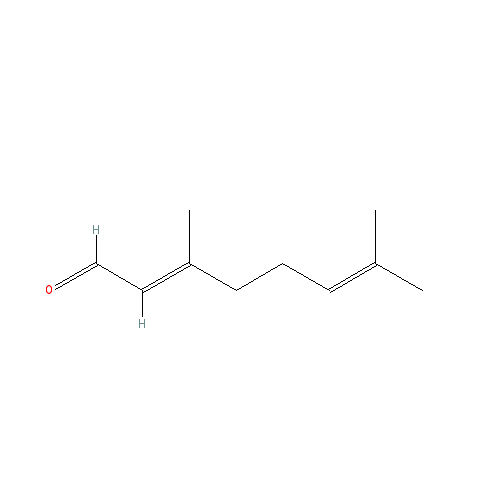
3,7-Dimethyl-2,6-octadienal
Geranial (E-isomer) · Neral (Z-isomer)
化学組成 · Constituent
Citral is a mixture of geranial (E) and neral (Z) isomers, typically 60:40 to 65:35 in nature. The compound is the major constituent of lemongrass, lemon myrtle and melissa.
Skin. A 21-day cumulative patch test at 8 percent was marginally irritant. A 48-hour patch test at 1–8 percent across 12 panels caused no reactions. In 100 dermatitis patients at 1 percent, two irritant reactions occurred. Citral causes contact dermatitis when skin contacts hot cleaning solutions containing it.
Sensitization. Maximation testing of various citral samples at 8 percent gave 32 percent sensitization; at 5 percent 32–64 percent; at 4 percent 12–36 percent; at 2 percent 8.3 percent. Citral is classified as a moderate sensitizer.
In clinical studies, fragrance-sensitive patients react far more to citral. Peru balsam sensitive patients also cross-react.
Oral. Acute oral LD50 in rats is 4.96 g/kg; rabbit dermal LD50 is 2.25 g/kg.
Eye. Oral and subcutaneous citral in rats elevated intraocular pressure; benign prostatic hyperplasia has also been linked.
Reproductive. High doses of 60 mg/kg/day in pregnant rats reduced fetal weight. The compound has weak in vitro estrogenic activity.
IFRA leave-on limit is 0.6 percent, but may be raised to 1.4 percent when paired with d-limonene at 5–10 times the citral level to suppress sensitization.
| Myrtle (lemon) | < 90.0 % |
| Lemongrass | 77.0 – 83.0 % |
| Tea tree (lemon-scented) | 77.0 % |
| May chang | < 74.0 % |
| Verbena (lemon) | < 68.0 % |
| Myrtle (honey) | 66.5 % |
| Melissa | < 64.4 % |
| Lemon leaf | < 50.0 % |
| Basil (lemon) | < 42.2 % |
| Lemon balm (Australian) | 17.6 % |
| Thyme (lemon) | 16.3 % |
| Lime (expressed) | ≈ 4.0 % |
| Bergamot (wild) | ≈ 3.0 % |
| Lemon (distilled) | ≈ 2.5 % |
| Lemon (expressed) | ≈ 2.5 % |
| Orange (sweet) | < 1.5 % |
| Palmarosa | ≈ 1.2 % |
Citral is rapidly and completely absorbed from the GI tract in rats and equally distributed across tissues. Within 24 hours, 61 percent is excreted in urine, 17 percent in feces and 20 percent in expired air. A 1 g/kg oral dose is fully eliminated in 72 hours.
The compound potently inhibits mitochondrial aldehyde dehydrogenase in rats in vitro, with implications for endogenous aldehyde oxidation. Induces CYP4A1 in rats.
Citral is the key carrier of the natural lemon note in perfumery and cosmetics. The compound also has antimicrobial and anticancer activity in many preclinical studies.
Citral has been combined with citronellal in treatment of 121 advanced cancer cases, with six reported cures on 10–15 year follow-up.