Safrole
1,2-Methylenedioxy-4-allylbenzene
Shikimole
化学組成 · Constituent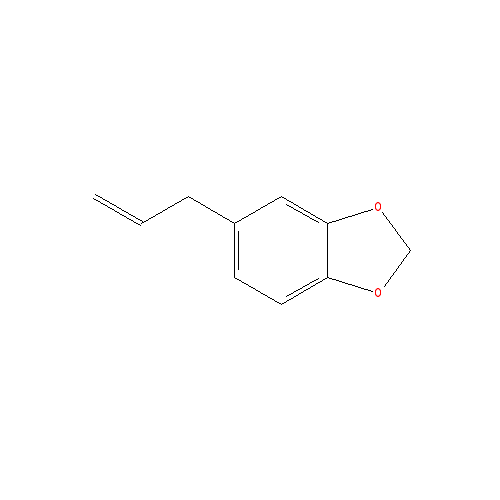
1,2-Methylenedioxy-4-allylbenzene
Shikimole
化学組成 · Constituent
Safrole is a hepatocarcinogen in rats and mice. IFRA and the EU prohibit it as a fragrance ingredient. As the principal constituent of sassafras, brown camphor and some Ocotea oils, these oils are unsuitable for cosmetics.
Skin. At 8 percent in petrolatum it was non-irritating on humans, non-sensitizing in a maximation test on 25 volunteers, and non-phototoxic. Dermal evaluation is separate from cancer risk.
Oral. Acute oral LD50 was 1.95 g/kg in rats and 2.35 g/kg in mice. Oral dosing at 750 mg/kg/day for 19 days killed 9 of 10 rats.
Liver and cancer. Long-term dosing causes hepatic fibrosis, fatty degeneration and hyperplasia. Rats fed 5,000 and 10,000 ppm in a two-year study developed benign and malignant tumors. Mice fed 4,000 ppm developed liver tumors. Dogs fed 20 mg/kg for six years showed microscopic hepatic damage.
Mutagenicity. Safrole and its metabolites form adducts with hepatic DNA. The number of adducts in liver DNA of human betel quid chewers with liver cancer was substantially lower than in mice, suggesting lower risk in humans.
Suggested safe dose. Rat NOAEL is approximately 1 mg/kg/day. Applying an uncertainty factor of 40 for interindividual variation gives a human safe daily dose of 0.025 mg/kg, equivalent to a dermal limit of 0.05 percent.
| Sassafras | 82.8 – 88.8 % |
| Camphor (brown) | 50 – 60 % |
| Betel | 6.5 – 45.3 % |
| Camphor (yellow) | 20 % |
| Ho leaf (camphor CT) | 0.1 – 5.0 % |
| Nutmeg (East Indian) | 0.3 – 3.3 % |
| Mace | 0.2 – 1.9 % |
| Cinnamon leaf | 0 – 1.0 % |
| Ho leaf (linalool CT) | 0.01 – 0.9 % |
| Nutmeg (West Indian) | 0.1 – 0.5 % |
| Ylang-ylang | 0.4 % |
| Anise (star) | 0 – 0.1 % |
| Cinnamon bark | 0 – 0.04 % |
After oral dosing, the principal metabolite is 1,2-dihydroxy-4-allylbenzene, accounting for 65 percent of total urinary metabolites in humans and 45 percent in rats. In humans, peak plasma levels occur at 30 minutes, with biphasic elimination half-lives of 2.5 and 15 hours, and 92 percent excreted in 24 hours.
1'-Hydroxylation and 2',3'-epoxidation lead to potentially carcinogenic compounds. 1'-Hydroxysafrole is a more potent hepatic carcinogen than safrole itself, and is further converted to 1'-sulfooxysafrole, considered the major carcinogenic metabolite.
Epoxide hydrolase activity in human liver varies by 20-fold, but even those with the lowest activity match the rat average. Epoxide hydrolysis is therefore faster in human liver than in rat, allowing a wide margin of safety.
Safrole is a classic case for interspecies cancer risk assessment. DNA adduct formation in human liver is 10 to 150 times lower than in mouse liver, and safrole carcinogenicity is 8.6 times more potent in mouse liver than rat liver.
Safrole is on the FDA's List 1 chemical inventory as a precursor that can be used to manufacture MDMA. Powdered sassafras root was a traditional flavoring for root beer in the United States before being banned in 1961.