Linalyl acetate
2,6-Dimethyl-2,7-octadien-6-yl ethanoate
Linalool acetate · Acetic acid linalyl ester · Bergamol
化学組成 · Constituent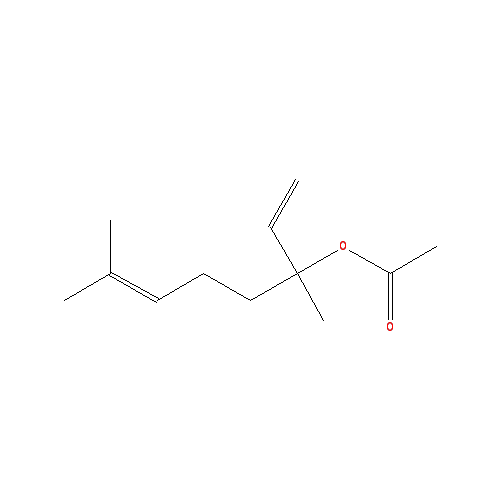
2,6-Dimethyl-2,7-octadien-6-yl ethanoate
Linalool acetate · Acetic acid linalyl ester · Bergamol
化学組成 · Constituent
Linalyl acetate is the dominant ester in many floral and bergamot oils. The compound is minimally skin reactive and non-toxic.
Skin. Patch testing at various concentrations on hundreds of volunteers showed no significant irritation. At 12 percent on 25 subjects and 20 percent on 25 subjects, no sensitization occurred. In dermatitis patient studies, allergic reaction rates were below 2.3 percent, with some samples suspected of containing reactive impurities.
Oral. Acute oral LD50 is very high at 14.5 g/kg and over 10 mL/kg in rats, 13.36 g/kg in mice. Acute dermal LD50 in rabbits exceeded 5 g/kg.
Mutagenicity. Non-mutagenic in Ames tests with or without S9. Did not induce UDS in primary rat hepatocytes and was not clastogenic in cultured human lymphocytes.
Cancer. In long-term mouse studies, ip injection of linalyl acetate did not produce lung tumors. Topical application alongside benzo[a]pyrene at high doses showed weak co-carcinogenic activity.
| Clary sage | 45.3 – 73.6 % |
| Orange leaf | 47.4 – 71.0 % |
| Mint (bergamot) | 34.0 – 57.3 % |
| Skimmia | 55.6 % |
| Linaloe wood | 47.0 % |
| Lavender | 25.0 – 46.0 % |
| Snakeroot | 28.0 – 41.4 % |
| Bergamot | 17.1 – 40.4 % |
| Bergamot (FCF) | 18.0 – 28.0 % |
| Snowbush | 18.0 % |
| Chamomile (Cape) | 14.1 % |
| Marjoram (sweet) | 7.4 – 10.5 % |
| Neroli | 0.6 – 10.0 % |
| Cardamon | 0.7 – 7.7 % |
| Lemon leaf | 0 – 6.5 % |
| Sage (Spanish) | 0.1 – 5.8 % |
Linalyl acetate hydrolyses in gastric juice to yield linalool. Some of this linalool is then rapidly ring-closed to a-terpineol.
Linalyl acetate, together with linalool, defines the aroma signature of lavender and bergamot. The linalool to linalyl acetate ratio is a key quality marker for lavender oil.